Sunday, September 16, 2012

What I Did on My Summer Vacation: Fine Feathered Friends

 
The Royal Alberta Museum is also currently hosting a temporary exhibit on the use of feathers in hat-making (millinery!) and fashion, called Fashioning Feathers. I'm not usually all that into the history of costume and fashion in museums, and so I was pleasantly surprised by how interesting I found this particular exhibit. I think it was the intersection of biology and fashion that was so neat.


There was a wide variety of taxidermied bird specimens showing what species were used for different styles, like in the photo above.
 
 
Besides the usual pheasants and roosters, there were some really unusual birds on display, like this Western Crowned Pigeon (Goura cristata).


I was pretty shocked to learn that many brilliantly coloured tropical birds, like birds of paradise, were dyed black for use in hats.  These three parrots are actually dyed Carolina parakeets (Conuropsis carolinensis), which, through a combination of hunting, habitat loss, and the plume trade, went extinct in 1918.
 
Audubon's Carolina parakeets, via Wikipedia.
 
Why not use naturally black or dark-coloured birds? Whatever would possess someone to harvest such colourful birds only to dye them black, when there are SO MANY shiny black birds present in North America? The mind boggles.

Friday, September 14, 2012

What I Did on My Summer Vacation: From Wolf to Woof

 
I had a chance to visit "Wolf to Woof", a travelling exhibit hosted by the Royal Alberta Museum this summer. This exhibit does a nice job covering the biology and evolution of dogs, and the relationships between canids and humans, and overall I was pretty happy that I got to see it.
 
 
The exhibit opens with the wolf ancestry of domesticated dogs and showed the variety of shapes and sizes of modern dog breeds. I liked these creepy cutaway dog skeletons, which show some of the differences in the skeletons of a St. Bernard, saluki, and French bulldog. There were quite a few models of dogs throughout the exhibit which were just slightly uncanny - I think it might have been the way that fur was sculpted and textured, that just made them feel slightly...slimy. It's hard to describe.
 
 
The domestication of dogs from wolves was explained in detail, but there was actually very little on the evolution of canids as a whole. A single station had a few replica skulls of Hesperocyon (an early canid), Canis dirus (the dire wolf), and Borophagus (the bone-crushing dog), and a cladogram showing the relationships of fossil and extant canids. I would have liked to have seen a bit more about the fossil history of dogs, but I guess I'm probably biased.


A real treat was the chance to see some taxidermied specimens of canid species you just don't really see in zoos or even in most museums, like this bush dog (Speothos venaticus)...
 
 
And a maned wolf (Chrysocyon brachyuris). There were also several foxes, a coyote, and a wolf.
 
 
There was a great station where you could listen to a variety of canid vocalizations and their 'translations'. But much of the remainder of the exhibit, on dog senses and roles in society, fell a little bit flat for me (e.g., a recreation of what it would be like to be rescued by a St. Bernard via crawling into a plastic snow pile; acute sense of smell in dogs demonstrated by wafting weird simulated bacon smell at your face, etc., and some out of place art pieces about dogs in media and life as a wolf). A final criticism was that the exhibit is clearly showing its age, with a lot of scuffed and scratched surfaces and some truly ancient interactive computer stations with roller balls. But the exhibit was reasonably popular on the summer day that I visited, and kids seemed to be getting a lot out of it, so perhaps I'm not exactly the target audience for something like this. I could see this exhibit working very well as a school field trip.

Wednesday, September 12, 2012

What I Did on My Summer Vacation: Take the Left Turn at Albuquerque

I visited the New Mexico Museum of Natural History in June for a couple of days with my friend and colleague Mike Burns to look at [top secret specimen yet again, sorry!]. OH MAN was Albuquerque toasty in June. But we had a very fine time indeed eating southwest food and visiting the museum.


In part I liked the museum because it has such a large collection of Triassic vertebrates, which I don't really see too much of in my travels to look at Late Cretaceous dinosaurs. I hadn't really realized just how BIG Placerias was.


There was a wonderful big block of Ghost Ranch Coelophysis, which you could definitely spend a good amount of time poring over.


And I also enjoyed the various walls-o-Triassic-skulls, like these phytosaurs.


I know Stegosaurus is a staple of many dinosaur halls, but the subdued yet modern pose of this particular mount is really pleasing. Note also that the manus is correctly mounted!


The Jurassic gallery is dominated by this Seismosaurus and Saurophaganax pair, as well as a deliciously weird but detailed mural. Many of the original bones used to create these mounts are laid out on the bases of the mounts, and there are helpful skeletal diagrams to show what original material is known.
 
 
A temporary exhibit celebrating 100 years of discovery in New Mexico reveals a new exhibit case each month. One month featured a relatively recently named tyrannosaur called Bistahieversor.
 
 
The Cretaceous hall was pretty neat, with lots of living trees and other plants and a mural of the seaside enveloping the room. Two life reconstructions of marine vertebrates of the Cretaceous, a mosasaur and the swimming bird Hesperornis, were particularly cool. I really liked the grebe feet on the Hesperornis! I'm not sure if there's any evidence for it, and now I want to find out!
 

Tuesday, September 11, 2012

What I Did on My Summer Vacation: Happy Campers

 
This is Happy Jack's (or as it used to be called, Old Mexico Ranch), an old homestead occupied by Happy Jack Jackson from 1903 to 1942. There are a couple of log cabins, some with cacti growing on the roof. Happy Jack's is found on the north side of the Red Deer River in Dinosaur Provincial Park, and is the home base for the Currie Lab when we do fieldwork in DPP.
 
 
The cabins are full of rattlesnakes, so rather than camping right out in the field, we have a really nice spot in the cottonwood grove near the river. The night I took this photo there were 18 people in camp, but most of the time our crew is around 10 people. 
 
 
The badlands around Happy Jack's have been very productive for the last five years, and we've collected several very nice skeletons that unfortunately I can't say anything about yet (but I promise they're good). This year we didn't have any major finds, but we did a lot of prospecting and collected lots of interesting small things. In the photo above, a bunch of us are checking out an articulated hadrosaur, that was unfortunately too far gone to be salvageable or worth collecting. It was a nice spot on a sunny day, however, so nobody minded too much. There are always more bones in Dinosaur Provincial Park.
 
 
And when I say there are always more bones, I mean it. Dinosaur Park is kind of a ridiculous place. There are so many bones that we only collect things that are complete and well-preserved, so I didn't bring back the vertebra you can see in the lower left of this picture (although I did get a hadrosaur frontal from this spot). There are many places where you can't help but walk all over bone fragments, because they are just so numerous.


And then there are bones that look like they're straight out of a 'How to be a Palaeontologist' book, like this femur my friend Scott found.  
 
 
We have some awfully nice scenery in camp.

Monday, September 10, 2012

What I Did on My Summer Vacation: Danek Bonebed

The summer is over and school is back in session. Here in Edmonton the leaves already started to turn yellow last week. And somehow the summer got so busy that I hardly posted anything at all here. So, it's nice to fix that up and talk about what I did on my summer 'vacation', by which I mean the time that undergrads are not at university but grad students are.
 
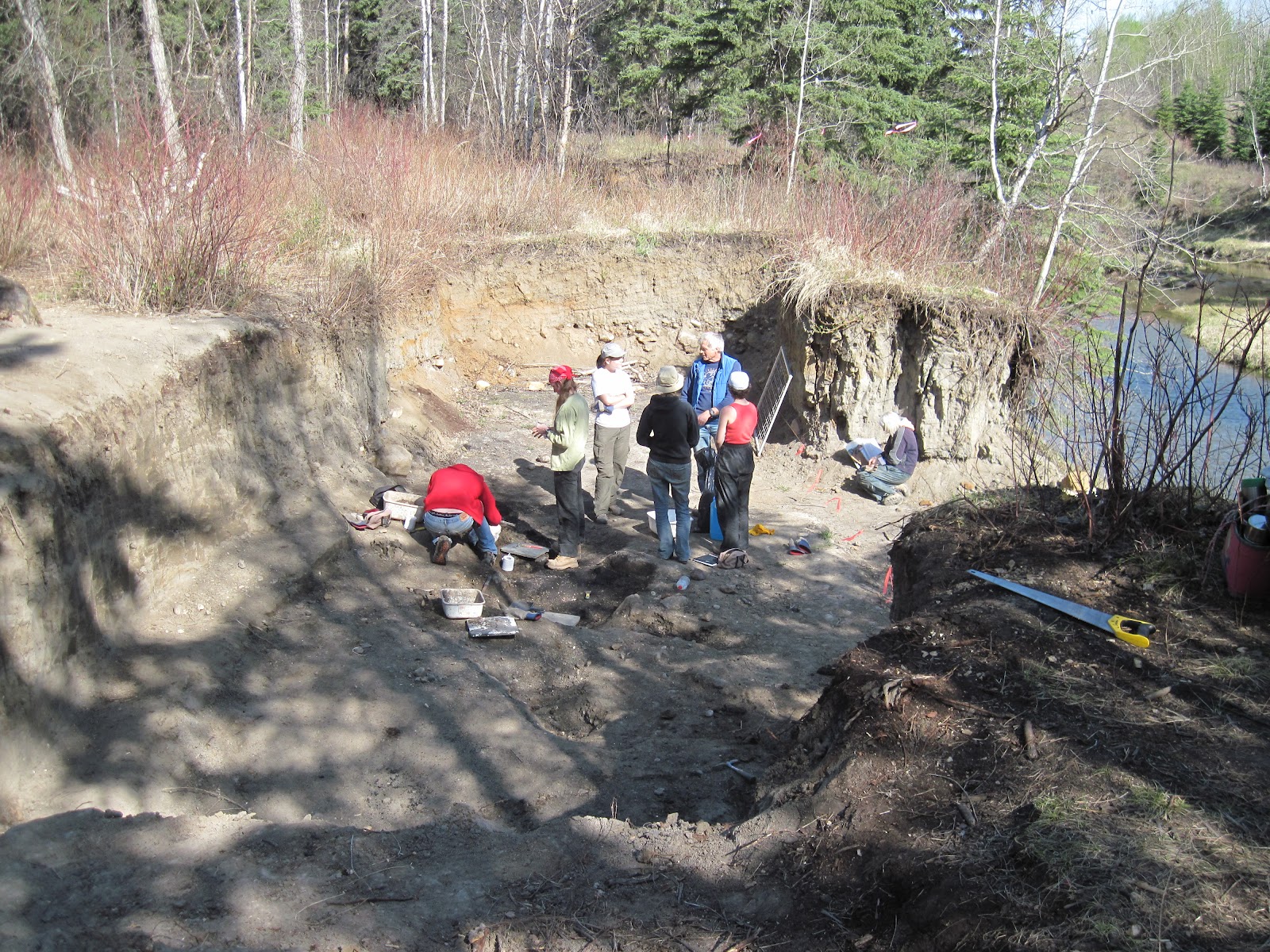
The 'summer' (which doesn't really start until mid-June in Edmonton, but whatevs) started up with the PALEO 400 field school in early May. For three weeks, students help excavate the Danek Bonebed, a hadrosaur bonebed located right in the city (but in a secret location, to prevent vandalism). Over the course of those three weeks, they get to do everything: shoveling lots of dirt, uncovering bones with fine tools, plaster jacketing, carrying heavy things back to the truck, quarry mapping, field identification, you name it. Each student comes up with a research project related to the bonebed and writes a paper and/or presents a talk in October. This year we had five enthusiastic students and I am looking forward to hearing all about their projects later this fall.


The Danek Bonebed is in a protected nature area, and as such we have to follow special rules to protect the surrounding environment. To prevent sediment runoff into the adjacent creek, we have to be careful about how we dispose of our unwanted dirt and rocks. This involves clearing an area in the forest nearby and removing and saving the topsoil. All of our dirt is evenly distributed in the cleared area, and at the end of the fieldwork the topsoil is places on top of the spoil pile. This helps the vegetation regrow more easily.

 
Once the spoil area is prepared, we can beginning digging in the actual quarries. We have been excavating this bonebed since 2006, and our three quarries are starting to get pretty large. This part is really hard work and quite time consuming, but luckily there are always lots of hands to take turns shoveling, carrying buckets, and hauling the wheelbarrow.


Here's the main quarry as of this year. The notch cut out in the foreground is the newly excavated area for 2012. Most of the sediment overlying the bonebed is glacial till and/or fluvial sediments, much of which is fairly easy to shovel except for the large boulders sitting immediately above the bonebed. The trickiest part this year was getting through some of the frozen soil, which required pickaxing. Yup, in May the ground was still frozen.


The original quarry, shown here, was first excavated by the Royal Tyrrell Museum in the late 1980s. We have expanded it a little over the last few years, and it proved to be the most productive area this year.
 
 
Almost all of the bones in the bonebed are from a large hadrosaurid (duck-billed dinosaur). We don't really find articulated skeletons, but lots of isolated, jumbled elements. The sediment around the bones is really easy to remove - no hammers and chisels required, just garden trowels and dental picks. The bonebed is within the Horseshoe Canyon Formation, although I'm not sure exactly which unit.
 
Once the bones come back to the university we have a pretty dedicated team of volunteers who help clean them up during our evening volunteer prep program.

Monday, July 16, 2012

Thoughts on Tarbosaurus, Part 3

Previously in this series on the poached Tarbosaurus skeleton, I've discussed the role of museums in fossil collecting, how the specimen was identified as Tarbosaurus, and how we know the skeleton came from Mongolia. Today, I'll discuss one final question: Why is fossil poaching such a big deal, anyway?

(Various museum trips, manuscript deadlines, and fieldwork in Dinosaur Provincial Park have kept me from returning to the blog as quickly as I had hoped, and much has transpired in the Tarbosaurus case in the last few weeks; in particular, see Phil Currie's article in New Scientist. Hopefully, posting will become a bit more frequent, and optimistic, in the next little while.)

To me, it seems obvious why fossil poaching is a big deal (in a bad way) - it reduces or removes access to fossil specimens, and reduces or removes important information about that fossil. First, let's talk about access to fossils. As I discussed in part 1 of this series, the role of museums is to conserve artifacts for present and future generations; additional responsibilities include facilitating research and education, and usually involve displaying objects to the public. Private owners of fossils have no such responsibilities. Some private collectors may choose to display some of their fossils to friends and family, or may even open their private residence to visitors. But they don't have to, and most fossils held by private collectors are probably only ever seen by a handful of people. For really common, super-abundant fossils, perhaps this is not a terrible thing. Vertebrate fossils are rarely common and abundant, and each specimen often has important information to contribute to the study of any particular organism.

A second point about access that is probably not widely known is that palaeontologists cannot really study or publish on privately-held fossils. This is because other palaeontologists may not be able to access those specimens to verify the original palaeontologist's findings, and so therefore the science would not be reproduceable. There are probably lots of instances where private collectors have made substantial contributions to museum collections by donating their discoveries or purchases, but while the specimen is privately held, it is, for all intents and purposes, 'invisible' to the scientific community. A specimen that cannot be published in the scientific literature does not contribute to our understanding of the fossil record, and represents lost knowledge. This is why it is important for fossils to be in recognized institutions like museums or university collections, so that palaeontologists (and the public!) can study the material and use it to better understand our world.

Next, let's talk about how poaching reduces the information content of fossils. Fossils do not exist in a vacuum. The sediments encasing a fossil are nearly as important as the fossil itself, as these provide at least two crucial pieces of information about the fossil: 1) how old it is, and 2) what the depositional environment was. Interpreting the age and depositional environment of a rock is not always easy, and requires specialized training in geology in order to be done properly. When a fossil is yanked out of the rock with no attention paid to where or how it was found, important information is lost.


Pop quiz! Is that the Nemegt or Baruungoyot Formation?

Finally, and most obviously, poaching can damage the fossils themselves, if the poachers do not have the appropriate tools or training to properly excavate the fossils. The more a fossil is broken, the more information is lost. Collecting fossils is tricky, difficult work that requires a lot of patience and strength. Without the right tools and people, fossils get broken. Amateur or commercial collectors may be excellent record-keepers and skilled excavators, and so this may not be a problem - but from my experience at least in Mongolia, poachers don't seem to be really good at collecting the dinosaurs they aim to sell.


 See those white bone fragments there? Those used to be a Tarbosaurus skull.


I hope the attention given to the Tarbosaurus auction marks the beginning of the end of fossil poaching in Mongolia, although I suspect I may be being overly optimistic with that sentiment. But fossil poaching and destruction is not limited to Mongolia, as evidenced by a tragic story that happened basically in my backyard this week. A few weeks ago, the University of Alberta and Pipestone Creek Dinosaur Initiative field crews found a beautiful hadrosaur skeleton, with skin impressions, along the Red Willow River near Grande Prairie. The PCDI team was excited because this would make for a great display specimen (not to mention it being a scientifically important specimen) for the museum they are working very hard to get funded and built. Earlier last week while in Dinosaur Park, we received the terrible news that the partially-excavated, plaster-jacketed specimen had been vandalized and severely broken. We're not sure who did it or why. Even earlier in the summer, an in situ display of the Pipestone Creek Pachyrhinosaurus bonebed had been smashed and vandalized as well.

In Alberta, excavating fossils without a permit, or damaging fossils, can get you a $40 000 fine and/or a year in prison. Nowhere else in Canada has fossil protection laws as good as Alberta's, and in no other province is the general public as widely educated about fossils. Fossils are everywhere in Alberta, we have an abundance of museums and public outreach, several universities conduct palaeontological research, and there's an active amateur society. And STILL people feel the need to wreck our fossils - no, scratch that, THEIR fossils. I find this intensely discouraging, and I don't have a good solution.

Given the recent international attention on the Tarbosaurus case, I hope Alberta sets a good example by prosecuting the fossil vandals to the fullest extent possible, if they are able to catch them. At the very least, I hope that this provokes a renewed interest in protecting our amazing fossil resources. Wherever you're from, support your local museums and universities, and be interested in the natural world around you. It will take all of us working together to protect it.

Friday, June 8, 2012

Thoughts on Tarbosaurus, Part 2

In my last post I talked about the role of museums in conserving fossil resources, with regards to the recent news about the Tarbosaurus auction. I wanted to address some of the other frequent comments I have seen on blogs and news articles. So, we’re now on to:

Comment 2: How do we know the tyrannosaur came from Mongolia? (and the related question, which I’ve decided to lump with this one: Why does the auction company, and subsequent news stories, refer to the specimen as Tyrannosaurus bataar while palaeontologists call it Tarbosaurus?


The first thing we need to address with these questions is the concept of ‘species’. In high school, most of us will have learned that a species is defined as a group of interbreeding individuals that can produce fertile offspring. This is called the Biological Species Concept. What many people may not know is that this is just one of many species concepts. Palaeontologists can’t go back in time to check on which dinosaurs were interbreeding, so the biological species concept can’t really be used in palaeontology. Instead, we generally use the Morphological Species Concept, which essentially boils down to ‘a species is a group of individuals that look like each other and not like others’.

Much of the arguing and debate in palaeontology results from the problems associated with the morphological species concept, and that is because individuals from the same species can look different from each other, and individuals from different species can look similar to each other. Biologists working on still living (‘extant’) animals need to worry about three main sources of morphological variation:
1.      Changes that occur during growth: An older individual of the same species can look different from a younger one.
2.      Sexual dimorphism: Males and females of the same species may look different.
3.      Normal individual variation: Individuals within a species can look different from each other because of normal variation resulting from small genetic differences and environmental differences. As an example, think about all the different dog breeds there are today. All dogs can interbreed (theoretically, although surely a Great Dane crossed with a Chihuahua must be pushing the limits of what is practical...) and produce fertile offspring, and belong to the same species, Canis familiaris. On top of that, all dogs are descended from domesticated grey wolves, and so many scientists regard them as a subset of the species Canis lupus. In taxonomic terms, this is called a subspecies, and we would write it as Canis lupus familiaris.


Palaeontologists need to add one more source of variation because we work with fossils, and that is:
4.     Changes that occur during fossilization (‘taphonomy’): Most fossils preserve only the skeleton, and so information from soft tissues like colour, integument, and muscles is lost. Skeletons become disarticulated, and individual bones get broken. All of this reduces the amount of information we have to work with. Finally, the remaining bones can become squished and distorted because of the extreme forces that occur as rocks form.

 Disarticulated Argali sheep skeleton in Mongolia, 2010.


Finally, it is important to remember that the natural world doesn’t always fit into discrete categories, and that the concept of species, genus, etc. is something that humans have created to help sort living things into workable categories. How many differences do two populations need to have in order to call them different species? How many differences until we split things into different genera? There isn’t really an answer to those questions, and so deciding on what are ‘species-level’ differences vs. ‘genus-level’ differences is the source of much debate.

But that’s ok, because that is a big part of what is fun about taxonomy and palaeontology!

So, moving on to Tyrannosaurus rex vs. Tyrannosaurus bataar vs. Tarbosaurus bataar. Tarbosaurus bataar and Tyrannosaurus rex have several morphological differences in the skull, but these are not necessarily obvious if you’re not accustomed to anatomical terminology or used to looking at skulls. Nevertheless, they are present, and there is an excellent, free to access paper in Acta Palaeontologica Polonica that you can go download right now to see for yourself. In a nutshell, the skull of Tarbosaurus is narrower than Tyrannosaurus when you look at it front on, and the nasal bones (the bones along the top of the snout) are domed near the front of the eyes. Additionally, the arms of Tarbosaurus are proportionately even shorter relative to the rest of the body than those of Tyrannosaurus, which are already pretty short.

Tarbosaurus bataar partial skull at the Palaeontological Institute in Moscow.


Tyrannosaurus rex skull at the Royal Tyrrell Museum in Drumheller, Alberta.


It’s pretty clear that Tarbosaurus bataar and Tyrannosaurus rex represent different species, because these differences are geographically separated. Small-armed, narrow-skull tyrannosaurs are only found in Mongolia, and longer-armed, wider-skull tyrannosaurs are found only in North America. You could make an argument that perhaps the differences are insufficient to warrant having two genera, in which case the genus Tyrannosaurus has priority over Tarbosaurus because it was named first. However, most palaeontologists accept both the genus Tarbosaurus and the genus Tyrannosaurus as being valid. So why did the auction house consistently call their skeleton Tyrannosaurus bataar? I can’t say for sure, but I suspect it is because Tyrannosaurus is much more a household name than Tarbosaurus, and this makes the skeleton more recognizable and interesting. It’s easier to tell someone your skeleton is a Tyrannosaurus than to do what I’ve just done here and explain how there is a similar, but different, tyrannosaur in Mongolia called Tarbosaurus.

So, we can look for anatomical features in the skull and skeleton that indicate whether or not the tyrannosaur was a Tarbosaurus or a Tyrannosaurus. But how do we know that the skeleton came from Mongolia? Well, much like certain animals today are found only in certain places, some dinosaurs were found only in some places and not others. Tarbosaurus has so far only been recovered from the Nemegt Formation, a set of rocks that are only known in the Gobi Desert of Mongolia. If the skeleton is shown to be a Tarbosaurus, and not some other species of tyrannosaur, then the conclusion we must come to without any additional information is that the specimen comes from Mongolia. We can also use the colour and preservation of the bones to identify where the skeleton came from, because different rock units will produce differently coloured fossils (in Alberta, dinosaur bones are often brown or black, and in Mongolia, they are often white or reddish).

If for some reason there was good evidence that the skeleton did not, in fact, come from Mongolia, that would only make the specimen more scientifically important, as it would extend the geographic or stratigraphic range of the genus Tarbosaurus and would give us important new information about that genus.


I had originally hoped to post this second part much sooner, and so much has transpired since my original Tarbosaurus post. I’m particularly pleased to see that a delegation of Mongolians and palaeontologists examined the auctioned Tarbosaurus this week as part of the investigation into the specimen. You can read their report at the Painter Law Firm's website. I also highly recommend this article at the Guardian by palaeontologist Dave Hone, and many thanks to Brian Switek at Dinosaur Tracking for his kind words about my first post in this series.

Literature!