Monday, May 9, 2011

Name That Specimen, Smithsonian Edition

The fossil halls at the Smithsonian were great fun, but do you know what might have been my next most favourite hall? The Hall of Bones! I am not sure I have ever seen so many non-mammal skeletons on display. I also liked how a lot of the displays highlighted anatomy and functional morphology. The whole thing was just deliciously old-school museum in all the best ways: detailed, focused, and elegantly presented. In a way it was like stepping into a 3-dimensional anatomy textbook, but more fun because here are the bones right in front of you that you can see from all kinds of different angles, and compare easily.


I'm not sure a hall like this would be built nowadays - detailed anatomy guides may not seem as relevant as ideas about ecology, conservation, and evolution. It was also extremely low-tech, with not a single touch-screen, TV, or projection to be seen. But I was glad it was there, and I think it complemented the taxidermy dioramas and multimedia-intensive galleries.

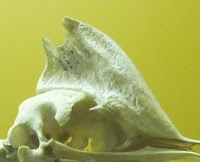
Here are some close-ups from some of the photos I took – can you guess what animal each belongs to? Answers below!


1.

2.

3.

4.

5.

6.

7.


------------------


1. Look closely – you’ll see the tiny arms of the brown kiwi (Apterix australis) alongside it’s egg-shaped body. I also had no idea kiwi ribs were so broad!

2. Quill knobs are prominent on the humerus of the brown pelican (Pelecanus occidentalis).

3. The powerful shoulders and large olecranon process should give you a clue: this is the arm of the giant anteater (Myrmecophaga tridactyla).

4. That fang looks like it should belong to a sabre-toothed cat, but it’s actually an Indian muntjac, Muntiacus muntjak, a small deer (amusingly labelled as a barking deer in the exhibit, which I suppose must be an older name).

5. The casque of the cassowary (Casuarius casuarius) is surprisingly spongy.

6. Those unusual rodent-life incisors belong to the aye-aye (Daubentonia madagascariensis).

7. This strangely bent neck belongs to the anhinga, Anhinga anhinga (anhinga anhinga anhinga...).

Saturday, May 7, 2011

Look at that...whatever it is.

I had an unsettling moment today when it occurred to me that, perhaps, people don’t learn anything from museums.

I sincerely hope this is not true. I say this after having visited the marvellous Smithsonian Museum of Natural History, spending about 5 hours today perusing the galleries and shamelessly eavesdropping on people’s reactions to the exhibits. Kids were certainly excited about the exhibits and eagerly pointed things out to their parents. But what sorts of things did I overhear parents saying to their children?

In reference to a very nice mosasaur skeleton, with accompanying illustration: “That’s neat sweetie, look. It looks kind of like a crocodile I guess. It must be a crocodile fish.”


By that logic, I guess the early whale Zygorhiza is probably a crocodile fish, too.


Looking at Pteranodon: “Look at that...whatever it is.”


That is a Pteranodon, good sir, as the label clearly states. This comment particularly stung because of all the things I remember from my visit to the Smithsonian when I was 10, it was this Pteranodon keeping watch over the dinosaur hall that was most burned into my memory. Also, holy mackerel! Look at the wing below it!


In front of Ceratosaurus: “Look kiddo, T. rex!”

Ceratosaurus does not equal Tyrannosaurus.


I was heartened to see some parents slowing down, reading things to their children and asking them questions about the exhibits. But for the most part, most folks simply went ‘Wow! A dinosaur!’, snapped a photo, and kept going. The same was largely true for a lot of the other exhibits as well, particularly in the ocean gallery (although in that case, the comment was ‘Wow! A giant squid!’).


In other galleries, I was a bit surprised by reactions to the unknown or new.

At the binturong: “What kind of cat is that?” followed by immediately walking away.


At the Chinese pangolin: “What the hell is that? GROSS!” followed by immediately walking away.


I will not fault people for not knowing that Ceratosaurus is different than Tyrannosaurus, or not having any idea what a pangolin is. What I find distressing is the lack of desire to KNOW reflected by some of these comments. The reactions were not “What kind of cat is that? A binturong? Oh, it’s not a cat? Why? That’s neat!” or “Look at that...whatever that is...oh, it’s a Pteranodon!” The reactions were “I don’t know what that is and I’m not going to do anything to change that.”

These comments got me thinking about the role of natural history museums (and museums of any sort, I suppose), once again. I love museums. I think I learn when I visit museums, especially for topics I know little about. I may not get a lot out of most dinosaur exhibits, but I almost always find something new (e.g., the Smithsonian’s small but very good exhibit on the dinosaurs from Maryland, and I will talk about this more in a later post). But how do other people approach museums? Perhaps not everyone shares the same enthusiasm for all topics, and will breeze through the exhibits – and that’s ok. Perhaps museums are most effective at teaching when they are visited by school groups; school visits are probably more focused on a single gallery, may have the students filling out worksheets or booklets and therefore LOOKING at things for more than 5 seconds, and teachers may have access to curriculum guides and other resources not available to tourists or parents. Follow-up activities may help the students reflect on what they saw. For most regular tourists though, what are they getting out of the museum? I don’t mean this flippantly – I would be genuinely interested to know if there has been any research done on what people retain from museum visits, and how to deliver information in a museum setting most effectively. The museum was busy and bopping and full of energy, and everyone seemed to be enjoying themselves immensely. But if you aren’t pausing, reflecting, asking questions and seeking answers, what are you getting out of the museum experience?

Tuesday, May 3, 2011

Congratulations Phil Bell!

Some congratulations are in order for my fellow grad student Phil Bell, who successfully defended his PhD thesis today!


Phil's thesis is titled "Systematics and palaeobiology of the crested hadrosaurine Saurolophus, from Canada and Mongolia." He's been working for the Philip J. Currie Dinosaur Museum (previously the River of Death and Discovery Dinosaur Museum) since last fall.

You can read more about his work on Saurolophus in these papers; I'm sure there will be several more to come:

Bell PR, Evans DC. 2010. Revision of the status of Saurolophus (Hadrosauridae) from California, USA. Canadian Journal of Earth Sciences 47:1417-1426.

Bell PR. 2011. Redescription of the skull of Saurolophus osborni Brown 1912 (Ornithischia: Hadrosauridae). Cretaceous Research 32:30-44.

Bell PR. In press. Cranial osteology and ontogeny of Saurolophus angustirostris from the Late Cretaceous of Mongolia with comments on Saurolophus osborni from Canada. Acta Palaeontologica Polonica.

Friday, April 29, 2011

"Best" and "Worst" Dinosaur Names

A couple of articles I've come across recently have gotten me thinking about dinosaur names, in particular a pair of (admittedly fluffy) articles on about.com, the "10 Worst Dinosaur Names" and the "10 Best Dinosaur Names".

It is interesting but somewhat disheartening to see how the public (and even other scientists, to be honest) react to certain dinosaur names, identifying them as 'good' or 'bad'. What makes a dinosaur name good or bad? I would argue that good names include something descriptive about the animal that sticks in your head, and that can be as simple as a location-based name or as complex as a clever word-play about the morphology or behaviour. Personally, I enjoy when new words, languages, or ideas are introduced into the name, things that haven't been used much previously. There's a lot of 'eo' and 'giganto' out there, and while that's not necessarily a bad thing, I certainly derive enjoyment from something unique. I'm not sure what would make a really bad name...perhaps something deliberately meant to look or sound similar to an existing name, thus causing confusion? Something offensive or rude? I can't think of any off the top of my head.

I am therefore disheartened when I see names considered 'bad' because they are too hard to pronounce. You know what? Lots of the dinosaur names are hard to pronounce...if English isn't your first language. In the "10 Worst" list, Futalognkosaurus (with futalognko derived from Mapudungun) sounds "like a hot dog", and Piatnitzkysaurus (named after a Russian-born Argentinian palaeontologist) has perhaps the worst writeup: "...the problem is that some paleontologists have cooler names than others." Yeah. By this logic, people with non-English names have less cool names, and that strikes me as an awfully wrong sort of thing to say or think. I see a lot of complaints whenever a Chinese dinosaur has a (gasp!) Chinese place name, and Zhuchengtyrannus comes to mind. Zhuchengtyrannus is a perfectly fine name. If you're not sure what to do with the 'zh' combination, look it up.

Just as an example, let's look at the list of names in the 10 worst and 10 best lists and see what languages they're derived from.

The ten worst:
1. Becklespinax: after fossil collector Beckles (England), spinax is either Latin or Greek
2. Futalognkosaurus: futalognko is from Mapudungun (Argentina), Greek saurus
3. Leaellynasaura: after the collector's daughter Leaellyn (Australia), Greek saura
4. Monoclonius: Greek
5. Mymoorapelta: from the Mygatt-Moore quarry, pelta from Greek
6. Opisthocoelicaudia: opisthocoel from Greek, caudia from Latin
7. Pantydraco: from Pant-y-ffynnon quarry (Wales) and Latin draco
8. Piatnitzkysaurus: after palaeontologist Piatnitzky (Russia) and Greek saurus
9. Sinusonasus: although I'm not sure, pretty sure sinusoidal and nasus are both Latin
10. Uberabatitan: from Uberaba locality (Brazil), Greek titan

The ten best:
1. Achillobator: from Greek Achilles and Mongolian bator
2. Gigantoraptor: Latin or Latin and Greek
3. Iguanacolossus: Latin
4. Khaan: Mongolian
5. Raptorex: Latin
6. Skorpiovenator: Greek
7. Stygimoloch: Styx is Greek, moloch is Hebrew
8. Supersaurus: Greek
9. Tyrannotitan: Greek
10. Vulcanodon: Greek

I think it's pretty safe to say that the 'best' names are overwhelmingly Greek and Latin, and therefore relatively easy to pronounce by English speakers. I realize that this is a very small sample and perhaps I should not read so closely into it, but it bothers me when I hear people complain that dinosaur names are hard to say just because they are foreign-sounding. Palaeontology is not just for anglophones.


To end on a lighter note, here are a few names incorporating non-Latin or Greek words that I really, really like.
1. Balaur (a dromaeosaur): Romanian for dragon
2. Banji (an oviraptorosaur): Chinese for striped crest
3. Citipati (another oviraptorosaur):  Sanskrit for funeral pyre lord, and a character in Tibetan Buddhist mythology
4. Ilokelesia (an abelisaur): Mapuche for flesh lizard
5. Jeyawati (a basal hadrosauroid): Zuni for grinding mouth
6. Kakuru (a theropod, maybe a coelurosaur): Guyani (Australian) name for the mythical Rainbow Serpent
7. Kol (an alvarezsaur): Mongolian for foot
8. Seitaad (a prosauropod): a sand-desert creature from Navajo mythology

Tuesday, April 26, 2011

Gwawinapterus update

For those who are keeping track of such things, I'd like to point out that a corrigendum to the Gwawinapterus paper is available online, noting a change in specimen number for the holotype. The specimen is now housed at the Royal BC Museum in Victoria, British Columbia, Canada, under the accession number RBCM.EH2011.003.0001. You may have encountered some news reports discussing controversy over the naming and credit for discovery of the specimen. Gwawinapterus stands as a valid name, but our corrigendum clarifies that the specimen was originally discovered by Sharon Hubbard, a resident of Parksville, BC; Graham Beard brought the specimen to our attention.

Reference:
Arbour VM, Currie PJ. 2011. Corrigendum: An istiodactylid pterosaur from the Upper Cretaceous Nanaimo Group, Hornby Island, British Columbia, Canada. Canadian Journal of Earth Sciences 48:778.

Friday, April 8, 2011

The winter term draws to a close, the fossils come out of hiding one last time.

We are very fortunate at the University of Alberta to offer several courses in Palaeontology (and not just through zoology or biology - they get their own PALEO course code). PALEO 418 and 419 cover vertebrate palaeontology in lecture and lab format, PALEO 414 focuses more on invertebrate paleontology and functional morphology, and PALEO 400 is a field school held right in Edmonton at the Danek hadrosaur bonebed.

Lucky for me, I got to TA the PALEO 419 labs this semester. PALEO 418 covers the origins of vertebrates, fish, early tetrapods, turtles, lepidosauromorphs, and marine reptiles. PALEO 419 covers the synapsids and archosauromorphs. And that means I get to teach people about dinosaurs!


The archosauromorph lab exam was held this week, and most of the specimens were out for review. It made for a pretty impressive sight when you walked in the lab.


Because a variety of instructors have taught this course over the years, we have a pretty good collection of teaching casts and specimens that covers a fair amount of archosauromorph diversity. Most of the specimens are casts, but we do use some original material that's relatively sturdy and/or abundant (things like ankylosaur osteoderms, hadrosaur limb elements, teeth, etc). The U of A also has a small but excellent palaeontology museum in the Earth Sciences building, and students are expected to check out certain specimens there throughout the semester. Because we have a variety of ceratopsian specimens from Dinosaur Park and Grande Prairie being prepared in our prep lab, we also did a 'field trip' there during the ceratopsian lab. Prospective students: the U of A is a good place to be for palaeontology!


But today the students wrote their exam, which means the semester is over for me (except for marking, of course)...and perhaps spring is on the way?*


*spring doesn't happen until June in Edmonton. Oh well.

Wednesday, April 6, 2011

River of Death gets a name change.

I haven't talked a whole lot here about the Pipestone Creek Dinosaur Initiative or the proposed River of Death and Discovery Museum. The area around Grande Prairie, Alberta, about a five hour drive northwest of Edmonton, is rich in Late Cretaceous fossils. The most famous locality is Pipestone Creek, where hundreds of the horned dinosaur Pachyrhinosaurus perished millions of years ago.

For nearly ten years, a dedicated group of folks in Grande Prairie have been trying to get their own palaeontology museum off the ground. The working name for the museum was the River of Death and Discovery Dinosaur Museum. However, the word 'death' in the museum name has made it difficult for the museum to get as many sponsors as they would have liked.

And so it was announced yesterday that the museum would be renamed to the Philip J. Currie Dinosaur Museum! You can read more about the name change at the Grande Prairie Daily Herald-Tribune's article.

There are some exciting things coming up this summer for the museum foundation, including the Akroyd Family and Friends Dinosaur Ball (yes, those Akroyds!), and the University of Alberta will return to our annual excavations at the Wapiti River Pachyrhinosaurus bonebed and the newly-reopened Pipestone Creek bonebed.


A helicopter approaches at the Wapiti River bonebed during the 2009 excavation. Helicopter lifts are the only way the large blocks can be brought up to the edge of the river valley.