Showing posts with label American Museum of Natural History. Show all posts

Sunday, December 6, 2015

Heroes in a half shell

In my continued quest to betray my dinosaurian research roots, I went to the American Museum of Natural History in New York to look at turtles! And what turtles they were - this is the skull of Ninjemys (the ninja turtle!), a giant meiolaniid turtle from Australia. Meiolaniids are the best turtles you've never heard of and it's a crying shame that they don't feature more prominently in prehistoric popular media.

Meiolaniids are basically ankylosaur-convergent turtles, all of which are very large for turtles and some, like Ninjemys, which would have been legitimately huge. They are only found in the southern hemisphere (and really mostly in Australia and nearby), and they all have elaborate cranial ornamentation. On the left in this picture is that same Ninjemys skull cast, and on the right we have Niolamia from Argentina - smaller, but arguably even weirder with those huge nuchal crests flaring off the back of the skull.

I'm interested in meiolaniids at the moment because they are one of the other groups of tetrapods that evolved a club-like tail weapon. Here's Meiolania platyceps, an island dwarf (!) meiolaniid, with some kind of boring mammal for scale.

And here's the business end of Meiolania. Stay tuned for more exciting discussion of animal business ends in the future!

Since we're looking at animal butts today, apparently, here are some Edmontosaurus rears...

...and a Triceratops derriere, for good measure.

Elsewhere in the fossil halls, I enjoyed meeting the disembodied floating head of this indricothere, which makes for a nice counterpoint to the fleshed-out model currently on exhibit at the North Carolina Museum of Natural Science's feature exhibit Extreme Mammals.

And here's a lovely trio of cingulates! The big fellow is the derived glyptodont Panochthus, the medium-sized fellow is the early glyptodont Propalaeohoplophorus, and off towards the back the little guy is the extant six-banded armadillo, Euphractus sexcinctus. The tail club on the Panochthus is mounted really weirdly, with it sticking straight out from the back of the shell rather than having any of the mobile rings from the base of the tail present, so I'm not sure what's quite up with that.

I post woefully few fish fossils on this blog, so here's a pretty great semionotid!

Science and anatomy and zoology are all around us if you keep your eyes open! I loved this chameleon logo on the side of a restaurant we came across one evening.

Monday, October 19, 2015

Wading With Dinosaurs

It's that time of year again! Time to talk palaeontology with a 1000 of my closest friends in a convention centre somewhere far, far away! That's right, it's the annual meeting of the Society of Vertebrate Paleontology, this time in Dallas, Texas. This year I tried out an SVP meeting field trip for the first time. We chased dinosaurs and their friends through the mid Cretaceous near Dallas!

First stop - Jones Ranch

While the morning was still cool, we ventured out to the Jones Ranch quarry, where the remains of several Sauroposeidon were excavated. Originally called Paluxysaurus, these bones belonged to several large sauropods from the Twin Mountains Formation, which is about 113 million years old or so. I was pretty impressed by the size of the quarry - I'm standing maybe 5 feet in front of one of the quarry walls, and looking towards the other.


Second stop - Dinosaur Valley State Park and the Paluxy River/Glen Rose trackways!

Dinosaur Valley State Park is one of those iconic dinosaur places that I'm sure is on many palaeontologist's bucket lists. If you've visited the American Museum of Natural History, you will probably have seen some of the trackways cut out of this very river - a piece of the tracksite was taken back to New York for display and hangs out underneath the Apatosaurus (Brontosaurus? Now I forget which specimens are which!). 

 The trackways are in the Albian aged Glen Rose Formation, and the rocks represent a lagoon or shallow marine environment. I guess dinosaurs liked the occasional day at the beach, as well! There are two kinds of trackmakers here, and here's one of them - a large theropod, probably something like Acrocanthosaurus.

And here's the other trackmaker, a large sauropod, possibly something like Sauroposeidon. In case that one is hard to make out, the hind foot print is about a foot to the left of that person's shoe, and is the large smooth depression with a series of vertical shadows at the front - those are the claw marks from a sauropod's hind foot. The front feet made totally different tracks, which look kind of like crescents or half-moons.

Intrepid field trip leader James Farlow heads into the river to sweep of a larger track surface. Most of the trackways are submerged, and you can see some of them in the foreground in this picture - look for the alternating big teardrop or circle shapes!

Most of us waded in and took turns sweeping slime out of the footprints and standing in them. 

The cool water felt pretty good on a hot Texas afternoon!

 
And this post wouldn't be complete without mentioning the great opportunity to see a different era of palaeontological history, in the form of original Sinclair World's Fair dinosaur statues!


Third stop - Arlington Archosaur Site


The Arlington Archosaur Site is a huge quarry in the Cenomanian Woodbine Formation that is located in an active housing development site - pretty soon, this will be part of some lucky people's backyards! It's a neat parallel to the Danek Bonebed in Edmonton, which is also located right within the city. Many volunteers have contributed thousands of hours to help excavate the remains of crocodilians, the early hadrosaur Protohadros, and more. This site has only been worked for a few years, so expect lots of discoveries and publications to come. Find some ankylosaurs, guys!

 The AAS volunteers had cold beverages and dinosaur trackway cookies waiting for us! Y'all are too nice. What a great way to end the day.


Many many thanks to the field trip leaders Chris Noto, Thomas Adams, and James Farlow for taking us on this romp through the mid Cretaceous - it was a great mix of classic sites and new discoveries, and a great start to the conference!

Monday, September 28, 2015

Mad-packed with all nine essential nutrimites to fortify your X-Zone!

So extreme! X-treme! Even more extreme than Extreme Blu!

I might find the name a little 90s for my liking (although I guess that Clone High reference I just made is circa 2002), but this is a must-see exhibit that shows off a whole lot of cool animals you probably haven't heard of before. It's an awesome mix of fossils, casts, life restorations of extinct mammals, skeletons and taxidermy mounts of unusual modern mammals, nice graphics, and fun interactive stations. Here's a slice of highlights from the opening party I attended last Friday!

Giant rhino relative Indricotherium (Paraceratherium?) greets you as you enter the exhibit. Ancient rhino relatives are really cool and don't get enough love!

Uintatherium, a weirdly ornamented archaic Palaeocene mammal, and not one you see in too many museum exhibits.

And check out this sivathere skull - this is a giraffe relative!

The exhibit includes a nice diagram showing the changes that occurred between the earliest synapsids, like Dimetrodon, to modern mammals, and even talks about the concept of 'crown groups'.

This floofular Macrauchenia looks like something straight of Jim Henson's workshop. Macrauchenia is a South American hoofed mammal that's part of a larger group of hoofed mammals from that continent of confusing and uncertain ancestry - we'll see a few more later.

Lots of exhibits showcased particular features of mammal anatomy and showed convergences across clades. Here's Thylacoleo, the marsupial lion, with Thylacosmilus, the marsupial sabre-tooth in the background.

Speaking of teeth, this exhibit showcased extreme incisors - that's a narwhal skull in the back, and an extinct elephant called Platybelodon in the front.

And more weird teeth: the extinct giant marsupial Diprotodon.

Real mammoth hair!!!

Way back in the Eocene, things were a bit toastier than today, and Arctic Canada was a lush forest inhabited by Coryphodon. This guy is one of the earliest really big mammals that evolved after the K-Pg extinction, but doesn't have any close living relatives despite its hippo-like appearance.

One of the most spectacular specimens in the exhibit, this Scarrittia is a notoungulate, another of those weird South American hoofed mammals. It probably would have looked somewhat rhino-like when alive, but I'm always weirded out by the lack of a gap between the front teeth and the molars, like you see in things like cows and horses.


Bonus alive mammals! We got to meet several living animals during the opening festivities, including...

Jerry the binturong, from the Conservators Center.

Plus this shy armadillo...

...hungry sloth....


and curious bat-eared fox from the Flying Fox Conservation Fund!


Extreme Mammals is at the North Carolina Museum of Natural Sciences until March 27, 2016, and is well worth a couple of visits! Have you seen Extreme Mammals on its tour? Tell me about it in the comments!

Sunday, October 5, 2014

Happy birthday, Dynamosaurus!

Today marks the auspicious anniversary of one of the most significant dinosaurs ever described: Dynamosaurus imperiosus! Surely one of the greatest and most fearful of all of the predatory dinosaurs, it stomped through the Maastrichtian of Wyoming and other parts of western North America. Dynamosaurus is noteworthy for its diagnostic dermal plates, which ran in transverse rows down its body and which formed a large knob of bone at the end of the tail. The function of these plates are still hotly debated, but they certainly gave Dynamosaurus a unique look among theropods.


I kid, of course, but I think Dynamosaurus deserves a mention on its more famous relative's naming day as well. Tyrannosaurus, Dynamosaurus, and Albertosaurus were all named by Osborn in 1905 and although Tyrannosaurus and Albertosaurus have proven to be distinct from each other, Dynamosaurus turned out to be a junior synonym of Tyrannosaurus. If Tyrannosaurus hadn't appeared first in the publication, good ol' T. rex might not be the household name it is today and we might all stand and gape at Sue or Scotty or Stan the Dynamosaurus. The distinctive osteoderms are probably Ankylosaurus osteoderms, although I haven't attempted to track down the specimens myself or any papers that discuss their identity, so I suppose they could also be Maastrichtian nodosaurid osteoderms. Updated 2 October 2015: Last year when I fired this off quickly I completely forgot that the Dynamosaurus osteoderms are figured in Ken Carpenter's 2004 Ankylosaurus paper!

Anyway, happy birthday, Dynamosaurus. I still like you, even if you never existed.


Osborn HF. 1905. Tyrannosaurus and other Cretaceous carnivorous dinosaurs. Bulletin of the AMNH 21: 259-265.

Osborn HF. 1906. Tyrannosaurus, Upper Cretaceous carnivorous dinosaur (second communication). Bulletin of the AMNH 22:281-296.

Thursday, May 9, 2013

Who-oplocephalus: Is Euoplocephalus 'real'?


The holotype of Euoplocephalus isn't very complete, as holotypes go. So, one of the first things I had to figure out for this project was whether or not the holotype of Euoplocephalus had any diagnostic features. Euoplocephalus was certainly unique when it was named – no other dinosaurs had the pattern of flat, polygonal plates on the skull like CMN 0210 has, and Lambe wasn't even entirely sure what the cervical half ring was (he suggested it might have been the back of a frill or crest).

Here it is again: CMN 0210, holotype of Euoplocephalus tutus.

A lot of times, features that are unique or diagnostic to a species when it is named are later found to be present in other closely related dinosaur species. There's a great term for this – character obsolescence (Wilson and Upchurch 2003). Anodontosaurus, named by Sternberg in 1929, had similar flat polygonal plates on the skull. And although Ankylosaurus was named in 1908, a skull was not known for some time – but it too has flat polygonal plates on the skull. So, this pattern isn't necessarily a diagnostic or unique feature for Euoplocephalus.

Paul Penkalski looked at variation of skulls referred to Euoplocephalus in 2001, and noted that there were a couple of different morphologies represented by cervical half rings. Is the cervical half ring of CMN 0210 unique? Luckily for me, the University of Alberta has an excellent ankylosaur specimen called UALVP 31. Collected by GF Sternberg in 1921 and described by Gilmore in 1923, the skull has been on display in our paleontology museum for several decades. 

And here's UALVP 31's skull on display, plus the tail club UALVP 16247.

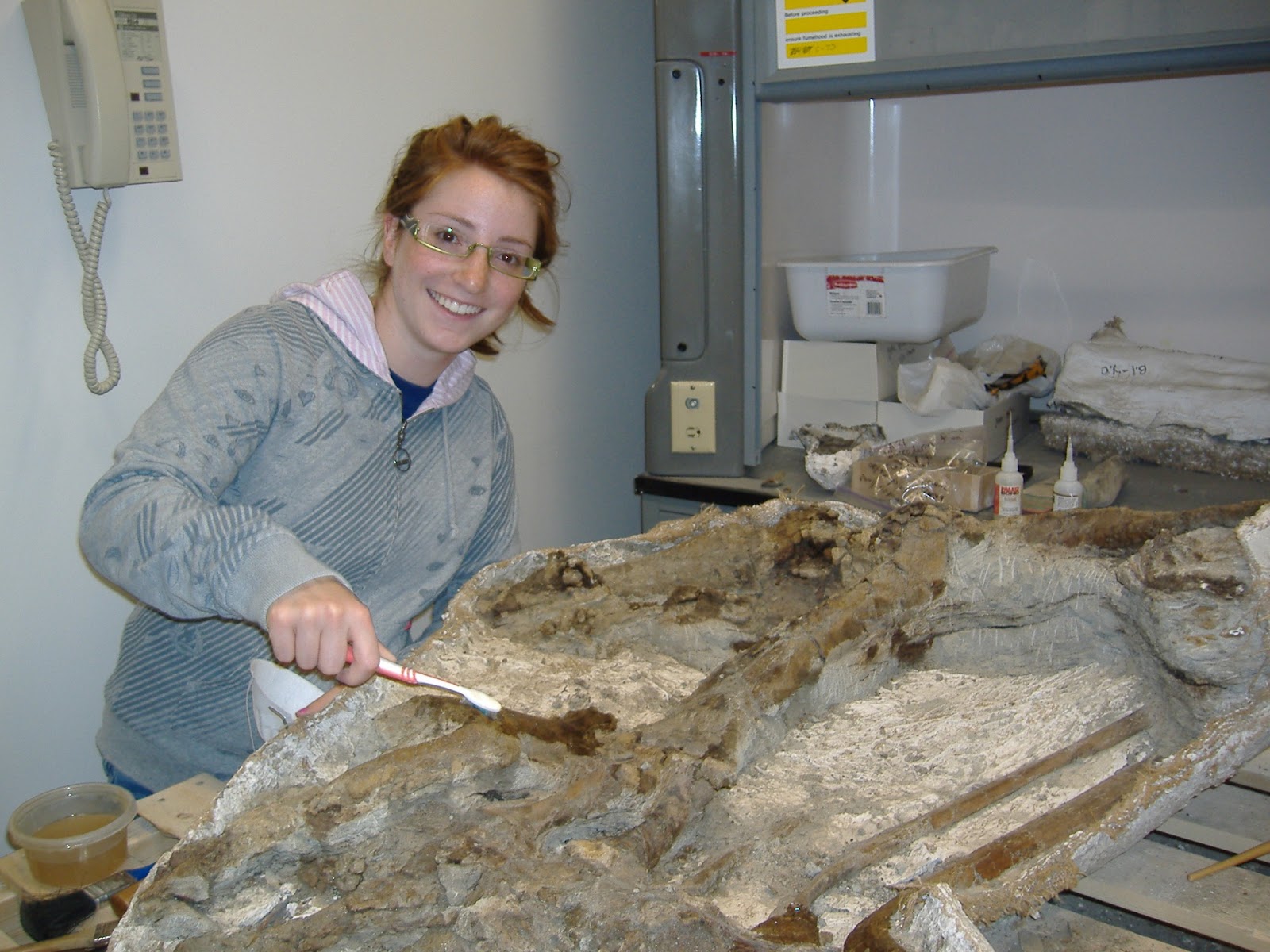
But more than the skull was collected – the cervical half rings, part of the hips and leg, a scapula, and other bits and pieces had been collected but never prepared! So, I dug out the half rings and other pieces and got to work.

Hop in the wayback machine, here's a picture from 2007, my first year at the U of A, working on the cervical half rings of UALVP 31.


Preparing the material took a couple of years, because I did it in bits and snags around my research and other projects. I had help from several of my fellow grad students and technicians – Robin Sissons did the scapula, Mike Burns and Kristina Barclay helped with the pelvis, and Ian Macdonald and Clive Coy assisted with some of the trickier parts like the poorly-preserved second cervical half ring.

You guys, opening up old jackets is hard! Anyway, this is Mike and Robin in 2008 being awesome weirdos. 


In 2009, I decided to supervise two high school students in the University of Alberta's WISEST Summer Research Program. WISEST (Women in Scholarship, Engineering, Science and Technology) is an awesome organization that organizes conferences for junior high and high school students, and supports grad students, postdocs, and early career professionals on campus. Their Summer Research Program places high school students into university labs for about 6 weeks during the summer, and by the end the students produce and present a poster discussing what they've been up to. In 2009 I was joined by Carmen Chornell and Idel Riemer, who were enthusiastic and excellent fossil preparators! Together we completed preparing the UALVP 31 pelvis, as well as other small bits.


Carmen works away on the pelvis and leg...

...while Idel puts the finishing touches on some osteoderms.

The UALVP 31 cervical half ring turned out pretty neat, but I needed more information to figure out if the half ring of CMN 0210 was unique. I visited lots of museums to see what the half rings of other "Euoplocephalus" specimens looked like, and to see the half rings of other species of ankylosaurs. Thankfully, it seems that the half ring of CMN 0210 is diagnostic, so Euoplocephalus is a real taxon after all. The first cervical half ring has 6 tall, keeled osteoderms, and each pair has a distinct morphology. The middle (medial) pair are tall, with a centrally located apex to the keel. The lateral pair also have a keel, but it's kind of sigmoidal (or, S-shaped). The distal pair, which cover the tips of the band, are flange-shaped. Some specimens, like UALVP 31, are missing the distal osteoderms – these don't seem to fuse on as tightly, so it's possible that they are more easily broken off before fossilization. The half ring of UALVP 31 shares the same morphology as CMN 0210, and so UALVP 31 was one of the few specimens that I could confidently refer to Euoplocephalus for a long time (another being AMNH 5406). UALVP 31 was the only one of these that had a complete skull. 

On the left, CMN 0210, in the middle is UALVP 31, and on the right is AMNH 5406.

In the next post, I'll talk about figuring out variation in the cranial ornamentation in Euoplocephalus skulls.


AND HERE ARE SOME PAPERS!


Brown B. 1908. The Ankylosauridae, a new family of armored dinosaurs from the Upper Cretaceous. Bulletin of the American Museum of Natural History 24:187–201.

Gilmore CW. 1923. A new species of Corythosaurus with notes on other Belly River Dinosauria. Canadian Field Naturalist 37: 1–9.

Lambe LM. 1902. New genera and species from the Belly River Series (mid-Cretaceous). Geological Survey of Canada Contributions to Canadian Palaeontology 3: 25–81.

Lambe LM. 1910. Note on the parietal crest of Centrosaurus apertus and a proposed new generic name for Stereocephalus tutus. Ottawa Naturalist 14: 149–151.

Penkalski P. 2001. Variation in specimens referred to Euoplocephalus tutus. In: Carpenter K (ed.) The Armored Dinosaurs. Bloomington: Indiana University Press, 363-385.

Wilson JA, Upchurch P. 2003. A revision of Titanosaurus Lydekker (Dinosauria – Sauropoda), the first dinosaur genus with a “Gondwanan” distribution. Journal of Systematic Palaeontology 1:125-160.

Tuesday, February 7, 2012

5 Questions for Phil Bell

Hot on the heels of yesterday's interview with Caleb, here's an interview with Phil Bell of the Pipestone Creek Dinosaur Initiative. Phil is a former Currie Lab member who completed his PhD last spring, focusing on the Mongolian and North American hadrosaur Saurolophus. He recently published a paper on skin impressions in Saurolophus. Thanks to David Lloyd of the Tyrrell Museum for the great photos of work at the Dragon's Tomb in 2010!


1. What inspired you to conduct this study?

Actually, it was entirely by accident. Like so many advances in science, it came from an unresolved problem: were these two species of Saurolophus (S. osborni from Alberta and S. angustirostris from Mongolia) actually different or were they the same thing? I was at the American Museum in New York in the process of looking at the bones and skeletons of Saurolophus to try and answer that question. I mean, that’s what you do if you work with dinosaurs, you look at the bones. But I immediately struck upon a load of skin impressions. Like most people before me, I thought “that’s cool” but being the first time I had worked with skin impressions, I took the time to photograph, and draw, and measure the hell out of them. When I got to Mongolia later that year, I had the chance to visit one of the great (but little known) palaeontological treasures of the world, the Dragon’s Tomb (see Q3). This site preserves a herd of ‘mummified’ Saurolophus and you can still find loads there today. It was here that I started to notice differences in the skin impressions between the two species and from there I began my search for more specimens with skin impressions that have been stashed in museums from Mongolia, Poland, to Russia.

Phil with a block of Saurolophus at the Dragon's Tomb, Gobi Desert, Mongolia, 2010.

2. Who is Saurolophus?

Saurolophus is a hadrosaur or duck-billed dinosaur. Like it’s more famous cousin, Parasaurolophus (which actually means, ‘like Saurolophus’), it had a rod-like crest sticking out of the back of its skull, but unlike Parasaurolophus, this crest was solid. There are two species: Saurolophus osborni from Alberta grew to around 10 m in length, whereas the Mongolian Saurolophus angustirostris was a giant growing to 12 m in length.

Phil at the Paleontological Institute in Moscow in 2010.

3. What is the Dragon’s Tomb?

The Dragon’s Tomb is the name given to a site discovered by Russian palaeontologists (well, actually, it was one of their drivers who found it) in 1947 in the heart of Mongolia’s Gobi Desert. When they arrived, they found not just one but six or seven Saurolophus skeletons lying on a rocky ledge, most with skin impressions. The Russian’s named it the Dragon’s Tomb for obvious reasons and since then many more Saurolophus skeletons have been found there. Unfortunately though, fossil poachers have also relocated the spot and have caused irreparable damage by using dynamite to blast out skulls and skeletons to sell on the black market. But the place is so rich you can still find great stuff there. I’m involved in a project with Michael Ryan (Cleveland Museum) and David Evans (Royal Ontario Museum) to further explore this site and to figure out why exactly tens of Saurolophus died there.


The Dragon's Tomb, Gobi Desert, Mongolia, in 2010.

4. What is special about the skin of Saurolophus?

Well, for the moment it’s the most complex scale pattern ever seen in a dinosaur. People have known of dinosaur ‘mummies’ for 100 years (actually, last year was the 100th anniversary of the discovery of the first, and in my opinion the best ‘mummy’ ever found; that of Edmontosaurus now on display in New York) but the complexity of their scale patterns has not been really appreciated until now. The stripy pattern on the tail of S. angustirostris was a complete surprise – one that I didn’t even believe when I first saw it. I thought it was a trick of the light or something to do with how the animal was preserved. But when I started to see it on more and more specimens, there was no denying it.
Preparing latex molds of skin. Fittingly, the latex brand is called "Dragon Skin".


5. Can different scale patterns tell us anything about the colour or colour pattern of Saurolophus?

That’s always a tricky question but without the actual colour preserved (as some people have shown with fossilized proteins that produce pigment) we can never be certain. One way of testing that question is to look at modern animals with scales (crocs, lizards, snakes). If you look closely at any of these animals you will notice that not all scales are born equal – some are big, some are small, some are long, circular or hexagonal. And they all have a function of some kind. Take a snake for example; most of the scales along its back are diamond-shaped and coloured in some way. But look at its underside and the scales are really wide, spanning the entire width of the animal, which they use to grip the ground when they’re on the move. They’re also usually a different colour to the top side. So, different shape, different function, and different colour. I’m not saying this is the way it always is but it’s a pretty compelling notion wouldn’t you say?


Thanks very much, Phil!


You can read the original paper here:


And also see "Saurolophus skin suggests speciation" at Superoceras, and "Judging a dinosaur by its cover" at Dinosaur Tracking, for more coverage of this paper.

Thursday, September 29, 2011

You can pick your friends, and you can pick your nose...and you can definitely pick your ankylosaur's nose.


Say hello to Euoplocephalus, the best known ankylosaur you've never heard of. Besides Pinacosaurus from Mongolia and China, there are more specimens referred to Euoplocephalus than to any other ankylosaurid, and it is certainly the most well represented ankylosaurid from North America. Yet Euoplocephalus often gets overlooked because its younger cousin is THAT ankylosaur, the one that starred at the World's Fair and was in Jurassic Park III and Clash of the Dinosaurs and Dinosaur Revolution and gets all the cool toys and, you know, is the namesake of the group. You know, Ankylosaurus. Well, hopefully you'll be hearing more from me about Euoplocephalus over the coming months. Today we'll be picking its nose.

Ankylosaurs are kind of weird as dinosaurs goes, because they get rid of things like the antorbital and supraorbital fenestrae, and tuck the laterotemporal fenestrae back behind the squamosals and quadratojugals. In a sense, the windows to the skull are all closed, and so it's hard to see some of the internal features that are more visible on other dinosaur skulls. Our new paper describes UALVP 47977, a busted up Euoplocephalus skull from Dinosaur Provincial Park. Normally, busted skulls don't appear very exciting, as important pieces might be missing, and they don't make very good display specimens. In this case however, UALVP 47977 gives us more information because it is broken! This specimen shows off details of the braincase and nasal passages that we don't typically get to see, including impressions of blood vessels.

I am trying (slowly but surely) to sort out the mess that is the genus Euoplocephalus, and so I was interested in comparing UALVP 47977 with other skulls to see if any of its features were present in other skulls. The only other skull that is naturally broken in a similar way is AMNH 5238, and it looks pretty similar - it even has blood vessel impressions in the same place (this specimen is also super cool because it has ciliary osteoderms, or, bony eyelids!). I was delighted when Dr. Larry Witmer made the CT scans of AMNH 5405 available on his website following the Witmer and Ridgely (2008) publication on paranasal sinuses. I also made arrangments to CT scan UALVP 31, one of our 'classic' University of Alberta specimens.

With CT scans in hand, I went through the process of eliminating matrix from the inside of the nasal passages (in essence, picking their noses), so I could examine the skull roof of these two specimens. This process is called segmentation, which means that you place a 'mask' over the parts of the CT scan that you want to appear in the 3D model, and remove the mask where you don't want something in the model. Although the software we use, Mimics, has lots of tools to help speed up the segmentation process, with fossils sometimes the contrast between bone and stone is not very great. As a result, sometimes you just have to go through the CT scans slice by slice and trace out by hand what you want to keep. This is super tedious work at times and I have the utmost respect for the amazing 3D visualizations that come out of Dr. Witmer's lab. Eventually we invited Dr. Witmer to collaborate on the paper with us, but I think it was good that we were able to independently test their 3D model using different software and fresh eyes, a sentiment echoed over on the WitmerLab blog.


The segmentation process begins! All of that uniformly-dense stuff in the palatal area has to go. The green 'mask' will be eliminated wherever there is matrix instead of bone, leaving only the bone in the 3D model.

I won't go into too much detail on the paper here, but I will say that this was a tough but very interesting project to work on. I've learned a lot about braincases and brains and noses over the course of writing this manuscript, but I'm sure I've still got more to learn. I've definitely had a lot of moments where I felt pretty stupid for not knowing certain things, but I think perhaps part of science is getting outside of your comfort zone. Ankylosaur tails are good, but skulls are pretty fun too, and I hope I can share some more skull papers with you soon! 

Here's a video we put together for the press release accompanying the paper, featuring the ever lovely UALVP 31.


Literature!

Miyashita T, Arbour VM, Witmer LM, Currie PJ. 2011. The internal cranial morphology of an armoured dinosaur Euoplocephalus corroborated by X-ray computed tomographic reconstruction. Journal of Anatomy, first published 29 Sept 2011, doi:10.111/j.1469.-7580.2011.01427.x.


And check out the post over at Pick & Scalpel, which has more information and some great images!


...and finally, because this has certainly helped me sometimes:
Schwartz MA. 2008. The importance of stupidity in scientific research. Journal of Cell science 121:1771.