Showing posts with label exciting new discoveries. Show all posts

Saturday, June 13, 2015

Cornelius says hello

Updated on July 8, 2015! 
"Cornelius" now has a scientific name - Wendiceratops pinhornensis! 
You can read the open access paper here:


Say hello to Cornelius! I got to meet him during a brief visit to the ROM last week, and he seems like a pretty nice guy.

This cool new ceratopsian is on display in the Age of Dinosaurs gallery in an exhibit called "New Dino Discovered", and was also featured in Dino Hunt Canada, which aired earlier this year. It should have a new name soon, but for now Canada voted to nickname it Cornelius. The really nice skeletal mount was put together by Research Casting International based on about a 50% complete disarticulated skeleton.

Here's a close-up of that winning smile. This new dude is a centrosaurine ceratopsid with some pretty neat ornamentation going on at the back of the frill.

I really liked the inclusion of a quarry map on the floor, which highlights some of the bones that are on display. The skeleton was found in southern Alberta in the Milk River area, and comes from the Oldman Formation.

The mounted skeleton is a cast, but there are some original bones on display, like the radius and ulna shown here.

In particular, I liked this set of panels on the wall showing differences in frill ornamentation between centrosaurines, and how we identify different species. On the right is the original frill material for Cornelius, the bottom left is Centrosaurus, and the top left is Styracosaurus.

And look, there was even an ankylosaur osteoderm on display! These are some of the fossils found in the Milk River area, which tell us a bit about the ecosystem that the new centrosaurine lived in.

It's a cool new dinosaur and a nice exhibit, so definitely don't miss it if you're visiting the ROM anytime soon!

Wednesday, May 6, 2015

On Failures of Imagination

Yesterday I talked about 'expected surprises' with regards to Yi qi. Yi qi is a surprise because its anatomy is so unlike other theropods, and it suggests that dinosaurs were experimenting with flight and/or gliding in some ways that were quite different from our current understanding of feather and bird wing evolution. But it was also not entirely unexpected, because scansoriopterygids had super weird anatomy to begin with that gave us enough information to speculate about possible gliding adaptations in those dinosaurs, even though the general consensus was that it was pretty far-fetched.

But today I wanted to talk about a related feeling, which I like to call the Failure of Imagination. Last summer I was working my way through a DVD set of classic sci-fi, fantasy, and adventure movies that I had picked up at some point. I wound up watching a lot of these with friends and basically Mystery Science Theatre 3000-ing the films, and in particular the old space adventure movies from the 40s-60s provided much entertainment. It's really fun to take a look back and see what sorts of things people envisioned the future holding for us – space travel, exoplanet exploration, robots. But what also struck me was the things that the filmmakers and storywriters couldn't even imagine. 

They could imagine spaceships and robots, but they couldn't imagine wireless technology. Or storing information in digital form rather than on spools of tape. 

They couldn't imagine non-button-and-dial-based instrumentation. 

And they definitely couldn't imagine women in roles other than administrative assistants (or as the bad guys). SO MANY SPACE SECRETARIES.


I kept thinking to myself – what sorts of failures of imagination are we having in palaeontology today? We can imagine so many things. But I wonder what kinds of things we won't even know we don't know. When we try our hand at speculative biology, what will scientists 80 or 100 years from now think was charming, or quaint, or ahead of its time. Failures of imagination are one of those things that make me nervous as a scientist, because I don't like the idea that I won't even know what I'm not imagining.

Tuesday, May 5, 2015

On Surprises

I love surprises. Which is unfortunate for me, because I am extremely bad at being surprised. And it's hard to be surprised by things as you get older, and as easier access to more and more information becomes available to us every day.

But boy, when a surprise comes along that actually takes me by surprise, what a thing to be able to savour.


An extraordinary painting of Yi qi by Emily Willoughby, CC-BY.

So, enter Yi qi. In many ways, it's hardly a surprise at all – numerous artists produced wonderful speculative art about scansoriopterygids predicting membranous wings and/or gliding abilities, and there was even this neat hypothetical Archaeopteryx ancestor that I found in a paper a few years ago. At the time, I wrote on Facebook: "I had not realized that a bat-winged proto-bird was an idea that was on the table!"

(I also wrote, "I like his smirk, lack of neck, and skinny skinny tail", and I agree with Past Victoria about all of those things.)

While Yi qi might not really be a proto-bird, it's still an amazing discovery that shows there was a lot of experimenting with flying and gliding going on back in the Mesozoic, which is perhaps unsurprising, given that lots of disparate groups of animals use gliding to their advantage today – fish, frogs, rodents, marsupials, dermopterans, you name it. And yet, even though there's lots of precedent for gliding vertebrates, and others had predicted something kind of like Yi qi before, I was still genuinely shocked when I saw the paper and press images. What a great feeling.

What I love best about Yi qi, apart from it's extremely meme-able name, is that it's a great example of maybe what I'll call an 'expected surprise'. A surprise that, as soon as you see it, it seems so obvious and like it should have been there all along. It's like the opposite of a failure of imagination. Surely there is a long German word that captures this specific emotion? What other expected surprises are lurking out there in our futures? What things have we speculated on today, dismissed as being way too out there to take seriously, and yet will pop up as really-for-real things later on?


I guess I need to get to work on some ankylosaur speculative biology! Maybe we'll find the real Yee?

Tuesday, April 7, 2015

A Brontobyte of Sauropods

Palaeontology emergency alert! This is not a drill! Brontosaurus is back!

YES I FINALLY GOT TO USE THIS ON THE BLOG. Success!


I mean, Brontosaurus never really left. That's the nice thing about taxonomy – once a name is out there, it's there forever, even if we decide later on that it might represent the same kind of animal that another name does. And so every now and then, we get to bring an old name back from the dead. Today, Tschopp and colleagues have published some very good support to indicate that Brontosaurus really is distinct from Apatosaurus after all, and we can all use that name and stop telling people that Brontosaurus isn't real. OMG, WHAT A RELIEF. 

To recap: Brontosaurus has not been an accepted name in the palaeontological community for more than 100 years, but because of its use in some museum exhibits, and things like the 1964 World's Fair and the "Rite of Spring" passage in Fantasia, for example, the name has become entrenched in the popular consciousness in a way few other dinosaur names have. It is very disappointing to learn that palaeontologists don't call that big dinosaur Brontosaurus, but the decidedly less evocative name Apatosaurus instead.

Click for sauropod-size. With many thanks to the authors and PeerJ for creating such a useful diagram, which I'm sure will be reproduced often and with much gratitude by palaeontologists, teachers, and other science communicators.


The new paper is staggering in its length (almost 300 pages!) and the amount of work it represents, and I'm not a sauropod specialist, so I'll summarize it here without delving into sauropod anatomy very much:
Two of the Big 3 diplodocids: Apatosaurus (in the back) and Diplodocus (foreground) face-off at the Carnegie Museum.

  1. Tschopp et al. did a specimen-level phylogeny of diplodocids, the sauropods like Apatosaurus and Diplodocus, but not Brachiosaurus or Camarasaurus. This means that individual specimens were coded, rather than species. Often, phylogenetic studies have just looked at the 'classic' diplodocids Apatosaurus, Barosaurus, and Diplodocus (the 'Big 3', shall we say?). And most of those studies elide the many species represented by these three genera. So a specimen-level phylogeny is a much-needed approach to resolve some questions about diplodocid diversity.
  2. They then used some techniques to quantify differences among specimens – pairwise dissimilarity, and apomorphy counts – that would help justify dividing clusters of individuals into different genera. There isn't a rule in palaeontology that individuals need to be a certain amount 'different' from each other in order to be a new genus or species, so the authors looked at how many unique characters separate some sauropods that everyone seems pretty comfortable calling different species and genera. Apatosaurus ajax and Apatosaurus louisae had 12 different features, and Diplodocus carnegii and Diplodocus hallorum had 11 different features. So 13 different characters was set as the baseline for separating out genera in the specimen phylogeny. Using the same approach, they also set 6 differences as the baseline for separating species within a given genus. These numbers only apply to this particular analysis, but it's an interesting approach that I think would be worth considering for other dinosaur phylogenies.
  3. Using this, they wind up doing some taxonomic reshuffling:

a.       Diplodocus longus lacks any diagnostic features at the species level and is a nomen dubium, which is bad because it's also the type species for Diplodocus. A petition to the ICZN to switch the type species to D. carnegii is in the works. Diplodocus includes the species D. carnegii and D. hallorum (née Seismosaurus)
b.      Dinheirosaurus (from Portugal) is a junior synonym of Supersaurus, and so Supersaurus is a cross-continental genus represented by two species.
c.       Diplodocus hayi passes the threshold for generic distinctiveness from Diplodocus and gets a new name, Galeamopus hayi. Specimens of Galeamopus are actually more complete than Diplodocus, which means that Diplodocidae is best represented by Galeamopus at present if you need a diplodocid for whatever you're working on.
d.      And finally, and arguably most significantly, Brontosaurus passes the threshold for generic distinctiveness from Apatosaurus. There are three species within Brontosaurus: B. exelsus ('classic' Brontosaurus), B. parvus (née Elosaurus), and B. yahnahpin (née 'Eobrontosaurus').


The third of the Big 3 diplodocids, the iconic rearing Barosaurus at the American Museum of Natural History.


I really hope this taxonomic shuffling gains wide acceptance, because 1) I think their approach and reasoning are pretty sound, and 2) it's going to be SO MUCH EASIER not to have to constantly 'debunk' Brontosaurus with non-palaeontologists.The oft-repeated story that "Brontosaurus" wasn't real because it had the head of one animal and the body of another is wrong, but the real story, about the rules of taxonomy and how we define species, is much more difficult to explain. (It's interesting, but it's not as easily parsed to a lay audience.) And let's face it, Brontosaurus was a really good name and it was sad that it had to be synonymized. The story of Brontosaurus now has a new and interesting chapter – our ideas about the biology of Brontosaurus have changed, but now we can talk about changes to how we think Brontosaurus looked and lived, rather than just focusing on a quirk of taxonomy. So let your Brontosaurus flag fly high, dinosaur fans, because Brontosaurus is back and that's awesome.

Old-timey sauropod in the little diorama at the Smithsonian, back in 2011.

Big taxonomic revisions are hard and important but often don't feel as 'sexy' as some of the other research that gets publicized. I like thinking about alpha taxonomy (uh, perhaps obviously) and I like doing this kind of research, and I think it's really important that we recognize how important this kind of work is – alpha taxonomy is really foundational to a lot of other studies. If you don't know how many species you have, or where they lived, or what anatomy belongs with each species, how can you do projects that look at the evolution of certain features through time, or understand changing ecosystems? 

For example, given that there's at least 14 species of diplodocid in only 11 million years of Morrison Formation, it's unlikely that there's a slice of time in there in which there's only one diplodocid species. (And remember, diplodocids weren't the only sauropods in the Morrison – this is also the home of Brachiosaurus and Camarasaurus and Suuwassea and who knows what else.) This is a pretty good reason to reject what I like to call the "Highlander hypothesis", i.e. There Can Only Be One ___(ankylosaur, tyrannosaur, whatever)___ in a given formation, something that I've encountered in conversations on occasion. It's understandable that we would feel unease at the idea of high species/generic diversity in such massive dinosaurs, because how are they dividing up ecosystem space? But over and over again it seems like lots of similarly-shaped dinosaurs were occupying similar times and spaces in terms of what we see in the rock record, which I find very interesting indeed. (Now what we need is a really good stratigraphic framework for putting all of these diplodocids into chronological and geographical context.) We can only do a good job of addressing these kinds of questions by having good data to put into those studies, and that data comes from taxonomic revisions like this one.

And revising taxonomy is probably a never-ending job, because we need to keep reassessing our definitions of genera and species as we get more information through new specimens. Let's make sure we all support this kind of research as palaeontology continues to evolve with new techniques, questions, and approaches. Bully for Brontosaurus, and bully for alpha taxonomy.


Stray observations:
  • The concept of a 'relatively small' animal that is 12-15 metres long amuses me. (re: Kaatedocus, page 2)
  • The 'brontobyte' image at the top of this post is an old joke from my Currie lab days; a brontobyte is actually 10^27 bytes. But I think it would be a good collective noun for sauropods, and it also feels appropriate given the large number of sauropod species recovered by Tschopp et al. In fact, we need more collective nouns for dinosaurs, and so I'd like to propose brontobyte for sauropods and armada for ankylosaurs, to join terror of tyrannosaurs.


Go read the paper! It's open access!: Tschopp E, Mateus O, Benson RBJ. 2015. A specimen-level phylogenetic analysis and taxonomic revision of Diplodocidae (Dinosauria, Sauropoda). PeerJ 3:857.

Wednesday, January 28, 2015

The Great Canadian Dinosaur Hunt

Dino Hunt Canada is almost here! Starting this Friday, History Channel Canada will be airing a series of hour-long documentaries devoted to dinosaur expeditions all across Canada - and not just in the famous badlands of Alberta! The production crew visited field localities in Nova Scotia, Saskatchewan, multiple places around Alberta, and British Columbia. It's going to be a real who's who and where's where of Canadian palaeontology.


I'll be in the second episode featuring work in Dinosaur Provincial Park, which we filmed in 2013. It was a fun if somewhat unusual experience to have such a large film crew with us, and I'm looking forward to seeing the whole shebang!


What was the crew filming in DPP? Tune in to find out!


There's also a really excellent website to accompany the show. You can learn more about some of the dinosaurs featured in the series (including wonderful new artwork by Danielle Dufault!), see interviews with some of the palaeontologists, and submit ideas for a nickname for a new dinosaur excavated during the show by the Southern Alberta Dinosaur Project. You can even submit questions and maybe have my weirdo face answer them via Skype! All in all, it's looking really good so far and I'm so happy to see the huge variety of dinosaur research being conducted across Canada by so many talented and hardworking people.

Monday, December 8, 2014

A Body for Terrible Hands

It was a whirlwind year for dinosaur palaeontology, yet again. This week I'm writing about what I consider the most important news in my science field for 2014, for the Science Borealis blog carnival. There are so many great stories to choose from! Kulindadromeus and feather-like structures in ornithischians? The bizarro new reconstruction of a short-legged Spinosaurus? Both of those stories were pretty interesting, but my choice has to be the description of multiple skeletons of the Mongolian ornithomimosaur Deinocheirus.

If you like dinosaurs, there's a good chance you've heard about Deinocheirus before, even if it's not quite a household name like Stegosaurus or Triceratops. Deinocheirus (which means "Terrible Hands") was found during the Polish-Mongolian expeditions in the 1960s, and up until very recently has only been known by this single specimen, a pair of tremendous arms. And I do mean tremendous!

Me, in 2007, mimicking the 'zombie arms' of Deinocheirus, rather convincingly if I do say so myself.

A few years ago, the quarry for this holotype specimen was relocated and some gastralia (belly ribs) were found and described, but besides that this has been it. What on earth did the rest of this dinosaur look like? Was it a carnivore, herbivore, or something else? Where did it fit in the Cretaceous Gobi ecosystem?

While the exact evolutionary relationships of Deinocheirus have been enigmatic, there's been a general consensus that it was some kind of ornithomimosaur, or ostrich-mimic dinosaur. Even if you're not a dino-buff, you'll recognize ornithomimids as the stampeding dinosaurs in Jurassic Park – Gallimimus was the one 'flocking this way', and, conveniently, Gallimimus is a commonly encountered fossil in the Upper Cretaceous rocks of the Gobi Desert and would have lived alongside Deinocheirus. Where Gallimimus is an elegant, sprightly kind of dinosaur, Deinocheirus, it turns out, is not at all, not even a little bit.


It turns out that Deinocheirus is even more surprising than we would have ever guessed; the giant arms are nothing compared to the weirdness of the rest of its skeleton. Deinocheirus looks like a cross between a therizinosaur and a hadrosaur. It's a big, broad-bellied ornithomimosaur with a 'sail' of heightened neural spines on its vertebrae, and a widened, shovel-like snout with a deep jaw and tiny eyes. It looks like it was adapted for eating vegetation and had gastroliths preserved in its stomach region, but also had fish scales in there as well, prompting the authors to describe it as a megaomnivore, which is among my new favourite words of the year. Given that its close relatives the ornithomimids are known to have had feathers, as well as many other theropod dinosaurs, it is most likely that Deinocheirus had at least some feathers.

Deinocheirus, by the always-incredible Michael Skrepnick.

I will forever be jealous of my colleague Derek Larson, who was on the 2009 Korea-Mongolia International Dinosaur Project expedition that found the new skeletons of Deinocheirus (I was there just a year later, and it was a great year...but no Deinocheirus). I'm so thrilled that I've been able to see the original bones in person, and they really are quite something to see – I hope that the specimen will eventually be mounted and put on display so everyone can see it for themselves, too!

The "Canadian contingent" (which actually includes at least one American and one Australian, but let's not be too picky) at the 2013 Hwaseong International Dinosaurs Expedition Symposium last December, gawking away at Deinocheirus.

Deinocheirus is also an important reminder that Mongolian fossils are under threat. Sadly, many probably excellent skeletons are removed illegally from Mongolia every year – no fossils are allowed to leave the country without a permit, and none can be sold, so any fossils from "Central Asia" on the auction blocks are almost certainly stolen goods. The Deinocheirus skull had made its way out of Mongolia some years ago, and was, thankfully, repatriated to Mongolia when word of the new skeletons began to circulate throughout the palaeontological community. Incredibly, the skull actually belonged to one of the newly collected skeletons! This is a story that could have ended very differently – we might not have known about the strange skull of Deinocheirus because of fossil poaching.

Poached fossils make everybody sad! Here Phil Currie is showing the remains of a tyrannosaur skull that was improperly collected by poachers and destroyed in the process.


So why choose Deinocheirus over Kulindadromeus or Spinosaurus? Like I said, all three are top contenders for the most surprising finds of 2014. In some ways, the fuzz of Kulindadromeus is less surprising, and its significance lies in the fact that it lends support to the hypothesis that fuzz was present in most dinosaurian clades. Spinosaurus has also long been considered a specialist in aquatic foods, so while the new skeletal revision is certainly weird, it's not quite a fundamental re-envisioning of this beast. But Deinocheirus is way beyond what anyone would have ever predicted the rest of the skeleton would have looked like, and just goes to show that there are surprises waiting around every corner for us when it comes to dinosaur diversity. And, in my opinion, Deinocheirus leads to even more questions than it answered: what was it doing with that sail; why is its jaw so deep and its eyes so small; what kind of environment produces a megaomnivore like that; are any of the bits and pieces of what we thought was Gallimimus actually parts of juvenile Deinocheirus? I could go on and on.

Congratulations to my colleagues in Korea and Mongolia for organizing the Korea-Mongolia International Dinosaur Project expeditions – I'm sure this is just the first of many wonderful projects that will result from those years of fieldwork.


Saturday, November 22, 2014

Know Your Ankylosaurs: Mongolia Edition!

After a whirlwind couple of weeks with a bunch of international travel, I've finally had a chance to sit down and write about my most recent paper on the ankylosaurs of the Baruungoyot and Nemegt formations of Mongolia. I've been interested in these ankylosaurs for a long time now, both because of their interesting cranial anatomy and their relationships to the ankylosaurs of North America (especially Alberta). So, here's a plain-language summary of some complicated taxonomy! Hooray!

Part the first: Dyoplosaurus giganteus

A toe!

We need to start here because Dyoplosaurus giganteus is the first of the ankylosaurs in this manuscript to have been named. Based on a fragmentary postcranium, Dyoplosaurus giganteus was considered similar to the North American Dyoplosaurus acutosquameus (pre-dating the synonymy of Dyoplosaurus with Euoplocephalus), but larger. Unfortunately, the holotype lacks any diagnostic characters that can differentiate it from specimens discovered since its original description, and so D. giganteus must be considered a nomen dubium. Which is important because...

Part the second: Tarchia
...it was partly synonymized with the newly-named genus Tarchia, based on similarities between the osteoderms, which then included Tarchia gigantea and Tarchia kielanae. Most people picture the beautifully preserved skull in the PIN collections as 'the' Tarchia, but in fact it is not the holotype of either D. giganteus or Tarchia kielanae. T. kielanae's holotype is a partial skull roof. Later, Tarchia kielanae was considered a junior synonym of Tarchia gigantea because it's quite fragmentary and there weren't any obvious differences between the two skulls. But here's the catch: the holotype skull of Tarchia kielanae does indeed preserve a diagnostic character that is not present in the PIN 'Tarchia' skull – a weird little ossification that sits on/in front of the squamosal horn, but isn't the squamosal horn. This feature is found only in one other described specimen – the holotype of Minotaurasaurus ramachandrani.

On the left, a sketch of T. kielanae's holotype from Maryanska's 1977 paper; on the right, a cast of the holotype of Minotaurasaurus.

The end result is that:
1.  Tarchia kielanae is valid
2. Minotaurasaurus is a junior synonym of T. kielanae
3. There are no diagnostic features in D. giganteus and no reason to refer the PIN skull to Tarchia, so T. gigantea is redundant.
4.  I'm sorry other ankylosaur workers, this really messes things up.

The Minotaurasaurus holotype is much more complete than the T. kielanae holotype and provides most of the anatomical information for Tarchia kielanae. Tarchia kielanae has extremely narrow squamosal horns, a prominent prefrontal caputegulum, four internarial caputegulum, a huge mandibular caputegulum, and that distinctive ossification above the squamosal horn.

Part the third: What about Saichania?

The Museum of Evolution in Warsaw has a cast of Saichania with the elements in situ.

Saichania is safe! This is an easily diagnosed taxon based on a GREAT holotype which includes a skull and front half of the postcrania and osteoderms that were articulated at the time of discovery (a cast of the in situ specimen shows the original arrangement). But, Saichania is probably not what you think it is – most people (well, at least those who think about such things) will probably visualize the mounted skeleton found in several museums/traveling exhibits. In one of my previous papers I argued that this skeleton should not be referred to Saichania based on several differences of the postcranial anatomy, and its provenance from the Djadokhta Formation rather than the Baruungoyot Formation. (The skull on this mounted skeleton is a cast of the holotype Saichania skull, and so unfortunately there isn't a lot of overlapping material.) Instead, that skeleton is possibly a relatively mature Pinacosaurus, or something different entirely.

Not Saichania, unfortunately! (Except for the head.) But maybe a big Pinacosaurus?


What about the PIN 'Tarchia' skull? 


So amazing!

Although it has a few small differences compared to the holotype Saichania skull, my best assessment right now is that this skull should also be referred to Saichania, not Tarchia. Both skulls have robust squamosal horns compared to the rediagnosed Tarchia, a small prefrontal caputegulum and large loreal caputeglae, and only a single internarial caputegulum. Eventually, as more specimens are found and described, it might be worth creating a new species of Saichania for the PIN skull, especially given that it was found in the Nemegt Formation and the holotype of S. chulsanensis is from the Baruungoyot Formation. Alternately, there might just be a single species of Saichania in both formations – a better understanding of the dinosaur biostratigraphy of Mongolia is much needed!


Part the fourth: A new kid on the block!

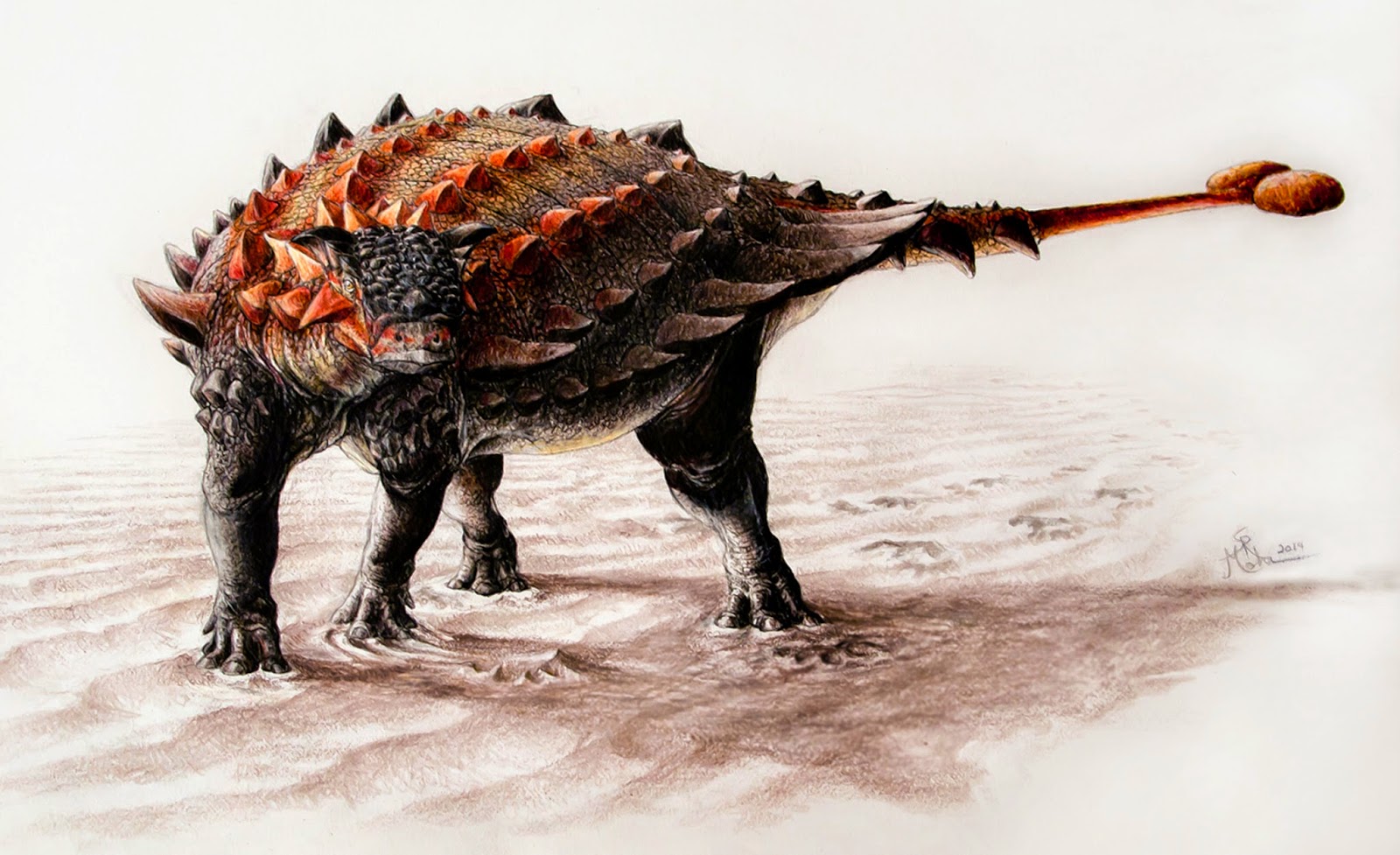
Meet Zaraapelta nomadis, a new ankylosaurid from the Baruungoyot Formation! This specimen was collected during the 2000 Dinosaurs of the Gobi expedition organized by Phil Currie and Nomadic Expeditions. 


Please enjoy this beautiful life restoration of Zaraapelta by my lovely and talented friend Danielle Dufault!


Zaraapelta has some features that indicate it's relatively closely related to Tarchia, including prominent prefrontal ornamentation. However, it has a couple of unique features that show that it is distinct – the squamosal horns are deep, like in Saichania, and there is extensive ornamentation behind the orbit. The squamosal horn also has a weird double-layered texture that I haven't encountered in any other ankylosaurid. At the moment we only have a skull for Zaraapelta, but I'm hoping that with the revision of ankylosaurid taxa I've proposed in this manuscript, future workers will be able to identify more specimens for these taxa as well!


And many thanks to Jessica Tansey, who did the technical illustrations of the skull for me while she was an undergrad at the UofA!


Part the fifth: Tail club conundrums


A cast of the ZPAL MgD I/113 tail club in the UALVP collections.

One really neat thing that I've mentioned in a couple of previous papers is that one specimen collected by the Polish-Mongolian expeditions in the 70s has a weird and unique tail club morphology. In pretty much all ankylosaurids, the tail club handle vertebrae look like a nested series of Vs in dorsal view, and the angle formed by the point is about 20-22 degrees. Ankylosaurus is the odd one out because it has distinctive U-shaped vertebrae. And ZPAL MgD I/113 has a morphology that's in between these two – not quite U-shaped, but not as sharply pointed as the V-shaped morphology in other ankylosaurids. There are also specimens from Mongolia with the V-shaped morphology, so we've got at least two species represented by tail club handles. But here's the problem: although we've got some really great skulls, partial skeletons, and skeletons with in situ osteoderms, there actually aren't any skeletons with both a skull and a tail club from these formations in Mongolia! Do either of the tail club morphotypes belong to the named species from Mongolia? Or does the unusual tail club handle represent a new species in the Nemegt Formation? We'll only be able to figure this out if we find a skull and tail club in the same specimen, but it would be pretty exciting if we were able to name another new ankylosaur from the Gobi.

So, that's a brief overview of the taxonomic stuff from the new paper. But before we finish, I want to pause for a moment to acknowledge one of my coauthors who couldn't see the paper in its final published form. Very sadly, our friend Badam passed away suddenly last December, which came as a shock to those of us who've benefited from her kindness and generosity while we've visited Mongolia. I wish I had had more time to spend with Badam, but I'm extremely grateful for the times I got to spend with her in Mongolia and when she visited Edmonton a few years ago. She is a presence that will be missed.


Miriam, Badam and I at Nemegt in 2007. A happy time. We miss you, Badam.

I'm glad to see this paper finally published - it was another one of those multi-year projects to visit lots of museums in order to see all of the necessary specimens - and it was a nice send-off for my time at the University of Alberta. Last weekend I moved down to Raleigh, North Carolina to begin a postdoc with Lindsay Zanno at the North Carolina Museum of Natural Sciences/North Carolina State University. I had an amazing time in Edmonton and I'm sure that's not the last Alberta will see of me, and I'm hoping to accomplish some fun things here in Raleigh. To new adventures!

If you want to learn more about Zaraapelta and friends, try:

Arbour VM, Currie PJ, Badamgarav D. 2014. The ankylosaurid dinosaurs of the Upper Cretaceous Baruungoyot and Nemegt formations of Mongolia. Zoological Journal of the Linnean Society 172:631-652.

Watch my awkward face on Global TV! (Also with footage from the Discovering Dinosaurs exhibit!)

Friday, September 26, 2014

Know Your Ankylosaurs: New Mexico Edition!

There's a new ankylosaur in town - meet Ziapelta sanjuanensis from the Cretaceous of New Mexico!

Hello, Ziapelta! Many thanks to new Currie Lab MSc student Sydney Mohr for this wonderful life restoration of Ziapelta.

Ziapelta is represented by the holotype skull, first cervical half ring, and assorted other osteoderms, AND a referred first cervical half ring! (What are the odds of finding two really nice cervical half rings in the same field season? Bonkers!) It's a wonderful find from an area that seems to keep producing interesting dinosaur fossils.

Surprisingly, Ziapelta doesn't seem to be particularly closely related to the other ankylosaurid from the Kirtland Formation, Nodocephalosaurus. Instead, it's a close relative of Euoplocephalus and friends from Alberta – it shares the same general shape and pattern of cranial ornamentation, with flat, hexagonal caputegulae rather than the round, conical caputegulae of Nodocephalosaurus. Ziapelta is distinct from all of the Albertan ankylosaurids though: it's squamosal horns are thick and curve slightly downwards laterally, and its median nasal caputegulum is huge and triangular, rather than hexagonal. Somewhat bizarrely, Ziapelta has slightly bulbous or 'inflated' looking cranial caputegulae, not to the same extent as some of the Mongolian ankylosaurids like Saichania, but definitely moreso than Euoplocephalus or Anodontosaurus.


Cervical half rings once again prove to be taxonomically useful. Ziapelta has taller, more rectangular keeled osteoderms compared to Euoplocephalus, Anodontosaurus, and Scolosaurus, but does share the interstitial osteoderms present in Anodontosaurus.

Although we don't have the rest of the postcrania, we can assume that Ziapelta would have had a tail club since it is deeply nested within the clade of clubbed ankylosaurids. Did it have huge, triangular osteoderms like Anodontosaurus, a round tail club like Euoplocephalus, or a narrow tail club like Dyoplosaurus?

Ziapelta isn't the first ankylosaur described from New Mexico - in fact, it's just the latest in a string of interesting armoured dinosaur discoveries from there. At present, Glyptodontopelta is the only nodosaurid from the state, from the Maastrichtian Ojo Alamo Formation. It's known only from osteoderms, and mostly those from the pelvic region, but they're pretty distinctive and have a unique dendritic surface texture.

Glyptodontopelta bits at the Smithsonian.

Nodocephalosaurus is known from a partial skull from the De-na-zin Member of the Kirtland Formation. Its nodular cranial ornamentation is totally unique among North American ankylosaurids and more closely resembles the Late Cretaceous Mongolian ankylosaurids - an intriguing biogeographical conundrum that remains unresolved.

Nodocephalosaurus holotype skull at the State Museum of Pennsylvania. Check out those conical caputegulae!


Lesser known but deserving of more attention, my fellow labmate Mike Burns and colleague Bob Sullivan recently named another ankylosaurid from the stratigraphically lower Hunter Wash member of the Kirtland Formation. Ahshislepelta has a weird scapula with a strongly folded-over acromion process, as well as various other bits and bobs of the postcrania. Although there is little overlapping material between Ahshislepelta and Ziapelta, Ahshislepelta's osteoderms have a smoother surface texture, and the stratigraphic separate suggests we're probably looking at two different species.

Ahshislepelta holotype scapula at the State Museum of Pennsylvania.


Ziapelta is also neat because it (and Nodocephalosaurus) occur in a slice of time where we don't have very good ankylosaurid material in Alberta. In Alberta, we're in the lower part of the Horseshoe Canyon Formation – probably Anodontosaurus was found here around that time, but we don't have too many good specimens. Was it possible that Ziapelta roamed through the lower HCF? Or, are Ziapelta and Nodocephalosaurus characteristic of a southern Laramidian dinosaur fauna, like we seem to be seeing with some of the slightly older formations in Alberta (Dinosaur Park Formation) and Utah (Kaiparowits Formation)? Only more specimens will help us answer those questions.

I'm very grateful to Bob Sullivan, who found these specimens, for inviting me to help out with this paper, and to Spencer Lucas at the New Mexico Museum of Natural History and Science for his hospitality during my visit in 2012 to study the specimen. I hope one day I can have a chance to do some fieldwork in New Mexico, although I fear my thick Canadian blood would not serve me well and I would pretty much immediately die from the heat. Mike Burns and I had a great visit to Albuquerque in June 2012 to study the specimen, but boy howdy was it hot there. Ziapelta is housed at the New Mexico Museum and will be on display there, so if you're in the neighbourhood go say hi for me!

You can read all about Ziapelta in our open access paper in PLOS ONE!


Ninja-edit! I would be severely remiss in not linking to some of the thoughtful news coverage we were very lucky to receive for this paper!
* Brian Switek covers our research at Laelaps: "Ziapelta - New Mexico's newest dinosaur."
* Hear my weirdo voice on the CBC's Edmonton AM!
* And via the University of Alberta, "New dinosaur from New Mexico has relatives in Alberta."

More papers!

Burns ME, Sullivan RM. 2011. A new ankylosaurid from the Upper Cretaceous Kirtland Formation, San Juan Basin, with comments on the diversity of ankylosaurids in New Mexico. New Mexico Museum of Natural History and Science Bulletin 53:169-178.

Ford TL. 2000. A review of ankylosaur osteoderms from New Mexico and a preliminary review of ankylosaur armor. New Mexico Museum of Natural History and Science Bulletin 17:157-176.

Sullivan RM. 1999. Nodocephalosaurus kirtlandensis, gen. et sp. nov., a new ankylosaurid dinosaur (Ornithischia: Ankylosauria) from the Upper Cretaceous Kirtland Formation (Upper Campanian), San Juan Basin, New Mexico. Journal of Vertebrate Paleontology 19:126-139.

Thursday, September 18, 2014

Discovering Dinosaurs, Revealing Teamwork

It's a wonderful feeling when you get to be part of something that celebrates teamwork.
Yesterday was the opening reception for the University of Alberta's new exhibit, Discovering Dinosaurs: The Story of Alberta's Dinosaursas told through U of A Research. The exhibit features the work of almost all of the current people in Phil Currie's lab, as well as many of our alumni and colleagues.

The exhibit focuses in on research projects and new discoveries at the university. You'll see lots of fossils and casts, but you'll also see plenty of panels like this one featuring my work on ankylosaur tail clubs. (To see more of the folks in our lab featured in the exhibit, check out the DinoLab's Facebook album.) I really like this approach, because it shows that science is done by real people, and it shows the specific kinds of questions that we ask in order to tell the bigger stories about dinosaur lives. How DO we find out if ankylosaurs used their tail clubs as weapons? What kinds of techniques do we use? What surprises do we encounter as palaeontologists?


There's so many great stories in the exhibit, and I think the focus on dinosaur parts rather than full skeletons means we get to focus on the subtler bits of anatomy that might be missed in a room full of giant skeletons. (Not that I don't like a good room full of skeletons!). The exhibit is divided into several themed rooms – this one is obviously the theropod shrine, but you'll also get to see ankylosaurs, hadrosaurs, ceratopsians, and birds, and some non-dinosaurs, too!


Even vertebrate microsites get some love in the exhibit.


I think this is particularly fun – take a peek inside our camp kitchen tent in the Mongolian fieldwork room, and see some film footage from the early days of collecting at the university and from more recent work in the PALEO 400 field school at the Danek Bonebed.


Edmonton-based palaeoartist extraordinaire Julius Csotonyi provided much of the art you'll see throughout the exhibit, including life-sized restorations of the species featured in the exhibit. I think this is really effective – the specimens are the data, the research stories are the process, and the art shows how it all comes together in the end to reconstruct these extinct animals.


It's really cool to see some of the specimens I've only known as trays in cabinets come to life as full skeletons. On one level you 'know' how complete a skeleton is, but it's still a bit surprising, even to me, just how good some of our specimens are. We have good fossils, you guys!


This will probably sound corny, but it was somewhat emotionally moving for me to see UALVP 31 all laid out and on display. This was one of the most important ankylosaur specimens for my work on revising the taxonomy of Euoplocephalus, and I did a lot of the prep work on the postcrania in conjunction with my colleagues Mike Burns, Robin Sissons, and Kristina Barclay, and with WISEST summer research students Carmen Chornell and Idel Reimer. (See what I mean about teamwork?). We also added in UALVP 47273 waaayy down at the other end, the tail club that Phil Bell found the year before I joined the lab and which was super important for my work on tail club biomechanics.


I'll finish off here, but know that this is only a tiny sampling of what's in store for you at the exhibit. I hope you'll check it out and learn something new. Discovering Dinosaurs is on display at the Enterprise Square Galleries in downtown Edmonton from now until January 31st, 2015. There's a great series of K-12 education programs associated with the exhibit, as well as a fun program of speakers and events for the general public over the next few weeks (if you want to hear more about ankylosaurs, I'll be speaking on September 27th!). You can also check out our permanent exhibit in the Paleontology Museum in the Earth and Atmospheric Sciences Building on campus. Not in Edmonton? You can still join the fun with Dino101, our massive open online course that's currently underway at Coursera.

Friday, July 25, 2014

Big screaming hairy dinosaurs.

Kulindadromeus, a little ornithischian from the Jurassic of Siberia, has the palaeosphere abuzz with talk of fluff, feathers, scales, and all kinds of interesting integumentary goodness. Kulindadromeus has scales on its feet, hands, and tail, but the head, body, and upper limbs are covered in three different kinds of filamentous integument. 

Beautiful restoration of Kulindadromeus by Andrey Atuchin, via National Geographic.

Feathers and fluff are extensively known in coelurosaurian theropods (and possibly other theropods as well), but are more controversial in ornithischians. Bristle- or quill-like structures are known in the little ceratopsian Psittacosaurus, and in the 'heterodontosaur' Tianyulong, but since these structures are so different than the filaments and feathers of theropods, there's been some debate about whether or not they evolved independently of true feathers.


A not-so-great photo of a cast of the quilled Psittacosaurus specimen at the Carnegie Museum (look towards the top of the photo for the long, thin filaments), and a life restoration in the museum as well.


In Kulindadromeus, the torso and head are adorned with simple filaments that are thinner than the quill-like bristles in Psittacosaurus and Tianyulong. There are tufted plumes, where multiple filaments converge to a scale-like base, on the upper arm and upper leg. Finally, there are some ribbon-like clusters of filaments on the shins. The tufted plumes still aren't really like anything in the theropods, but the fact that they are branching filaments certainly suggests these are more feather-like than the quills of other ornithischians.

Besides its amazing fluff, Kulindadromeus is pretty neat for a couple of other reasons: 1) we don't really have a lot of dinosaurs from Siberia, so anything new from this region is cool!, and 2) basal things are always interesting, and 3) its non-feathery integument is super interesting! Kulindadromeus is a little more derived than Agilisaurus or Stormbergia, but is still in a relatively basal position in Neornithischia, the clade of ornithischian dinosaurs that includes everything except thyreophorans (ankylosaurs and stegosaurs), 'heterodontosaurs' like Heterodontosaurus, Fruitadens, and Tianyulong, and the most basal ornithischians like Pisanosaurus. The scales on its tail remind me of aetosaur osteoderms, but lack any bone and so aren't osteoderms, but true epidermal structures.

Anyway, I've been thinking about dinosaur skin a lot lately, having written papers on ankylosaur scale pattern diversity and soft-tissue crests in Edmontosaurus. In particular, I'm intrigued by the idea of scaly and fluffy ornithischians. We know that hadrosaurs and ankylosaurs had scaly skin, but does that preclude having fluff too? Well, Kulindadromeus shows you can totally have skin and fluff in different regions of the body. On the other hand, lots of large mammals today lack hair over most of their body, so large dinosaurs may have done the same.

Most of the ankylosaur skin impressions I know of come from Alberta, where the conditions are not ideal for preserving feathers and fluff. However, it's not impossible – feathers have been reported from ornithomimids from Alberta, so maybe we just need to look more carefully in the future. I think the idea of a fluffy ankylosaur probably seems preposterous – how could such an armoured, osteodermy animal have filaments in addition to its tough scales? And it's true – most animals today with osteoderms, like crocodiles, turtles, and lizards, don't have fluff. But there's one group of animals around today that very definitely have osteoderms and fluff:

Via Arkive.

Here's the big hairy armadillo, Chaetophractus villosus. It's one of the fuzziest of the armadillos, with lots of coarse hair on its belly, but also hairs growing off of the individual scutes (if I understand correctly). I'm not going to argue that ankylosaurs definitely had this kind of morphology – armadillos, being mammals, have totally different osteoderms than ankylosaurs that evolved on their own independent evolutionary pathway, and mammal hair/skin and ankylosaur skin are very different. Additionally, we now have evidence for branching filamentous structures as far back as Neornithischia, but ankylosaurs lie outside of that clade (Tianyulong, with its quills, is more basal than ankylosaurs). But being an armoured, osteodermy animal does not always rule out also being a gross hairy thing. Because seriously, look at that guy.

So here, have a big hairy Pseudoplocephalus. He's not so bad, is he?


Or better yet, make it a screaming hairy Pseudoplocephalus, like Chaetophractus vellerosus.


Papers! (And if anyone has any literature on big hairy armadillos, please send it my way!)

Arbour VM, Burns ME, Bell PR, Currie PJ. 2014. Epidermal and dermal integumentary structures of ankylosaurian dinosaurs. Journal of Morphology 275:39-50. [Paywalled! Accessible post here.]

Bell PR, Fanti F, Currie PJ, Arbour VM. 2014. A mummified duck-billed dinosaur with a soft-tissue cock's comb. Current Biology 24:70-75. [Paywalled! Accessible post here.]

Godefroit P, Sinitsa SM, Shouailly D, Bolotsky YL, Sizov AV, McNamara ME, Benton MJ, Spagna P. 2014. A Jurassic ornithischian dinosaur from Siberia with both feathers and scales. Science 345:451-455. [Paywalled! Accessible post here.]
Mayr G, Peters SD, Plodowski G, Vogel O. 2002. Bristle-like integumentary structures at the tail of the horned dinosaur Psittacosaurus. Naturwissenschaften 89:361-365. [Paywalled! Accessible post here.]

Zelenitsky DK, Therrien F, Erickson GM, DeBuhr CL, Kobayashi Y, Eberth DA, Hadfield F. 2012. Feathered non-avian dinosaurs from North America provide insight into wing origins. Science 338:510-514. [Paywalled! Accessible post here.]

Zheng X-T, You H-L, Xu X, Dong Z-M. 2009. An Early Cretaceous heterodontosaurid dinosaur with filamentous integumentary structures. Nature 458:333-336. [Paywalled! Accessible post here.]