Showing posts with label know your ankylosaurs. Show all posts

Sunday, August 23, 2015

Know Your Ankylosaurs: Everybody's in this Together Edition

So with all of those posts about ankylosaur taxonomy over the last few weeks, what have we learned about the evolution of this group? Over the course of my PhD research, I was able to identify a bunch of new characters that seemed useful for understanding ankylosaur phylogenetic relationships, including characters related to the cranial ornamentation, pelvis, and osteoderms. Although ornamentation and osteoderms can be tricky, they can still yield useful information if you're careful about how you construct the characters.

Here's a sampling of some of the new characters from the supplementary file that goes along with the paper. Long live rainbow ankylosaur skulls.


With all the new information, here's what the results of the analyses gave us (click to embiggen):


From this, we can take away some interesting points:

1. Gondwanan ankylosaurs are probably not ankylosaurids, but they also don't form a single evolutionary group. Whatever "Minmi" is, it's a very basal kind of ankylosaur, possibly outside the split between Ankylosauridae and Nodosauridae. It's a little bit harder to say what's going on with "Antarctopelta" (previously considered an ankylosaurid), and the Argentinian ankylosaur: both came out as relatively derived nodosaurids, but my dataset isn't designed to test the interrelationships of nodosaurids. I wouldn't be surprised if future analyses incorporating more nodosaurids and more nodosaurid-based characters found that these two species were closely related. It would also be interesting to know which lineage of nodosaurids (probably a lineage from North America) dispersed into South America in the Late Cretaceous in order to give us these two ankylosaurs.

2. There are nodosaurids in the early-mid Cretaceous of Asia, but not necessarily the ones that have been proposed previously. Zhongyuansaurus, for example, was first described as a nodosaurid but is instead a junior synonym of the shamosaurine ankylosaurid Gobisaurus. However, a couple of taxa, like Taohelong, Sauroplites, and Dongyangopelta, are recovered as basal nodosaurids. At present, there doesn't seem to be much overlap between Asian nodosaurids and ankylosaurids, which is interesting! Why didn't nodosaurids hang on in Asia once ankylosaurids evolved, when the two groups seem to have coexisted pretty happily in North America later on?

3. The ankylosaurids from the Late Cretaceous of North America represent a dispersal of Asian ankylosaurines sometime during the early-mid Late Cretaceous. The earliest ankylosaurine is probably Crichtonpelta, from China, and North American ankylosaurines are a deeply nested clade within Ankylosaurinae. We propose the new name Ankylosaurini for the North American ankylosaurines (plus Talarurus, for now).

Here, have some frowny-faced rainbow ankylosaurs. Ankylosaurs are very serious dinosaurs.

4. Where do ankylosaurids first evolve? Unfortunately, that question isn't easy to answer right now: down at the base of Ankylosauridae, there's a mix of taxa from North America and Asia. The position of Gastonia as an ankylosaurid tips the scales slightly in favour of a North American origin for the clade, but some analyses recover this taxon as a nodosaurid, so I think we should be a little cautious about this result. One step up the tree, we've got a polytomy of Aletopelta and Cedarpelta (both from North America) and Liaoningosaurus and Chuanqilong (both from China). Does Ankylosauridae originate in North America with something like Cedarpelta, with a subsequent migration and diversification into Asia? Or does this group originate in Asia with something like Liaoningosaurus and Chuanqilong, and Cedarpelta represents an immigration into North America?

5. And finally, what's going on with ankylosaurids in the mid-Cretaceous of North America? Why don't we find any ankylosaurids between Cedarpelta and the later ankylosaurins? Did 'endemic' North American ankylosaurids go extinct during that time? And why does Aletopelta have such a weird basal phylogenetic position despite being from the Campanian? I don't really have answers for some of these questions, although if you come to the Society of Vertebrate Paleontology meeting in Dallas this October I'm going to try addressing some of them. For now, Aletopelta remains the biggest ankylosaurid enigma to me – it really shares very few things in common with the other Campanian ankylosaurids and I doubt it is an ankylosaurin from the Asian immigration into North America – could it represent a distinctive lineage of North American ankylosaurids stemming from things like Gastonia or Cedarpelta, for which we just don't have other representatives at the moment? Or, is it a nodosaurid masquerading as an ankylosaurid because I haven't sampled the right taxa or characters?

Darn you Aletopelta, why must you vex me so?

As usual, I wind up with more questions than answers every time I try to figure something out.

That wraps up the summaries for this paper, but stay tuned for some more cool research coming out in the next few weeks, and some summer fieldwork recaps!


Arbour VM, Currie PJ. In press. Systematics, phylogeny and palaeobiogeography of the ankylosaurid dinosaurs. Journal of Systematic Palaeontology.

Wednesday, August 19, 2015

Know Your Ankylosaurs: Mongolian Odds and Ends Edition

I'm back in civilization, so let's get back to ankylosaurs! Ready Set Go!


Gobisaurus, Zhongyuansaurus, and Shamosaurus

Shamosaurus is a really interesting ankylosaurid from the Zuunbayan Formation of Mongolia. Unlike later ankylosaurids, it still has a relatively long snout like you see in basal ankylosaurs and nodosaurids, and it lacks the distinctive tile-like skull ornamentation of ankylosaurs like Euoplocephalus or Saichania, instead just having a granular, pebbly texture on the skull surface. Gobisaurus, from the Ulansuhai Formation of China, is nearly identical in appearance, and only a few features distinguish these two taxa, namely the length of the tooth row relative to skull length and the orientation of the pterygoids. (Indeed, I think you could make an argument for subsuming Gobisaurus into Shamosaurus as Shamosaurus domoculus, but I'm generally reluctant to start making new combinations given that generic separation is pretty arbitrary anyway.)

Shamosaurus and its too-cool-for-school cervical half rings, on display in Moscow.

Gobisaurus and Shamosaurus are sister taxa; the name Shamosaurinae was proposed at one point and there's no reason to discard it at present even though it only contains two taxa. Shamosaurinae is the sister taxon to Ankylosaurinae. I also identified one new character that links Gobisaurus and Shamosaurus together which isn't present in other ankylosaurids: both taxa have a distinctive groove on each premaxilla, the purpose of which is unknown but there you go. There have been some suggestions that Cedarpelta (from North America) is also a shamosaurine ankylosaurid, and while I find the overall morphology of Cedarpelta to be pretty compelling for placing it in a clade with Gobisaurus and Shamosaurus, I didn't recover it with those taxa in my analysis (it came out more basally-positioned). However, I wouldn't be surprised if Cedarpelta winds up in Shamosaurinae at some point in the future as we find more specimens of both it and Gobisaurus and Shamosaurus.

Zhongyuansaurus was originally described as a nodosaurid ankylosaur partly because of its long snout, but it's indistinguishable from Gobisaurus (except for being smashed and flattened). The holotype is also a subadult (or at least not fully skeletally mature), since some of the cranial sutures are still visible towards the back of the skull. There are some interesting things going on with the postcrania of Zhongyuansaurus, but that's a story for a few weeks from now so STAY TUNED NO SPOILERS IF YOU'VE READ MY THESIS.


Tsagantegia

Of all of the more obscure ankylosaurs I looked at during my PhD, Tsagantegia might be my favourite for being the most surprising in person compared to what I had read about it. Tumanova included a line drawing of the specimen in her original description, which has been oft reproduced, but interestingly it doesn't really do justice to the original specimen (despite being a pretty nice drawing). The line drawing shows a long-snouted ankylosaur with amorphous cranial ornamentation, not dissimilar to Shamosaurus, but with a wider premaxillary beak more typical of later ankylosaurs. In person, however, the skull has distinct cranial caputegulae like we see in Euoplocephalus and Ankylosaurus! It's a pretty cool ankylosaur and I think it's probably really important to understanding the dispersal of ankylosaurs from Asia into North America and the diversification of ankylosaurids in the Campanian-Maastrichtian of Asia, but it's really hard to pin down the age of the Bayan Shiree Formation, and we don't have any postcrania for this taxon. I'm sure I'll be revisiting this guy in the future.

Heck yeah Tsagantegia!

Here it is again but in a more different view!

Talarurus

Way back when I originally started this blog in 2010, I had travelled to Korea to spend some time working in the Hwaseong paleo lab preparing Talarurus material and generally studying the ankylosaur material they had collected from the Gobi. Talarurus, like Tsagantegia, is also from the Bayan Shiree Formation but is clearly distinct. The holotype skull has very subtle cranial ornamentation that takes the form of small cones, rather than flat hexagonal tiles like Euoplocephalus, or bulbous pyramids like Saichania. Weirdly, this configuration is also present in the North American taxon Nodocephalosaurus – either this ornamentation style has convergently evolved, or, as I recovered in my analysis, these two taxa are closely related despite being fairly widely separated geographically and temporally. This is another ankylosaur that I'm sure we'll talk about again.
Talarurus butt in Moscow. The skeleton on display is a composite of several individuals from the same locality, and the skull is totally sculpted and a bit out of date.

Here's the holotype skull, with its weird, weird ornamentation.


Saichania

I've talked about Saichania fairly extensively here last year, but there were a few new things added in this most recent paper: Tianzhenosaurus and Shanxia (both from China) are, most likely, junior synonyms of Saichania, making this the most geographically widespread of the Asian ankylosaurids. Tianzhenosaurus has a nearly identical cranial ornamentation pattern when compared to Saichania, and I couldn't identify any differences that were outside of the usual ornamentation pattern variation we see in something like Euoplocephalus. Shanxia is known from the same formation but from a less well preserved skull, but the morphology of the squamosal horn is consistent with that of both Tianzhenosaurus and Saichania and therefore it probably represents the same taxon.


Next up: what's the big picture here, anyway?

Friday, August 7, 2015

Know Your Ankylosaurs: North American Odds and Ends Edition

I've covered many of the North American ankylosaurs in my previous papers and blog posts. In 2013, I argued that what we thought was Euoplocephalus was more likely 4 taxa – Anodontosaurus, Dyoplosaurus, Scolosaurus, and Euoplocephalus proper. Then in 2014 we described a newankylosaurid, Ziapelta, from New Mexico. There are a few other taxa that had previously been proposed to be ankylosaurids, so let's take a look at them here.

Aletopelta, Stegopelta and Glyptodontopelta
Aletopelta is one of the more tantalizingly enigmatic ankylosaurs from North America. It's from a weird place – California – which may have been much further south 75 million years ago compared to its current position. It was also found in marine sediments, and the decaying carcass had formed a little reef, with oysters encrusting the ribs. The only known specimen of Aletopelta is relatively complete, all things considered, with the osteoderms in situ over part of the pelvis, the legs partially articulated, and with various odds and ends like osteoderms and vertebrae. Unfortunately, the ends of the bones are often chewed apart, and some of the material is a bit hard to interpret.

Here's the articulated pelvis and hindlimbs, and some other armour pieces, on display at the San Diego Museum of Natural History.

Regardless, Aletopelta is a very interesting ankylosaur. It has an unusual osteoderm morphology over the pelvis, with small hexagonal osteoderms closely appressed to each other. Ankylosaur pelvic armour seems to come in two major flavours: fused rosettes, like we saw in Dongyangopelta and Taohelong (and perhaps most famously in Polacanthus), and interlocking hexagons, like in Stegopelta, Glyptodontopelta, and Aletopelta. Tracy Ford suggested that ankylosaurs with these hexagonal pelvic shields might represent a clade (dubbed Stegopeltinae) of ankylosaurids. Glyptodontopelta has since typically been interpreted as a nodosaurid, as has Stegopelta, but the most recent interpretation of Aletopelta was that it was an ankylosaurid. In the revised phylogeny in my new paper, we found Stegopelta and Glyptodontopelta as nodosaurids, but Aletopelta as a very basal ankylosaurid. However, although Ford and Kirkland reconstructed Aletopelta with the typical ankylosaurid tail club, I don't think that it possessed one: the preserved distal caudal vertebrae don't show any of the lengthening or other modifications that are characteristic of ankylosaurid handle vertebrae.

An updated restoration of the known elements in Aletopelta - the main differences between this and Ford and Kirkland's reconstruction are the absence of a tail club, and uncertainty over what the head should look like.


Cedarpelta

Cedarpelta is an important taxon for understanding the biogeography and evolution of ankylosaurids, and I wish we had more specimens! I don't have many new comments to add about this taxon, since Ken Carpenter published a great description of the disarticulated skull back in 2001. Cedarpelta has been interpreted as a shamosaurine ankylosaur, as a relative of taxa like Gobisaurus and Shamosaurus (which I'll talk about in the next post) from Asia, and thus may point towards a mid Cretaceous faunal interchange between these two continents. In our revised phylogenetic analysis, we didn't find Cedarpelta as the sister taxon to either Gobisaurus or Shamosaurus, but it does come out as a basal ankylosaurid in their general neighbourhood, and I honestly wouldn't be surprised if future analyses or new taxa show support for it as a shamosaurine ankylosaur after all.

Nodocephalosaurus

Nodocephalosaurus! What a fun ankylosaur. It's really quite unlike the other ankylosaurids from North America, which typically have flat, hexagonal cranial ornamentation. Instead, Nodocephalosaurus has bulbous, conical cranial ornamentation. Bulbous cranial ornamentation is typical of Campanian-Maastrichtian Mongolian ankylosaurs like Saichania and Tarchia, but in those taxa the ornamentation is pyramidal rather than conical. The front end of the snout in Nodocephalosaurus is also unusual, because there's no obvious narial opening and instead the ornamentation has a stepped appearance. Hopefully better specimens with more complete snouts will resolve this weird morphology. I've also reinterpreted the position of the quadratojugal horn compared to Sullivan's original figures – the horn should be rotated forward so that the bottom margin of the orbit is complete.

Nodocephalosaurus holotype skull in dorsal and left lateral views.


Tatankacephalus

I don't have much to say about Tatankacephalus because I didn't look at the original material myself, but the previous phylogenetic analysis by Thompson et al. recovered it as a nodosaurid rather than an ankylosaurid as originally suggested by Parsons and Parsons, and we found the same result. Overall, Tatankacephalus is VERY similar to Sauropelta, so this is perhaps not surprising.


Up next: More odds and ends, but after I return from Utah!


Arbour VM, Currie PJ. In press. Systematics, phylogeny and palaeobiogeography of the ankylosaurid dinosaurs. Journal of Systematic Palaeontology.

Friday, July 31, 2015

Know Your Ankylosaurs: Gondwana Edition

Last time, I talked about the ankylosaurids of China, and today we're talking about Gondwanan ankylosaurs. Gondwana basically refers to the continents of today's southern hemisphere; when the supercontinent Pangaea broke apart, it split into two large continents – Laurasia in the north, and Gondwana in the south. Gondwana includes South America, Africa, Australia, and Antarctica, and, somewhat nonintuitively, India (India kind of beelined into Asia from Australia and that's why we have the Himalayas). Almost all of the ankylosaurs we know about are from the Laurasian continents, which means that the few found in Gondwana are phylogenetically and biogeographically interesting: do they represent southern branches of the ankylosaur family tree, or new migrations into Gondwana from Laurasia? Let's take a closer look:

Minmi paravertebra and Minmi sp.
Minmi is the iconic Australian ankylosaur. Most people, when they think of such things, think of the spectacular referred skeleton with agood skull and in situ armour.

The Smithsonian has a cast of the specimen - here's a section of the ribcage, showing some of the osteoderms in their original arrangement.


Sadly, the holotype is extremely fragmentary and has few elements to make a diagnosis with. Originally, one of the most striking features of Minmi paravertebra was the presence of paravertebral elements, thin rod-shaped bones along the dorsal vertebrae. These were originally interpreted as ossified tendons of the dorsal muscles, and although these are cool to see in Minmi, they are not really unique to Minmi or even to ankylosaurs, since ossified tendons are ubiquitous throughout Ornithischia. One unusual aspect of these ossified tendons is that one set has a flattened, expanded front end. These were interpreted as possible ossified aponeuroses (aponeuroses are sheets of connective tissue in between muscles and tendons). This particular aspect of the ossified tendons IS very unusual, because ossified aponeuroses are extremely rare in animals. While I was hunting around for information about ossified aponeuroses, I came across a very odd case study about mouse deer (Tragulus) – the males completely ossify the aponeuroses above their pelvis and back, creating a carapace-like structure! This is super weird and I would love to investigate this further at some point.


Ossified aponeuroses have since been identified in the European nodosaur Hungarosaurus, which poses a bit of a problem for Minmi: since this feature was one of the only diagnostic characters for Minmi, and since it is now found in an animal that is very unlikely to be Minmi given the spatial and temporal distance between the two, Minmi paravertebra is left without diagnostic characters. A sticky situation that will hopefully be resolved in the future by people who have spent time with the original fossil material!

Antarctopelta
Did you know that the first dinosaur discovered in Antarctica was an ankylosaur? Cryolophosaurus might get all the buzz, but Antarctopelta was first to the press. Antarctopelta is a very interesting little ankylosaur, which I had the chance to study during my visit to Argentina back in 2011. The material is fragmentary but tantalizing, with some pieces of the pelvic armour that are reminiscent of ankylosaurs like Stegopelta and Glyptodontopelta from North America. Unfortunately, in the course of my research I noticed that some of the bones attributed to Antarctopelta and used to help diagnose the taxon didn't quite seem like they came from an ankylosaur. The material was found on an ancient beach strandline with some marine fossils mixed in, and it looks like some of the material originally interpreted as ankylosaurian might be better interpreted as belonging to a mosasaur and a plesiosaur. In the end, we weren't left with any diagnostic characters for Antarctopelta and we should consider that a nomen dubium for now, but there's definitely an Antarctic ankylosaur and I hope at some point some better material is recovered so we can determine the best name for this guy.

The Argentinian ankylosaur
Finally, I also had the chance to study the only described ankylosaur from Argentina. This is also a fairly fragmentary specimen, and it came from a channel lag deposit so it's possible that more than one individual is represented. There are osteoderms, some vertebrae, and a femur, and all are very small – about the same size as the juvenile Anodontosaurus (originally described by Coombs as Euoplocephalus) from Alberta. The femur is interesting because it has some very prominent ridges running lengthwise on it, which seem to be intermuscular lines; these are present but very faint on some other ankylosaurs, and I haven't encountered anything like that in other ankylosaurs. There also may be fragments of the cervical half rings preserved as part of this specimen, since there are some unusual curved osteoderms with multiple peaks and keels. These don't bear any resemblance to other half rings I've looked at, and cervical half ring morphology seems to be taxonomically informative for ankylosaurs. Together, the weird intermuscular lines and unusual cervical half ring fragments might be enough to diagnose the Argentinian specimen as a new taxon, although we withheld from doing so at present.


Here's the specimen on display at the Museo Carlos Ameghino in Cipoletti!

There have been reports of some possible ankylosaur material from India and Madagascar, although much of this material is either very fragmentary (a single tooth from Madagascar), or has not been described (material from India). Stay tuned to find out more about how these rare ankylosaurs fit into the big picture of ankylosaur evolution!


Next up: a grab bag of everybody else!


Arbour VM, Currie PJ. In press. Systematics, phylogeny and palaeobiogeography of the ankylosaurid dinosaurs. Journal of Systematic Palaeontology.

Friday, July 24, 2015

Know Your Ankylosaurs: China Edition

I'm in Utah digging up dinosaurs! But also, one of the last big chunks of my PhD thesis has just been published online at the Journal ofSystematic Palaeontology. They are generously allowing free access to the paper through the end of August, so head on over and grab a copy while it's free! This time, I'm taking all of the knowledge gained from my previous taxonomic revisions, adding in some more taxa, and doing a revised phylogenetic analysis building on previous analyses to see how everyone shakes out and to learn a little bit more about ankylosaurid biogeography. I'll cover some of the taxonomic stuff over the next few posts, and finish off with the big picture of ankylosaurid evolution.


Pinacosaurus!

I've talked previously about the ankylosaurs of Mongolia, but I've also had the opportunity to study some of their friends from across the border in China. In particular, I got to see lots of specimens of Pinacosaurus, both from the Alag Teeg bonebed in Mongolia, and from Bayan Mandahu in China. Because Pinacosaurus specimens are relatively abundant and usually well preserved, there has already been lots of descriptive work on this taxon, including on the skull (and here, and here), hands and feet, and general postcrania. 

Baby Pinacosaurus are so teeny tiny! This one is from Bayan Mandahu and was collected during the Canada-China Dinosaur Project back in the 1980s.

I've discussed just a few new points about Pinacosaurus, especially about how we tell the two species of Pinacosaurus apart. Pinacosaurus grangeri is known from lots of specimens, almost all of which are juveniles; it has relatively short horns at the back of its skull, a constriction in the snout between its nose and its eyes, and a notch in the rough ornamentation above each nostril. Pinacosaurus mephistocephalus is known from just one specimen (also a juvenile), and it has long squamosal horns, no constriction in its snout, and no notch in the ornamentation above each nostril (it looks like it does on one side, but I think this is just damage given that it is not present on the other side). Both species are known from Bayan Mandahu, and so it is reasonable to ask whether or not these could represent the same taxon – given the differences in skull morphology, I suspect we're not looking at intraspecific variation here, although more specimens of P. mephistocephalus would be very helpful in this regard!


Crichtonsaurus becomes Crichtonpelta

Crichtonsaurus is another cool ankylosaur that has received surprisingly little attention given its Jurassic Park affinities. Two species have been named: Crichtonsaurus bohlini (the type species), and Crichtonsaurusbenxiensis. Crichtonsaurus bohlini is, unfortunately, a very incomplete jaw that does not bear any diagnostic features, and so we argue that Crichtonsaurus should be considered a nomen dubium. Crichtonsaurus benxiensis, on the other hand, is a great specimen with a really good skull and a fair bit of the postcrania, and the skull has some unique features that make it easy to distinguish from other taxa, most specifically the upturned quadratojugal horns. We've proposed the new name Crichtonpelta benxiensis for this material – Crichtonsaurus was a good name and we wanted to keep the replacement name similar, so now we have Crichton's shield instead of Crichton's lizard.


During the Flugsaurier symposium in 2010, while I was visiting Beijing and the IVPP, we took a field trip out to Liaoning and visited the Sihetun Fossil Site. It has a cool museum, including a mounted Crichtonpelta skeleton! I don't think this specimen has been described, but it does corroborate certain aspects of the holotype skull. Crichtonpelta seems to lack discrete caputegulae (tile-like ornamentation) on its skull, which gives it a similar appearance to Pinacosaurus. I don't think the osteoderms have been placed quite correctly on this skeletal mount – I think they've been tipped on their sides so that the keel forms part of the 'base', giving it a somewhat stegosaur-like appearance.


Liaoningosaurus and Chuanqilong

I'm going to talk more about Liaoningosaurus in a few months, but it is one cool little ankylosaur! At only about 30 cm long, the holotype is one of the smallest known ankylosaur specimens and probably represents a very young individual. There may be a few osteoderms in the cervical/scapular region, but that's about it. I've previously argued that the putative plastron in this specimen is more likely skin impressions, which is still pretty cool because we don't have a lot of belly skin for ankylosaurs. 

Liaoningosaurus! YAY!

I also wanted to give a shout out to here to Chuanqilong, a larger ankylosaur from Liaoning that was described last summer and which didn't make it into my thesis but which I did include in the revised phylogenetic analysis in the final paper.

Here's Chuanqilong, from Han et al. (2014).


Dongyangopelta, Taohelong, and Sauroplites

Let's finish off this post today with a triad of interesting but enigmatic ankylosaurs. Dongyangopelta and Taohelong are relatively new entries to the world of ankylosaurs, with both taxa appearing in 2013. Neither are particularly complete, but they are interesting because both species possess chunks of fused osteoderms, which would have been found over the pelvis and which are most commonly encountered in nodosaurids and 'polacanthids/polacanthines', and are presently unknown in ankylosaurids – and indeed, Yang et al. described Taohelong as the first example of a polacanthine from Asia. Nodosaurids (including 'polacanthines' as basal taxa within this clade) have been tentatively identified from Asia previously (an interesting but fragmentary specimen from Japan may be a nodosaurid), but to find a Polacanthus-like animal in Asia is unexpected and very interesting. The two species can be differentiated based on the morphology of these pelvic shield pieces. Dongyangopelta comes from the Chaochuan Formation, and another ankylosaur, Zhejiangosaurus, had been named from that formation in 2007; it may eventually shake out that Dongyangopelta is a junior synonym of Zhejiangosaurus, but in the absence of overlapping diagnostic material we opted to keep these taxa separate for now.

Pelvic shield fragments - Dongyangopelta redrawn from Chen et al. (2013), Taohelong redrawn from Yang et al. (2013), and Sauroplites redrawn from Bohlin (1953).

Sauroplites, on the other hand, is a very old name that has been largely overlooked in recent assessments of ankylosaurs. The material was originally described by Bohlin in 1953, but sadly the whereabouts of the original material is unknown today (although there are casts at the American Museum of Natural History). I think Sauroplites was overlooked for a while because it's based off of osteoderms alone, and it's hard to assess diagnostic characters in osteoderms sometimes because they vary so much along the body. This is partly why I like cervical half rings and pelvic shields – in these structures, you can understand the positions of the osteoderms on the body and directly compare patterns and morphologies across different taxa. Supposedly, the osteoderms for Sauroplites were preserved in their original positions when the specimen was excavated, and if so, it's a bit surprising that more of the skeleton was not preserved. Bohlin correctly identified some of these pieces as elements of the sacral armour, and the morphology of these pieces can be used to differentiate Sauroplites from Taohelong and Dongyangopelta, and we consider Sauroplites to be a valid, but poorly known, taxon. It's good to revisit poorly figured and fragmentary taxa from time to time, because new discoveries might help put those pieces in context.


Next time: we head south! See you then!


Arbour VM, Currie PJ. In press. Systematics, phylogeny and palaeobiogeography of the ankylosaurid dinosaurs. Journal of Systematic Palaeontology.

Saturday, November 22, 2014

Know Your Ankylosaurs: Mongolia Edition!

After a whirlwind couple of weeks with a bunch of international travel, I've finally had a chance to sit down and write about my most recent paper on the ankylosaurs of the Baruungoyot and Nemegt formations of Mongolia. I've been interested in these ankylosaurs for a long time now, both because of their interesting cranial anatomy and their relationships to the ankylosaurs of North America (especially Alberta). So, here's a plain-language summary of some complicated taxonomy! Hooray!

Part the first: Dyoplosaurus giganteus

A toe!

We need to start here because Dyoplosaurus giganteus is the first of the ankylosaurs in this manuscript to have been named. Based on a fragmentary postcranium, Dyoplosaurus giganteus was considered similar to the North American Dyoplosaurus acutosquameus (pre-dating the synonymy of Dyoplosaurus with Euoplocephalus), but larger. Unfortunately, the holotype lacks any diagnostic characters that can differentiate it from specimens discovered since its original description, and so D. giganteus must be considered a nomen dubium. Which is important because...

Part the second: Tarchia
...it was partly synonymized with the newly-named genus Tarchia, based on similarities between the osteoderms, which then included Tarchia gigantea and Tarchia kielanae. Most people picture the beautifully preserved skull in the PIN collections as 'the' Tarchia, but in fact it is not the holotype of either D. giganteus or Tarchia kielanae. T. kielanae's holotype is a partial skull roof. Later, Tarchia kielanae was considered a junior synonym of Tarchia gigantea because it's quite fragmentary and there weren't any obvious differences between the two skulls. But here's the catch: the holotype skull of Tarchia kielanae does indeed preserve a diagnostic character that is not present in the PIN 'Tarchia' skull – a weird little ossification that sits on/in front of the squamosal horn, but isn't the squamosal horn. This feature is found only in one other described specimen – the holotype of Minotaurasaurus ramachandrani.

On the left, a sketch of T. kielanae's holotype from Maryanska's 1977 paper; on the right, a cast of the holotype of Minotaurasaurus.

The end result is that:
1.  Tarchia kielanae is valid
2. Minotaurasaurus is a junior synonym of T. kielanae
3. There are no diagnostic features in D. giganteus and no reason to refer the PIN skull to Tarchia, so T. gigantea is redundant.
4.  I'm sorry other ankylosaur workers, this really messes things up.

The Minotaurasaurus holotype is much more complete than the T. kielanae holotype and provides most of the anatomical information for Tarchia kielanae. Tarchia kielanae has extremely narrow squamosal horns, a prominent prefrontal caputegulum, four internarial caputegulum, a huge mandibular caputegulum, and that distinctive ossification above the squamosal horn.

Part the third: What about Saichania?

The Museum of Evolution in Warsaw has a cast of Saichania with the elements in situ.

Saichania is safe! This is an easily diagnosed taxon based on a GREAT holotype which includes a skull and front half of the postcrania and osteoderms that were articulated at the time of discovery (a cast of the in situ specimen shows the original arrangement). But, Saichania is probably not what you think it is – most people (well, at least those who think about such things) will probably visualize the mounted skeleton found in several museums/traveling exhibits. In one of my previous papers I argued that this skeleton should not be referred to Saichania based on several differences of the postcranial anatomy, and its provenance from the Djadokhta Formation rather than the Baruungoyot Formation. (The skull on this mounted skeleton is a cast of the holotype Saichania skull, and so unfortunately there isn't a lot of overlapping material.) Instead, that skeleton is possibly a relatively mature Pinacosaurus, or something different entirely.

Not Saichania, unfortunately! (Except for the head.) But maybe a big Pinacosaurus?


What about the PIN 'Tarchia' skull? 


So amazing!

Although it has a few small differences compared to the holotype Saichania skull, my best assessment right now is that this skull should also be referred to Saichania, not Tarchia. Both skulls have robust squamosal horns compared to the rediagnosed Tarchia, a small prefrontal caputegulum and large loreal caputeglae, and only a single internarial caputegulum. Eventually, as more specimens are found and described, it might be worth creating a new species of Saichania for the PIN skull, especially given that it was found in the Nemegt Formation and the holotype of S. chulsanensis is from the Baruungoyot Formation. Alternately, there might just be a single species of Saichania in both formations – a better understanding of the dinosaur biostratigraphy of Mongolia is much needed!


Part the fourth: A new kid on the block!

Meet Zaraapelta nomadis, a new ankylosaurid from the Baruungoyot Formation! This specimen was collected during the 2000 Dinosaurs of the Gobi expedition organized by Phil Currie and Nomadic Expeditions. 


Please enjoy this beautiful life restoration of Zaraapelta by my lovely and talented friend Danielle Dufault!


Zaraapelta has some features that indicate it's relatively closely related to Tarchia, including prominent prefrontal ornamentation. However, it has a couple of unique features that show that it is distinct – the squamosal horns are deep, like in Saichania, and there is extensive ornamentation behind the orbit. The squamosal horn also has a weird double-layered texture that I haven't encountered in any other ankylosaurid. At the moment we only have a skull for Zaraapelta, but I'm hoping that with the revision of ankylosaurid taxa I've proposed in this manuscript, future workers will be able to identify more specimens for these taxa as well!


And many thanks to Jessica Tansey, who did the technical illustrations of the skull for me while she was an undergrad at the UofA!


Part the fifth: Tail club conundrums


A cast of the ZPAL MgD I/113 tail club in the UALVP collections.

One really neat thing that I've mentioned in a couple of previous papers is that one specimen collected by the Polish-Mongolian expeditions in the 70s has a weird and unique tail club morphology. In pretty much all ankylosaurids, the tail club handle vertebrae look like a nested series of Vs in dorsal view, and the angle formed by the point is about 20-22 degrees. Ankylosaurus is the odd one out because it has distinctive U-shaped vertebrae. And ZPAL MgD I/113 has a morphology that's in between these two – not quite U-shaped, but not as sharply pointed as the V-shaped morphology in other ankylosaurids. There are also specimens from Mongolia with the V-shaped morphology, so we've got at least two species represented by tail club handles. But here's the problem: although we've got some really great skulls, partial skeletons, and skeletons with in situ osteoderms, there actually aren't any skeletons with both a skull and a tail club from these formations in Mongolia! Do either of the tail club morphotypes belong to the named species from Mongolia? Or does the unusual tail club handle represent a new species in the Nemegt Formation? We'll only be able to figure this out if we find a skull and tail club in the same specimen, but it would be pretty exciting if we were able to name another new ankylosaur from the Gobi.
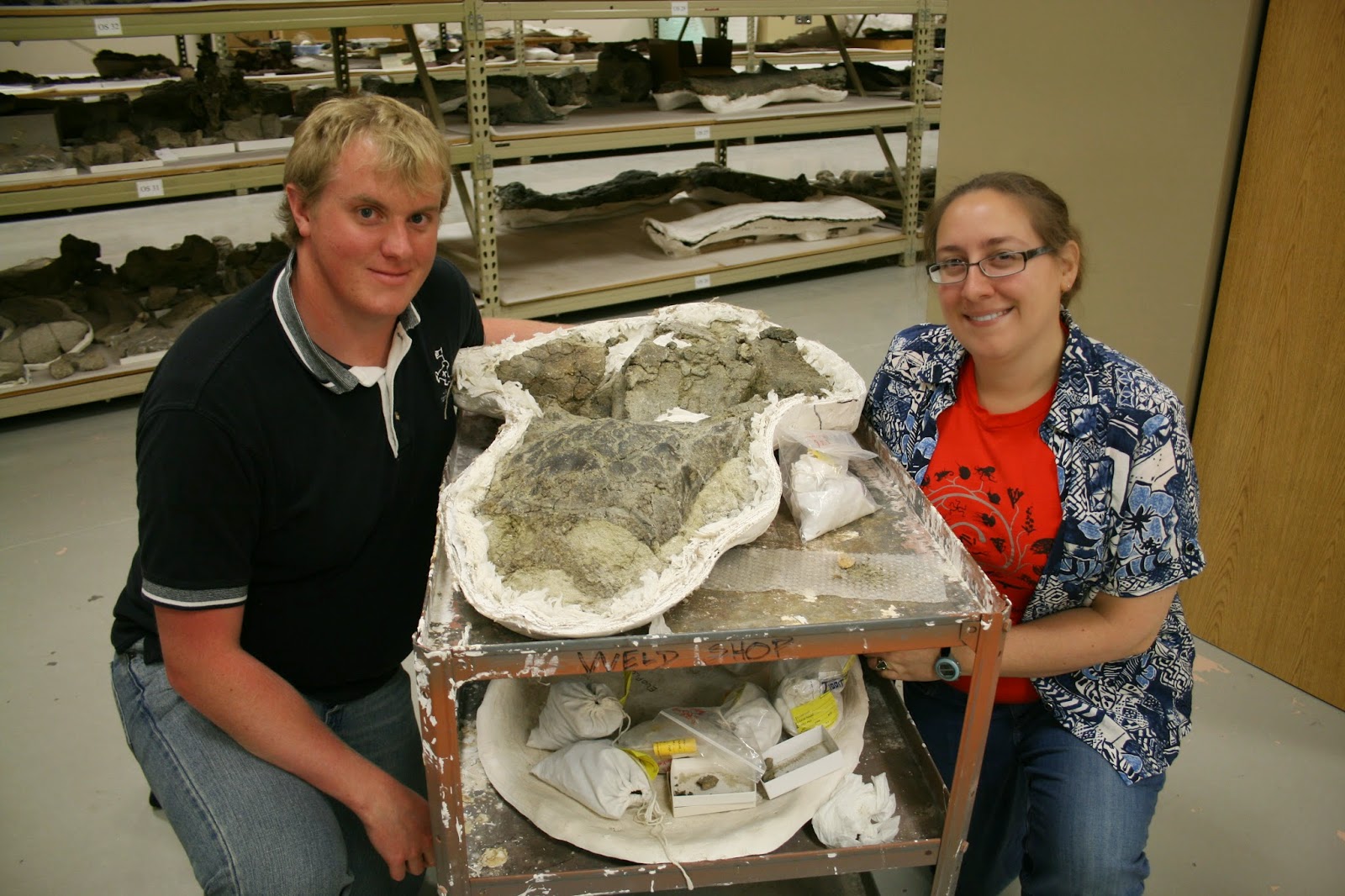
So, that's a brief overview of the taxonomic stuff from the new paper. But before we finish, I want to pause for a moment to acknowledge one of my coauthors who couldn't see the paper in its final published form. Very sadly, our friend Badam passed away suddenly last December, which came as a shock to those of us who've benefited from her kindness and generosity while we've visited Mongolia. I wish I had had more time to spend with Badam, but I'm extremely grateful for the times I got to spend with her in Mongolia and when she visited Edmonton a few years ago. She is a presence that will be missed.


Miriam, Badam and I at Nemegt in 2007. A happy time. We miss you, Badam.

I'm glad to see this paper finally published - it was another one of those multi-year projects to visit lots of museums in order to see all of the necessary specimens - and it was a nice send-off for my time at the University of Alberta. Last weekend I moved down to Raleigh, North Carolina to begin a postdoc with Lindsay Zanno at the North Carolina Museum of Natural Sciences/North Carolina State University. I had an amazing time in Edmonton and I'm sure that's not the last Alberta will see of me, and I'm hoping to accomplish some fun things here in Raleigh. To new adventures!

If you want to learn more about Zaraapelta and friends, try:

Arbour VM, Currie PJ, Badamgarav D. 2014. The ankylosaurid dinosaurs of the Upper Cretaceous Baruungoyot and Nemegt formations of Mongolia. Zoological Journal of the Linnean Society 172:631-652.

Watch my awkward face on Global TV! (Also with footage from the Discovering Dinosaurs exhibit!)

Friday, September 26, 2014

Know Your Ankylosaurs: New Mexico Edition!

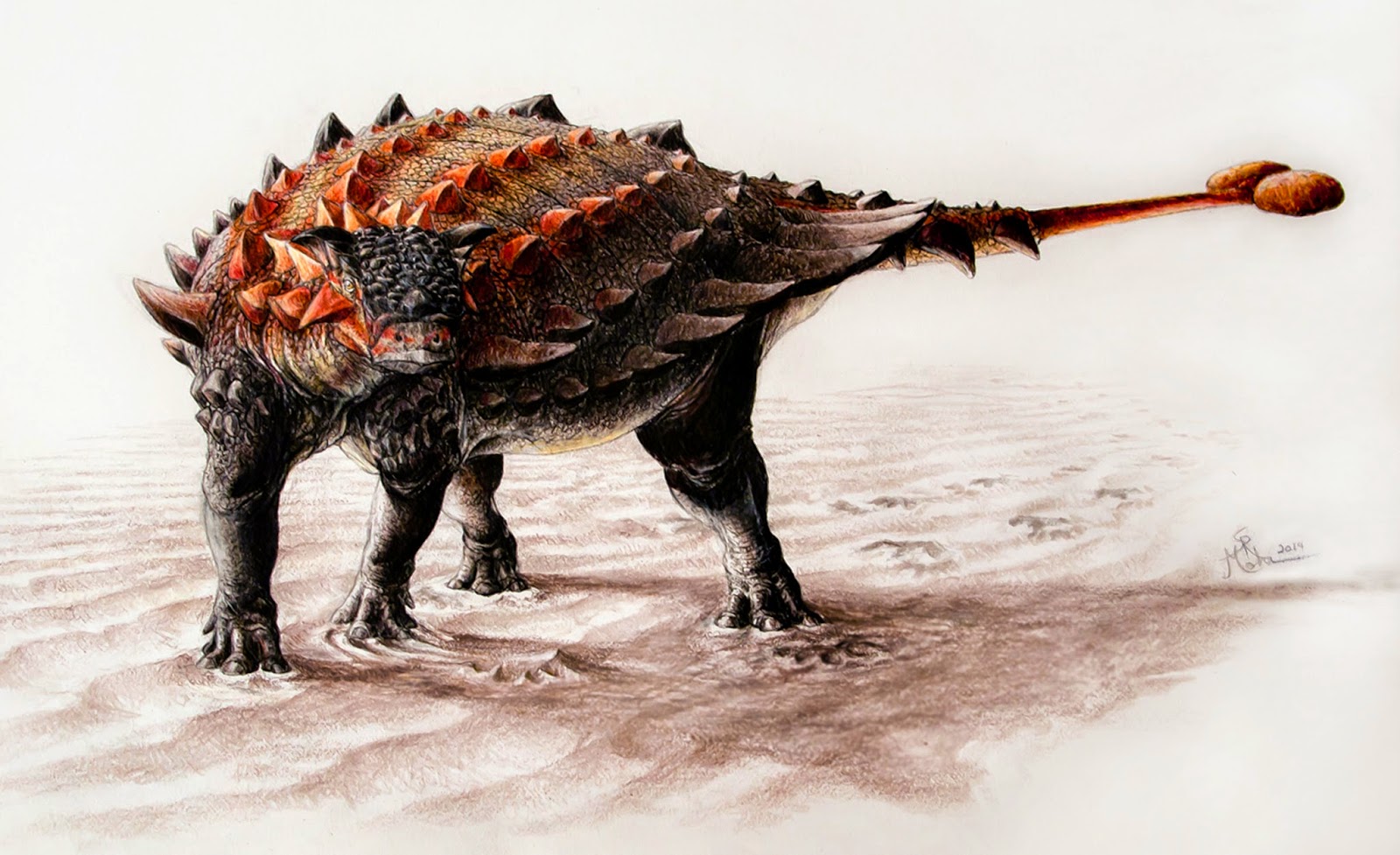
There's a new ankylosaur in town - meet Ziapelta sanjuanensis from the Cretaceous of New Mexico!

Hello, Ziapelta! Many thanks to new Currie Lab MSc student Sydney Mohr for this wonderful life restoration of Ziapelta.

Ziapelta is represented by the holotype skull, first cervical half ring, and assorted other osteoderms, AND a referred first cervical half ring! (What are the odds of finding two really nice cervical half rings in the same field season? Bonkers!) It's a wonderful find from an area that seems to keep producing interesting dinosaur fossils.

Surprisingly, Ziapelta doesn't seem to be particularly closely related to the other ankylosaurid from the Kirtland Formation, Nodocephalosaurus. Instead, it's a close relative of Euoplocephalus and friends from Alberta – it shares the same general shape and pattern of cranial ornamentation, with flat, hexagonal caputegulae rather than the round, conical caputegulae of Nodocephalosaurus. Ziapelta is distinct from all of the Albertan ankylosaurids though: it's squamosal horns are thick and curve slightly downwards laterally, and its median nasal caputegulum is huge and triangular, rather than hexagonal. Somewhat bizarrely, Ziapelta has slightly bulbous or 'inflated' looking cranial caputegulae, not to the same extent as some of the Mongolian ankylosaurids like Saichania, but definitely moreso than Euoplocephalus or Anodontosaurus.


Cervical half rings once again prove to be taxonomically useful. Ziapelta has taller, more rectangular keeled osteoderms compared to Euoplocephalus, Anodontosaurus, and Scolosaurus, but does share the interstitial osteoderms present in Anodontosaurus.

Although we don't have the rest of the postcrania, we can assume that Ziapelta would have had a tail club since it is deeply nested within the clade of clubbed ankylosaurids. Did it have huge, triangular osteoderms like Anodontosaurus, a round tail club like Euoplocephalus, or a narrow tail club like Dyoplosaurus?

Ziapelta isn't the first ankylosaur described from New Mexico - in fact, it's just the latest in a string of interesting armoured dinosaur discoveries from there. At present, Glyptodontopelta is the only nodosaurid from the state, from the Maastrichtian Ojo Alamo Formation. It's known only from osteoderms, and mostly those from the pelvic region, but they're pretty distinctive and have a unique dendritic surface texture.

Glyptodontopelta bits at the Smithsonian.

Nodocephalosaurus is known from a partial skull from the De-na-zin Member of the Kirtland Formation. Its nodular cranial ornamentation is totally unique among North American ankylosaurids and more closely resembles the Late Cretaceous Mongolian ankylosaurids - an intriguing biogeographical conundrum that remains unresolved.

Nodocephalosaurus holotype skull at the State Museum of Pennsylvania. Check out those conical caputegulae!


Lesser known but deserving of more attention, my fellow labmate Mike Burns and colleague Bob Sullivan recently named another ankylosaurid from the stratigraphically lower Hunter Wash member of the Kirtland Formation. Ahshislepelta has a weird scapula with a strongly folded-over acromion process, as well as various other bits and bobs of the postcrania. Although there is little overlapping material between Ahshislepelta and Ziapelta, Ahshislepelta's osteoderms have a smoother surface texture, and the stratigraphic separate suggests we're probably looking at two different species.

Ahshislepelta holotype scapula at the State Museum of Pennsylvania.


Ziapelta is also neat because it (and Nodocephalosaurus) occur in a slice of time where we don't have very good ankylosaurid material in Alberta. In Alberta, we're in the lower part of the Horseshoe Canyon Formation – probably Anodontosaurus was found here around that time, but we don't have too many good specimens. Was it possible that Ziapelta roamed through the lower HCF? Or, are Ziapelta and Nodocephalosaurus characteristic of a southern Laramidian dinosaur fauna, like we seem to be seeing with some of the slightly older formations in Alberta (Dinosaur Park Formation) and Utah (Kaiparowits Formation)? Only more specimens will help us answer those questions.

I'm very grateful to Bob Sullivan, who found these specimens, for inviting me to help out with this paper, and to Spencer Lucas at the New Mexico Museum of Natural History and Science for his hospitality during my visit in 2012 to study the specimen. I hope one day I can have a chance to do some fieldwork in New Mexico, although I fear my thick Canadian blood would not serve me well and I would pretty much immediately die from the heat. Mike Burns and I had a great visit to Albuquerque in June 2012 to study the specimen, but boy howdy was it hot there. Ziapelta is housed at the New Mexico Museum and will be on display there, so if you're in the neighbourhood go say hi for me!

You can read all about Ziapelta in our open access paper in PLOS ONE!


Ninja-edit! I would be severely remiss in not linking to some of the thoughtful news coverage we were very lucky to receive for this paper!
* Brian Switek covers our research at Laelaps: "Ziapelta - New Mexico's newest dinosaur."
* Hear my weirdo voice on the CBC's Edmonton AM!
* And via the University of Alberta, "New dinosaur from New Mexico has relatives in Alberta."

More papers!

Burns ME, Sullivan RM. 2011. A new ankylosaurid from the Upper Cretaceous Kirtland Formation, San Juan Basin, with comments on the diversity of ankylosaurids in New Mexico. New Mexico Museum of Natural History and Science Bulletin 53:169-178.

Ford TL. 2000. A review of ankylosaur osteoderms from New Mexico and a preliminary review of ankylosaur armor. New Mexico Museum of Natural History and Science Bulletin 17:157-176.

Sullivan RM. 1999. Nodocephalosaurus kirtlandensis, gen. et sp. nov., a new ankylosaurid dinosaur (Ornithischia: Ankylosauria) from the Upper Cretaceous Kirtland Formation (Upper Campanian), San Juan Basin, New Mexico. Journal of Vertebrate Paleontology 19:126-139.

Wednesday, April 9, 2014

Nitpicking Euoplocephalus

A friend of mine posted this amazing video on Facebook, and I must share it!


I really like how the Geek Group have obviously put a lot of time into researching the anatomy of the dinosaurs they're featuring, and the stylized animations are super cool. I'm obviously biased towards this episode, but I'm looking forward to seeing more!

For those who are interested in learning more about the anatomy of Euoplocephalus, may I offer these blog posts?:

Baron von Nopcsa, Scolosaurus, and the spiky-clubbed ankylosaur.

You can pick your friends, and you can pick your nose...and you can definitely pick your ankylosaur's nose.

Who-oplocephalus
Who-oplocephalus: Is Euoplocephalus 'real'?
Who-oplocephalus: Heads for tails.
Who-oplocephalus: The Fellowship of the Half Ring
Who-oplocephalus: Everything old is new again.

Scaling up


And for the keeners, you can also check out a lecture I did for the Royal Tyrrell Museum's lecture series via their YouTube page!


Bonus: The Dinosaur Toy Blog also enjoys nitpicking the accuracy of dinosaur toys!

Monday, May 20, 2013

Who-oplocephalus: Everything old is new again.


Over the last few posts, I've talked about why Euoplocephalus tutus is a valid genus and species, how the Horseshoe Canyon Formation ankylosaurid is really Anodontosaurus lambei, and how the headless and clubless holotype of Scolosaurus cutleri is most likely the same species as the ankylosaurid from the Two Medicine Formation. Here's a diagram summarizing some of the key points from the paper.


One ankylosaur I didn't talk about in the previous posts was Dyoplosaurus acutosquameus, an ankylosaurid long synonymized with Euoplocephalus tutus but resurrected by me and my colleagues Michael Burns andRobin Sissons back in 2009. 

ROM 784, holotype of Dyoplosaurus acutosquameus, from Arbour et al. (2009).

The holotype of Dyoplosaurus, ROM 784, is another really nice specimen, consisting mostly of the back half of the animal (although a fragmentary skull is also preserved). Dyoplosaurus differs from Euoplocephalus in the shape of the hooves on the hind foot (which are more triangular than in other ankylosaurs), and in some aspects of the pelvis. The tail club knob is very narrow compared to almost all other tail clubs from the Dinosaur Park Formation, although it's not entirely clear how much of this is related to ontogeny versus taxonomy. Do tail clubs start off narrow and become increasingly wider as the animal grows? Or do they maintain approximately the same proportions and just increase in size? The sole tail club knob for Scolosaurus is about the same width as in ROM 784, but the knob is round and about as long as wide. If knob proportions changed as they got bigger, we'd expect knobs of the same width to have about the same length:width ratio, but that isn't the case between TMP 2001.42.9 and ROM 784. We'll need more specimens in order to really test this hypothesis, but for now I'm tentatively considering the narrow tail club knob of Dyoplosaurus to be a characteristic of that genus. And because of that, there is one other isolated tail club that may be referable to Dyoplosaurus – UALVP 47273, a specimen I CT scanned and used in my biomechanics of tail clubbing project.

Digital model of UALVP 47273 from CT scans, made using Mimics. 

Going from one to four species is a big increase in diversity. Is this a reasonable conclusion based on the patterns of diversity in other dinosaurs? I think so. Euoplocephalus was already kind of weird for dinosaurs from Alberta because it occurred in the Oldman Formation, throughout the Dinosaur Park Formation, and throughout the Horseshoe Canyon Formation. Few dinosaur species are found in all three formations, and even within the Dinosaur Park Formation there are three faunal zones with distinct sets of species. Based on my research, there is now good evidence to suggest that Euoplocephalus tutus was primarily found in Megaherbivore Assemblage Zone 1 (sensu Mallon et al. 2012), which represents about the lower 30 m of the formation. Anodontosaurus lambei is almost exclusively found in the Horseshoe Canyon, with only one specimen, TMP 1997.132.1, found in the upper part of the Dinosaur Park Formation. Scolosaurus is mostly present in the Two Medicine Formation, and the holotype is either from the lowest Dinosaur Park Formation, or perhaps from the Oldman Formation. Finally, Dyoplosaurus is from the lowest Dinosaur Park Formation as well.


Campanian-Maastrichtian ankylosaurids from Alberta and Montana, from Arbour and Currie (2013).

So, where do I go from here? Well, for my PhD dissertation I'm trying to better understand the evolution of ankylosaurid dinosaurs, and so knowing who all of the players are is really essential for constructing a revised phylogenetic tree. Understanding variation in cranial ornamentation in Euoplocephalus will also help me understand which other ankylosaur species are valid or need to be synonymized, or maybe even identify some new species. I also now know that tail club shapes are at least somewhat taxonomically informative, and this leads to questions about function and behaviour. If there really are three ankylosaurid species in the lower Dinosaur Park Formation, what does that mean for niche partitioning among similar large herbivore species? Why does Scolosaurus appear in the geologically older Oldman Formation, disappear, and then reappear in the younger upper Two Medicine Formation? Does this reflect habitat preferences in ankylosaurid species? As usual in science, answering one question leads to many more.

I've also had some people asking if there's anything going on with the Albertan nodosaurid ankylosaurs. My fellow grad student Mike Burns is currently working on the nightmare of taxonomy that is Edmontonia longiceps, Edmontonia rugosidens, Panoplosaurus mirus, and various combinations thereof. I'm looking forward to seeing what he comes up with! And of course, don't forget that the Royal Tyrrell Museum collected an astonishingly good nodosaurid (probably) fossil from Early Cretaceous marine sediments near Fort McMurray, Alberta, in spring 2011. If you're visiting the Tyrrell this summer, you can see parts of it being prepared in the lab.

Tomorrow I am off to Dinosaur Provincial Park for a brief bit of fieldwork, including, hopefully, a search for the Scolosaurus quarry. Wish me luck, and hopefully there will be even more ankylosaur news over the next couple of months.


Papers!


Arbour VM, Snively E. 2009. Finite element analyses of ankylosaurid dinosaur tail club impacts. Anatomical Record 292:1412-1426.


Hill SR. 2012. An unconvential discovery from an unconventional resource: recovery of an Early Cretaceous ankylosaur fossil from an oil sands mining operation, Fort McMurray, Alberta, Canada. Search and Discovery Article #70121, adapted from poster and extended abstract presented at AAPG Annual Convention and Exhibition, Long Beach, California, April 22-25, 2012.

Mallon JC, Evans DC, Ryan MJ, Anderson JS. 2012. Megaherbivorous dinosaur turnover in the Dinosaur Park Formation (upper Campanian) of Alberta, Canada. Palaeogeography, Palaeoclimatology, Palaeoecology 350-352:124-138.