Wednesday, November 23, 2011

Ambling Around Argentina.


Guess where I’ve been? The boots don't lie...


Just three days after the SVP meeting in Las Vegas, I flew to Argentina to see what the other side of the Andes looked like. I joined Dr. Rodolfo Coria’s team at a site in Neuquen province, about two hours away from Plaza Huincal.


The formation we were working in is relatively unexplored, so it will be exciting to see how the research develops over the next few years.


Most of my time was spent helping at a quarry that was worked earlier this year – my friend and former Currie Lab student Dr. Phil Bell posted about his experiences at this quarry over at the Philip J. Currie Museum’s Blogosaur. We had help lifting some of the large jackets out of the quarry, which made a big difference!


I also drank a lot of mate, a tea you drink through a straw out of a little gourd-cup that gets passed around to everybody. It is quite sociable.


And to celebrate at the end of the week, we had two cevitos! (They were delicious.)

I’ve been roaming around Argentina visiting museums for the last few days, and will post more photos upon my return to Edmonton. See you soon!

Saturday, October 22, 2011

A marvelous thing happened today.


A shark flew!

(Today was the University of Alberta's Open House, and I spent a while in the afternoon talking to prospective students about majoring in science. The shark was clearly getting a bit pooped by the time I took this video at take-down, but it is lovely nonetheless. I fear I may need to purchase one, because this is certainly the sort of practical thing every grad student needs...)


It seems I've been doing a lot of outreach-type activities the last few weeks - today's open house, a "Discover Science" day to celebrate the opening of the new Centennial Centre for Interdisciplinary Studies, and a talk for the local Girl Geek chapter's monthly dinner. I like doing these sorts of things for a variety of reasons. I feel it's important to show people that scientists are just regular folks, that science can be very accessible, and to make science a bit more transparent to the public. I like encouraging people to get involved in science. I also feel that since I have benefitted from government scholarships, and thus I have been paid by taxpayer money, that it is important for me to be 'giving something back', as it were. Finally, I also find science outreach fun, and so I do it for me, too.

Here's a couple of shots from the Discover Science day, featuring a palaeo-themed Biological Sciences booth manned by myself and Currie Lab postdoc Angelica!

Angelica shows off a mammoth tooth. Pro tip: these are really popular with non-palaeontologists because they look so unlike teeth.

 Yours truly with a selection of friends. Many of these casts are also used in our PALEO419 labs, although we also had a few sturdy real fossils to show off.

Monday, October 17, 2011

Junk in the Trunk Redux

Today I've got another interview from Scott Persons! Scott's going to tell us all about his new paper on the tail of Carnotaurus, which follows his paper on the tail of Tyrannosaurus published last year. Enjoy!


[Persons WS, Currie PJ. 2011. Dinosaur speed demon: the caudal musculature of Carnotaurus sastrei and implications for the evolution of South American abelisaurids. PLoS ONE 6(10): e25763.]


-------

 
1. What inspired you to conduct this study?


This was a case where no inspiration was required, just thoroughness . . . and a pinch of luck. My work on Carnotaurus was part of my Master’s thesis, which looked at the tail morphology of a wide range of carnivorous dinosaurs. Carnotaurus, a member of the unusual abelisaurid group, was on my list of potential dinosaurs to examine. The first Carnotaurus material that I saw was a cast at the Natural History Museum of Los Angeles County. Examining the L.A. Carnotaurus cast fit in nicely with my schedule, but I was in California primarily to measure the tail of a Dilophosaurus skeleton at Berkley.

Fortunately, it only takes one look at a Carnotaurus tail vertebra to realize that something dramatically weird is going on with the animal’s tail.  On a “normal” theropod tail vertebra (or, for that matter, a “normal” anything-else tail vertebra), boney projections, called the caudal ribs, stick out horizontally and have a simple rod-like shape. In Carnotaurus, the caudal ribs of the basal tail vertebrae project more vertically than horizontally, and their shape is complex – with tips that are thin and shaped like half-crescents. After examining the specimen in California, I realized how interesting a Carnotaurus tail study would be, and it became a major focus of my research (which meant Dilophosaurus and several other theropods had to take a backseat).


The 6th tail vertebra of Carnotaurus, as seen from the side (upper left), the front (upper right), and from above (lower center).


2. Why “speed demon”?


The title of the Carnotaurus tail paper (published in the online scientific journal PLoS ONE) is "Dinosaur Speed Demon". It is an unusual title. Supernatural fiends (fast or otherwise) and peer-reviewed natural history literature don't usually mix. But the explanation is straightforward:
Carnotaurus is famous for its ugly mug and two large conical horns that stick out from its forehead in an indisputably devilish style (hence “Demon”).  As for “Speed”, the conclusion that I and Dr. Phil Currie came to was that the vertically oriented caudal ribs and their bizarre half-crescent-shaped tips (which interlocked with those adjacent in the vertebral series) provided an expanded and ridged framework for one super-sized tail muscle: the caudofemoralis. The caudofemoralis is a locomotive muscle that attaches to the femur and lends considerable force to the power strokes of the legs. Except for some birds, all dinosaurs had caudofemoral muscles (that’s a major reason why dinosaurs have big tails), but I estimate that, relative to its body-size, Carnotaurus had the biggest.


A new Carnotaurus illustration created for the paper by artists Lida Xing and Yi Liu.

Big locomotive muscles mean more locomotive power, which means Carnotaurus was adapted for speed.  Some puns are too good to pass up.


3. So...could Carnotaurus outrun the Jeep in Jurassic Park?

Estimating the maximum running speed of a dinosaur or any other extinct animal is hard. (So hard that in the published paper, I stick to offering a qualitative rather than a quantitative assessment of Carnotaurus running performance.) There are lots of important variables besides absolute muscle mass that determine how fast an animal can run.

As I said in my previous blog post, just keeping pace with the JP Jeep would require a speed of 30-40 mph (48-64 kph) (remember, the black-leather-clad rump of a certain chaotician was preventing the driver from switching into high gear).  So, achieving Jeep-catching speed would mean a charging Carnotaurus was roughly 30% faster than a charging black rhinoceros – a scary thought, but not an implausible one. If I had to guess, I would say: Yes, Carnotaurus was fast enough to outrun the Jeep. Just the same, I don’t think Carnotaurus would have caught it. Here’s why:


The tree branch doesn’t move, and the T. rex doesn’t appear to see it.

Jurassic Park fans will recall that in the chase scene, just as the T. rex is getting close enough for Jeff Goldbloom to feel its hot breath, the Jeep drives under a low tree branch. Being the colossus that it is, the Tyrannosaurus just smashes through the branch and stays on course. At roughly one third T. rex’s size, Carnotaurus probably couldn’t do that. Instead, the abelisaurid would have had to avoid the collision. While my study indicates that Carnotaurus was evolutionarily engineered for speed, it also indicates that this speed came at the cost of turning performance.

The rigid framework provided by the interlocking caudal ribs would have limited sinuous motions, which would have disadvantageously increased the animal’s effective rotational inertia. When turning, Carnotaurus would have been forced to awkwardly swing its hips and the front half of its tail all at once, like a single stiff board. The set of a tropical Hawaiian forest just isn’t the ideal hunting ground for Carnotaurus, and I think having to swerve around the foliage would have slowed Carnotaurus down considerably.


4. Does this tell us anything about the evolution of abelisaurids?

Yes, but exactly what it tells us is a matter of debate.

Abelisaurids are known from Africa, India, Madagascar, and South America. Carnotaurus is from South America. If you look at the tails of older South American abelisaurids, you will see what I think is a clear evolutionary sequence of adaptations in the vertebrae that leads to the advanced form of Carnotaurus. I would argue this shows that, over time, South American abelisaurids were getting faster. I would also argue this strongly suggests that Carnotaurus is more closely related to other abelisaurids from South America than it is to abelisaurids from Africa, India, or Madagascar (all of which lack special tail-vertebrae adaptations). The argument is important, and a matter of contention, because it has been previously asserted (by paleontologists much more experienced than myself) that Carnotaurus is most closely related to abelisaurids from outside South America.


The evolution of South American abelisaurid tail vertebrae through time (each vertebra is depicted in frontal and top-down views, numbers are millions of years from now).


5. Carnotaurus may not be as famous as Tyrannosaurus, but it has popped up occasionally in film and TV. What are your favorite portrayals of Carnotaurus?

Yeah, Carnotaurus has had its chance in the spotlight, probably because its striking facial profile makes it a natural fill for villainous roles. Picking my favorite portrayals is hard . . . because most have been so terrible.

In Michael Crichton’s second Jurassic Park novel, a Carnotaurus pack poses a threat to the inexplicably resurrected character of Ian Malcolm. The book gives Carnotaurus cuttlefish-like powers of camouflage, but the dinosaurs ultimately prove no match for the tactic of annoyingly waving flashlights (really, that’s what Crichton wrote).

A pair of marauding Carnotaurus played the bad guys in Disney’s Dinosaur. But these red menaces had to suffer an anatomical redesign and wound up looking more like tyrannosaurs with horns.


By giving some of the Iguanodon a nose horn, the Mickey Mouse organization set paleontology back to the days of Gideon Mantell. The big red Carnotaurus, or “Carnotaur”, wasn’t much better.

A Carnotaurus had the starring dinosaur role in the 2008 animated movie Turok: Son of Stone. This was a film that managed to be offensive at an artistic, intellectual, and social level (kind of like Transformers 2 [Victoria's note: don't get me started on Transformers 2...]), but the Carnotaurus does get some good (though ridiculously over-the-top) action scenes.


Turok and his trusty steed prepare to go all Stone Age on a gang of Neanderthal sumo wrestlers.
Most recently, Fox TV’s Terra Nova series showed us a new CGI Carnotaurus. Terra Nova’s Carnotaurus has its flaws (though, perhaps no more so than any of its other cast members), but I enjoyed seeing it in action.


Outside the Terra Nova compound, a Carnotaurus squares off against what I thought was a beige version of the new Batmobile.

I would have to say my favorite media portrayal of Carnotaurus is in the absurd Japanese cartoon series Dinosaur King. In the show, a Carnotaurus named Ace is the loyal companion of a young boy and helps him fight evil.


Ace and Rex take the bus (the pet dinosaur is named “Ace” and the boy is named “Rex”).
The Dinosaur King’s CGI cartoon Carnotaurus actually suffers from fewer anatomical inaccuracies than ether Disney’s or Terra Nova’s, and it’s nice to see a theropod get to play the hero for a change. From what I’ve seen, Dinosaur King is a something of a Pokemon rip-off, and all the dinosaurs get special super powers -- some of the dinos breathe fire, others cause earthquakes, etc. And what is Ace’s special power? Super speed!


Valiantly defending us from alien invaders, mad scientist, and temporal paradoxes, Ace (seen here in his grownup form) is a two-horned, purple, people protector.


Friday, October 14, 2011

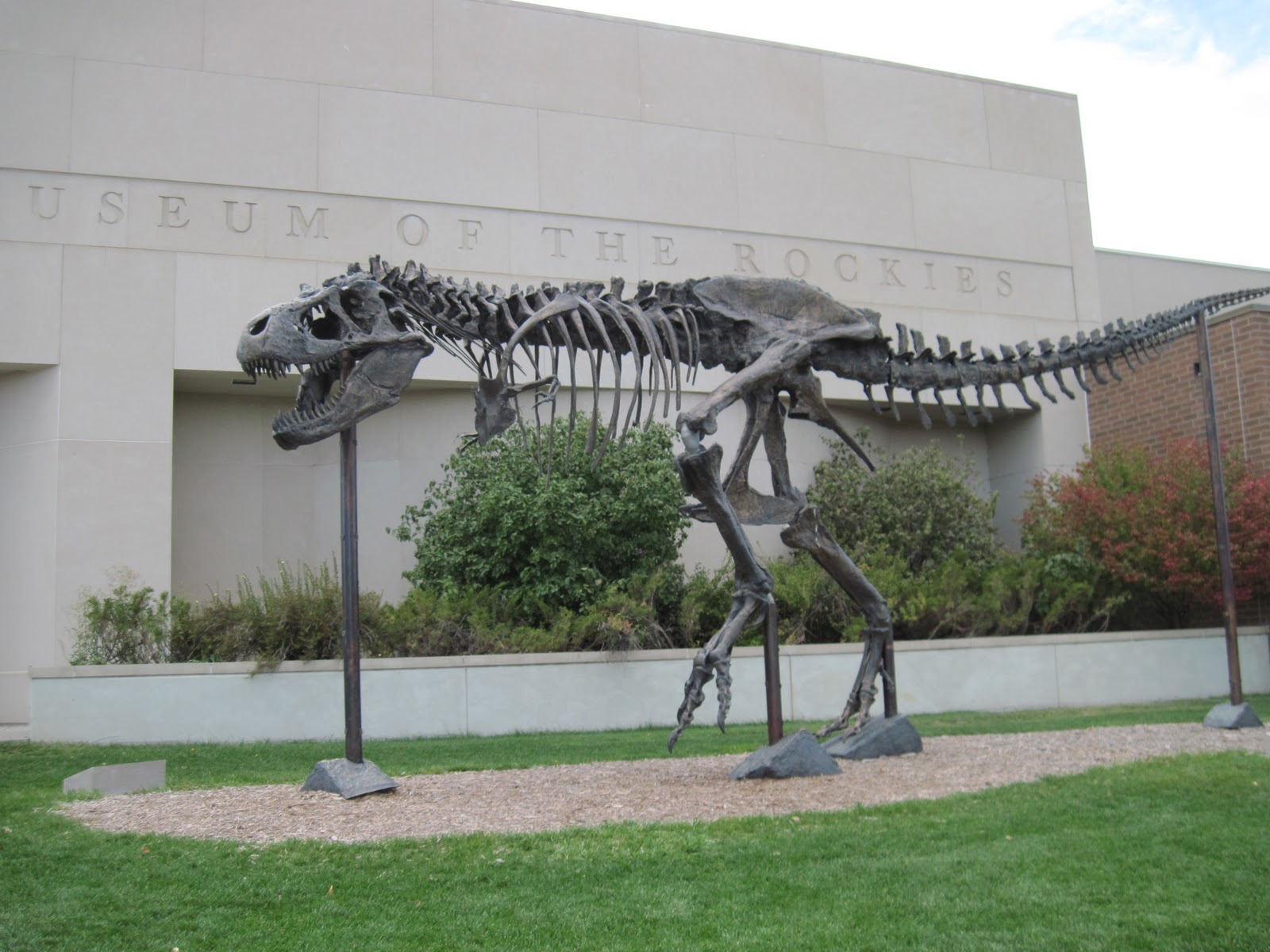
Name That Specimen, Museum of the Rockies Edition!


I spent the better part of last week studying ankylosaur material from Montana at the Museum of the Rockies in Bozeman, Montana. Many thanks to all of the MOR and MSU grad students for their hospitality during my stay!


Also, my hotel had a bear in the breakfast nook!


Anyway, I figured it was high time for another round of Name That Specimen...can you guess what specimens the close up photos belong to? Answers below!


A


B


C


D


E


---------------------------


A - This fabulous forearm belongs to my second favourite basal ornithopod, Thescelosaurus. For those dying to know, my favourite basal ornithopod is Parksosaurus...

B - The distinct epoccipitals on this frill show that this is a subadult Triceratops.

C - A relative of Alberta and Alaska's Pachyrhinosaurus, Achelousaurus has bosses instead of horns over the orbits.

D - This snaggle-toothed grin is from none other than Big Al, the bruised and beat-up Allosaurus.

E - A final ceratopsian for a ceratopsian-filled museum, and a fitting end to this Montana-themed Name That Specimen, Montanaceratops is more primitive than Triceratops or Achelousaurus but is pretty darn cute.

Friday, October 7, 2011

Hearing more about them.


After the talks had ended on the first day of the Hadrosaur Symposium, I had a bit of free time to visit the galleries, which I hadn't seen in about a year and a half. I was expecting the Alberta Unearthed: 25 Years of Discovery exhibit, but was delighted by this unexpected surprise: a short, but excellent, exhibit on women in palaeontology!


Located on the ramp up to the Darwin exhibit after you exit Lords of the Land, the exhibit consists of 19 or 20 profiles of female palaeontologists. Each framed image included a photo, a brief biography, and an image of a representative specimen or field locality (example above featuring Dr. Betsy Nicholls). I was particularly pleased to see that the Tyrrell had attempted to include women of many different races, nationalities, ages, and career stages, studying a variety of taxa and using many different techniques.

I was particularly intrigued the quote from Naomi Oreskes below the exhibit title, "The question is not why there haven't been more women in science, the question is rather why we have not heard more about them." Dr. Oreskes is a historian of science at University of California at San Diego, and her paper "Objectivity or Heroism? The Invisibility of Women in Science" is well worth a read (and really, go read it - palaeontology is all about heroism). It's a sentiment that I share and that I've discussed before: although there may not be an equal ratio of women:men in palaeontology yet, we're definitely getting closer, so why don't we seem to be as visible as the men? It is certainly up to us to speak up for ourselves, but it's really, really nice to see a major institution like the Tyrrell stepping up and hosting an exhibit like this.

I hope that at least some people will take the time to stop and read some of the biographies on their way to the fossils - if I had one complaint, it is that because the exhibit consists only of pictures in a hallway leading to the main exhibits, that it may be easily passed over. If specimens had been incorporated somehow, as they were with the Great Minds, Fresh Finds exhibit (showcasing the work of the museum's scientists), that might have been able to grab more attention. Sadly, most people walking through this hallway while I was present would pause for a moment at the entrance, but then skip on through the rest of the exhibit. I realize that space constraints probably would not permit anything more than what they have done, however, and the exhibit is pleasant to look at and rewarding for those who take some time to read the biographies. In particular, I hope school groups take advantage of it and that teachers incorporate questions about female scientists into their activities.

I'll finish here with a very nice video produced by the Tyrrell, featuring Dr. Don Brinkman discussing the work of Dr. Betsy Nicholls, who was a curator at the museum until her death in 2004 and whose work is featured in the Triassic Giant gallery.

Thursday, September 29, 2011

You can pick your friends, and you can pick your nose...and you can definitely pick your ankylosaur's nose.


Say hello to Euoplocephalus, the best known ankylosaur you've never heard of. Besides Pinacosaurus from Mongolia and China, there are more specimens referred to Euoplocephalus than to any other ankylosaurid, and it is certainly the most well represented ankylosaurid from North America. Yet Euoplocephalus often gets overlooked because its younger cousin is THAT ankylosaur, the one that starred at the World's Fair and was in Jurassic Park III and Clash of the Dinosaurs and Dinosaur Revolution and gets all the cool toys and, you know, is the namesake of the group. You know, Ankylosaurus. Well, hopefully you'll be hearing more from me about Euoplocephalus over the coming months. Today we'll be picking its nose.

Ankylosaurs are kind of weird as dinosaurs goes, because they get rid of things like the antorbital and supraorbital fenestrae, and tuck the laterotemporal fenestrae back behind the squamosals and quadratojugals. In a sense, the windows to the skull are all closed, and so it's hard to see some of the internal features that are more visible on other dinosaur skulls. Our new paper describes UALVP 47977, a busted up Euoplocephalus skull from Dinosaur Provincial Park. Normally, busted skulls don't appear very exciting, as important pieces might be missing, and they don't make very good display specimens. In this case however, UALVP 47977 gives us more information because it is broken! This specimen shows off details of the braincase and nasal passages that we don't typically get to see, including impressions of blood vessels.

I am trying (slowly but surely) to sort out the mess that is the genus Euoplocephalus, and so I was interested in comparing UALVP 47977 with other skulls to see if any of its features were present in other skulls. The only other skull that is naturally broken in a similar way is AMNH 5238, and it looks pretty similar - it even has blood vessel impressions in the same place (this specimen is also super cool because it has ciliary osteoderms, or, bony eyelids!). I was delighted when Dr. Larry Witmer made the CT scans of AMNH 5405 available on his website following the Witmer and Ridgely (2008) publication on paranasal sinuses. I also made arrangments to CT scan UALVP 31, one of our 'classic' University of Alberta specimens.

With CT scans in hand, I went through the process of eliminating matrix from the inside of the nasal passages (in essence, picking their noses), so I could examine the skull roof of these two specimens. This process is called segmentation, which means that you place a 'mask' over the parts of the CT scan that you want to appear in the 3D model, and remove the mask where you don't want something in the model. Although the software we use, Mimics, has lots of tools to help speed up the segmentation process, with fossils sometimes the contrast between bone and stone is not very great. As a result, sometimes you just have to go through the CT scans slice by slice and trace out by hand what you want to keep. This is super tedious work at times and I have the utmost respect for the amazing 3D visualizations that come out of Dr. Witmer's lab. Eventually we invited Dr. Witmer to collaborate on the paper with us, but I think it was good that we were able to independently test their 3D model using different software and fresh eyes, a sentiment echoed over on the WitmerLab blog.


The segmentation process begins! All of that uniformly-dense stuff in the palatal area has to go. The green 'mask' will be eliminated wherever there is matrix instead of bone, leaving only the bone in the 3D model.

I won't go into too much detail on the paper here, but I will say that this was a tough but very interesting project to work on. I've learned a lot about braincases and brains and noses over the course of writing this manuscript, but I'm sure I've still got more to learn. I've definitely had a lot of moments where I felt pretty stupid for not knowing certain things, but I think perhaps part of science is getting outside of your comfort zone. Ankylosaur tails are good, but skulls are pretty fun too, and I hope I can share some more skull papers with you soon! 

Here's a video we put together for the press release accompanying the paper, featuring the ever lovely UALVP 31.


Literature!

Miyashita T, Arbour VM, Witmer LM, Currie PJ. 2011. The internal cranial morphology of an armoured dinosaur Euoplocephalus corroborated by X-ray computed tomographic reconstruction. Journal of Anatomy, first published 29 Sept 2011, doi:10.111/j.1469.-7580.2011.01427.x.


And check out the post over at Pick & Scalpel, which has more information and some great images!


...and finally, because this has certainly helped me sometimes:
Schwartz MA. 2008. The importance of stupidity in scientific research. Journal of Cell science 121:1771.

Sunday, September 25, 2011

Hadrosaurs get their moment in the sun.

Living in Edmonton means I'm in close proximity to the dinosaur capital of Canada, Drumheller, and the wonderful Royal Tyrrell Museum. Last week the U of A crew headed down to the Hadrosaur Symposium, a wonderful event by all accounts with lots of interesting talks and good conversation. I won't report on the science presented as much of the research is as yet unpublished (although look out for the eventual symposium volume), but thought I would share a few photos and links to symposium goodies.

First off, the Tyrrell is making some of the keynote lectures available on their Youtube channel. David Weishampel's is already online; other keynote speakers were Kishigjav Tsogtbaatar, Pascale Godefroit, Rodolfo Coria, and Jack Horner.


You can also check out the official Hadrosaur Symposium Flickr page for some very nice photos of the goings on.

And here's a few photos of my own!


Symposium attendees get a backstage tour of the collections.


Hadrosaur heads in the main gallery.


And some hadrosaur bodies!


There were some original skulls on display in the poster room as well.