Showing posts with label Canadian Museum of Nature. Show all posts

Wednesday, October 28, 2015

How to look at dinosaurs in a museum

I've been traipsing around North America a lot lately for a fresh burst of museum visits, which got me to thinking about the things I need to do in order to do research in museum collections. I thought I'd share some advice about visiting museum collections – consider this a mix of tips for beginners and experienced collections researchers alike. Obviously this advice is geared towards palaeontological research, but I bet it's applicable to many other fields as well, and it would be interesting to hear about differences! Also beware, this post is more text-heavy than usual for me!

Before going to the museum:
  • Before visiting a collection, you'll need to contact a curator or collections manager to request access to the collections. Write a polite (but brief!) email outlining who you are, what you want to see, and the dates you're interested in visiting.
  • Once you've settled on a visit, you should also ask the collections manager or curator what time you should arrive and if there is a special entrance you should arrive at – sometimes you aren't entering through the regular public entrance but a staff entrance, so make sure you know where to go. If you're visiting a collection located on a university campus, ask if they can point you towards a campus map, since it's often a bit more difficult to navigate around unfamiliar campuses. I rarely rent a car when I'm traveling, but if you are arriving via a car, make sure you check out parking rates and locations ahead of time – university parking lots are notoriously expensive for visitors or have restricted access for non-permit holders.
  • It's also good to ask if the collections are closed during lunch, and what time you need to leave by. I usually also ask (or check the museum's website) to see if there is a cafe or restaurant nearby for lunch – a notable example where there is no food on site is the Canadian Museum of Nature collections: bring your own lunch if you're visiting there, as there isn't any food nearby!

On the plus side, the CMN staff cafeteria looks over a very pleasant pond, and also there is an Amargasaurus to keep you company!


What to bring with you:
  • DSLR camera – although I typically use a point-and-shoot or cellphone camera for fun and casual pictures, for specimen photos I use a DSLR camera. I am by no means an accomplished photographer and I really ought to take some classes or watch some tutorials to get the most out of my camera, but having at least a basic beginner's DSLR is important for getting publication-worthy specimens photos. BUT, in the earliest days of my MSc I got away with a point-and-shoot digital camera because I had a:
  • Tripod – you can get away with a less good camera if you have a tripod. I have a nice Manfrotto tripod that extends out to about as tall as I am and has a pivoting head. It set me back about $100 CAD, but a tripod is really crucial for getting good photos. A tripod and decent lighting will get you 90% of the way to a good photo if you're working with large-ish dinosaur fossils; for small fossils, you probably need some different gear.
  • That being said, keep a backup camera on you in case something happens to your 'good' camera! I also have had pretty good success pointing a regular digital camera down the eyepiece of a microscope to take pictures when I didn't really have a proper setup for doing that kind of work. The DSLR didn't work as well in that instance so I was glad I had my little point-and-shoot camera.
  • Calipers – I have a digital caliper that I love to death because I am a lazy butt and don't want to fuss about with reading the actual numbers on the calipers. Turn it on, zero it, line it up, and bam you're done. They are the best. If you work on very small fossils and/or require a super high degree of accuracy, you might want to invest in fancier calipers, but for me these calipers from Canadian Tire get the job done. Pro tip: avoid packing calipers in your carry-on luggage – I have run into trouble with security thinking they could be used as a weapon, and have almost had them confiscated!

My basic kit! If you've got these, you're 90% of the way there.

  • Measuring tape – some of my fossils are too big for my calipers, so I still rely on measuring tape for the large fossils. Also, soft measuring tape is crucial for taking circumference measurements, say if you want to eventually calculate body mass using limb bones. Don't leave home without measuring tape!
  • Notebook and pencil kit – I am a weirdo who likes to write down my measurements before transferring them to Excel or wherever, so I always keep a lined notebook and a bunch of pens, pencils, pencil crayons, erasers, and pencil sharpeners on hand for museum trips. Secret pro tip: only write on one side of your notebook pages – it seems wasteful, but prevents bleed-through of your notes if you scan your pages later or as ink penetrates the paper, and prevents smudging on opposite pages if you're using pencil.
  • Scale bars – I keep like a billion scale bars on me at all times because I lose them everywhere. You should always keep a scale bar in your photographs! I like to buy the official Society of Vertebrate Paleontology scale bars (although the new ones are not as good, SVP exec! Bring back the old blue ones!), but I have frequently gotten good freebies at conferences, and some cool credit-card sized ones from the Journal of Vertebrate Paleontology and the Canadian Museum of Nature that can stay in my wallet! You can get away with just your measuring tape and/or calipers, but scale bars look nicer.
  • Things I don't do yet: Portable lights! Most museums have a variety of desk lamps or photography setups for visiting researchers, but not everywhere. While you can still get pretty ok photographs sometimes without extra lighting, sometimes you might want some low-angle lighting to highlight skin impressions or other subtle features, or you might want light to penetrate more deeply into an object, like the palatal region of a skull. I have sometimes included a small flashlight in my kit, for spotlighting areas on fossils and for peering into dark racks and cabinets. I have been considering purchasing a small desk lamp that could travel in my checked luggage – readers, do you travel with your own lighting?
  • While I don't often use a background cloth, some of my friends travel with either a white or black sheet to lay under fossils. Somewhat counterintuitively, black works well if you have dark fossils, because of the way it makes your camera interpret the light. I don't mind deleting out backgrounds manually from my photos, but a uniform white or black background probably cuts down the processing time for some people.

At the museum:
  • Be gentle with fossils! Make sure you're handling fossils carefully, by lifting them at the most sturdy parts and supporting as much as them as possible. Use carts wherever possible, and keep them on foam – if there isn't foam already on the cart or table, scavenge around the collections until you find some. When photographing specimens in different views, try to keep delicate parts supported on foam or sandbags; if for some reason those things are not readily available, I have occasionally used erasers (white and gum) to provide soft-ish supports for fossils during photography.
  • Be nice to collections managers and curators: put fossils back exactly where you found them, and keep specimen cards with the specimens. If something breaks, tell them!
  • Take more photos than you think you need – make sure you get orthogonal views (top, bottom, sides, etc.), but try varying the angle of your light sources, your zoom, your angle, etc. It's also helpful to have a variety of close-ups for interesting features (braincases, noses, palates), and to have unorthodox views that might jog your memory or reveal proportions or angles that are lost in orthogonal-only views. Sometimes I literally just walk around the specimen snapping photos, such that I could probably make some photogrammetry models from things I photographed 10 years ago before photogrammetry was a thing. I take hundreds of photos each day during a collections visit.
  • When you're photographing a specimen, include a least a few photos where you include the original specimen tag – this helps keep the info with the specimen for years later when you may be revisiting old photos.
  • Lunchtime is a good time to visit the exhibits and snoop on how people are interacting with the museum's interpretive materials, which is one of my favourite creepy pastimes.

Here's me and my inexplicably hidden face (I obviously haven't totally figured out this new 'do yet) working in the Ft Worth collections last week! Working in museum collections is awesome and one of my favourite parts of being a palaeontologist.


After your visit:
  • Download your photos each night and sort them by specimen number. I have a huge folder of all of my specimen photos sorted by museum, visit (when I've been to a collection more than once), date, and specimen number. I'm a weirdo and tend to remember things in time-relative terms, so sorting by date helps me remember specimens and correlate back to my notebook; you might prefer to sort by taxon and then museum, or museum and then taxon, or any way that works for you.
  • Scan/photograph/photocopy your notebook as a backup.
  • Send a thank you email to the people who helped you during your visit! It's just good manners and also it is nice to be nice to other people.

Ok, that's my slightly too long stream-of-consciousness discussion of museum visit tips and tricks! What things do you bring with you or do in order to have a successful research visit in museum collections? What would you recommend to beginners in the field? And don't forget to fill out the research survey about science blogs!

Saturday, April 5, 2014

Name that Specimen, Canadian Museum of Nature edition

I haven't done one of these for a while! See if you can guess what specimen is which!

1.

2.

3.

4.

5.


 1. It's spiky side up for this Styracosaurus!
2. Here's the shovel-beaked maw of a hadrosaur.
3. Don't get too close to the business end of an ankylosaurid – the tail club can pack a wallop!
4. Did you guess Edmontosaurus? Here's the pelvic girdle of this iconic hadrosaur.
5. The reconstructed skin of Vagaceratops is very colourful!

Monday, May 13, 2013

Who-oplocephalus: Heads for Tails.


With the identification of UALVP 31 as a specimen that could be confidently referred to Euoplocephalus based on the shape of the cervical half ring, I now had a pretty complete skull, and some postcranial material, to help expand our knowledge of Euoplocephalus. 


The Euoplocephalus skull UALVP 31. From Arbour and Currie (2013).
  
The top of the skull of UALVP 31, and the holotype CMN 0210, is covered in small flat polygons. In some ankylosaurs, like Saichania and Minotaurasaurus, these polygons bulge upwards from the skull. One of the things I wanted to know was whether or not the shapes and patterns of these polygons could be taxonomically useful. Many previous authors have said the distribution of polygons in at least some regions of the skull is random, but was it really? One problem is that there hasn't been a consistent nomenclature for these polygons, and it's also unclear what their developmental origin is. Are the polygons fused osteoderms, like in the skulls of gila monsters, or are they formed from sculpturing of the skull bones, like in crocodiles?


Ooh, labels. The 'ca' in the abbreviations usually refers to caputegulum. From Arbour and Currie (2013).

To get around the osteoderm-vs-sculpturing problem, I decided to use a term that was coined back in 2001 by William Blows, but which had not caught on in the literature: caputegulum. Caputegulum means 'skull tile', and neatly removes any developmental origin from the descriptive aspect of comparing the polygon patterns among skulls. I compared Euoplocephalus skulls to juvenile ankylosaurs which had visible cranial bone sutures, so I could figure out which bones the caputegulae probably belonged to. Some caputegulae had been given names before – like the supranarial caputegulae or the median nasal caputegulum – but others are new for this study, like the lacrimal and loreal caputegulae. By naming the caputegulae, it is easier to compare them.

This is where having a large (and by that I mean 'large') sample size for this study was essential. If wanted to understand how the caputegulae patterns and shapes varied in Euoplocephalus, I needed to see as many specimens as possible. I tried to look at pretty much every published skull referred to Euoplocephalus, and all of the more recently collected or unpublished skulls that I could find out about. Do you have a skull in your collection that I missed? Let me know, I would love to see it!

Because specimens have been collected from Alberta for a long time, Albertan dinosaurs have wound up in many museums around the world. In order to collect my dataset, I had to see specimens in the collections of the Royal Tyrrell Museum, the Royal Ontario Museum, the Canadian Museum of Nature, the American Museum of Natural History, the Smithsonian, the Natural History Museum in London, and the Museum of the Rockies. It was great fun to visit all of these interesting museums, but it can take a long time to finish a project like this – planning so many trips takes time, arranging for funding for said trips takes time, and museum trips need to be worked around teaching and fieldwork schedules. A tip for any of my aspiring palaeo friends: I am very lucky to be part of a large lab, and one way I was able to cut down costs significantly while traveling was to have people to share my hotel room with. Oftentimes, I would travel with several other Currie Lab members – we would figure out who needed to go to what museums, and coordinate our trips so we went at the same time. It makes a huge difference when you need to go to, say, New York...


Rainbow ankylosaur skulls FTW! From Arbour and Currie (2013).

When you compare the Euoplocephalus skulls, there's definitely a lot of variation in the shapes, numbers, and positions of the caputegulae. But there is also a lot of stuff that is pretty similar, or varies only slightly. For example, all of the skulls have a large hexagonal median nasal caputegulum, all of them have a single loreal and all of them have a single lacrimal caputegulum. What are some of the sources of variation? I'm not entirely sure. The number of discrete caputegulae varies a lot, as does how far back on the skull they go before they fade out in the parietal region. Maybe this is just regular variation, or maybe it has to do with ontogenetic changes.

TMP 1997.132.1, and CMN 8530. See the extra caputegulae behind the eye? From Arbour and Currie (2013).

As I looked at the skulls, I noticed that some of them had extra caputegulae at the base of the squamosal and quadratojugal horns, and some of them didn't. I thought this was pretty interesting, because the specimens with these extra caputegulae (which I called postocular caputegulae) always had extra, smaller osteoderms (interstitial osteoderms) on the cervical half rings, ringing the main osteoderms.

What turned out to be very interesting indeed was the fact that whether or not a specimen had these extra osteoderms seemed to be related to its stratigraphic position! Specimens from the Horseshoe Canyon Formation always had postocular caputegulae and interstitial osteoderms, and almost all specimens from the Dinosaur Park Formation did not. One significant exception is TMP 1997.132.1, which is from relatively high in the Dinosaur Park Formation compared to most of the other specimens.

The stratigraphic separation of cranial ornamentation features wasn't the only difference I noticed. Tail club knobs from the Horseshoe Canyon Formation were typically wider than long, and had a pointy look to them in dorsal view, whereas the ones from the Dinosaur Park Formation were usually about as wide as long, and round in dorsal view.

All together, these features seemed to indicate that "Euoplocephalus" specimens from the Horseshoe Canyon Formation were not the same species as those from the Dinosaur Park Formation. CMN 0210, the holotype of Euoplocephalus, is from the Dinosaur Park Formation. But CMN 8530, the holotype of Anodontosaurus, is from the Horseshoe Canyon Formation. And lo, the taxon that I originally thought I was least likely to resurrect became one of the best supported species in my paper. Anodontosaurus has postocular caputegulae, interstitial osteoderms on the cervical half ring, and a wide, pointy tail club.

Anodontosaurus was also probably orange. So there.

It's a shame about the name - Anodontosaurus means 'toothless lizard', which isn't really accurate at all. Ankylosaurs have very small teeth, but they are definitely present. The holotype of Anodontosaurus, CMN 8530, does not preserve teeth, but that doesn't mean they weren't there - teeth often fall out after an animal dies. Oh well! Anodontosaurus it is.

Next time: a headless and clubless wonder - how will the mystery of NHMUK R5161 be solved?


PAPERS!


Blows WT. 2001. Dermal armor of the polacanthine dinosaurs. In: Carpenter K (ed). The armored dinosaurs. Bloomington: Indiana University Press, pp. 363-385.


Sternberg CM. 1929. A toothless armoured dinosaur from the Upper Cretaceous of Alberta. Canada Department of Mines Geological Survey Bulleting (Geological Series) 54:28-33.


Thursday, May 9, 2013

Who-oplocephalus: Is Euoplocephalus 'real'?


The holotype of Euoplocephalus isn't very complete, as holotypes go. So, one of the first things I had to figure out for this project was whether or not the holotype of Euoplocephalus had any diagnostic features. Euoplocephalus was certainly unique when it was named – no other dinosaurs had the pattern of flat, polygonal plates on the skull like CMN 0210 has, and Lambe wasn't even entirely sure what the cervical half ring was (he suggested it might have been the back of a frill or crest).

Here it is again: CMN 0210, holotype of Euoplocephalus tutus.

A lot of times, features that are unique or diagnostic to a species when it is named are later found to be present in other closely related dinosaur species. There's a great term for this – character obsolescence (Wilson and Upchurch 2003). Anodontosaurus, named by Sternberg in 1929, had similar flat polygonal plates on the skull. And although Ankylosaurus was named in 1908, a skull was not known for some time – but it too has flat polygonal plates on the skull. So, this pattern isn't necessarily a diagnostic or unique feature for Euoplocephalus.

Paul Penkalski looked at variation of skulls referred to Euoplocephalus in 2001, and noted that there were a couple of different morphologies represented by cervical half rings. Is the cervical half ring of CMN 0210 unique? Luckily for me, the University of Alberta has an excellent ankylosaur specimen called UALVP 31. Collected by GF Sternberg in 1921 and described by Gilmore in 1923, the skull has been on display in our paleontology museum for several decades. 

And here's UALVP 31's skull on display, plus the tail club UALVP 16247.

But more than the skull was collected – the cervical half rings, part of the hips and leg, a scapula, and other bits and pieces had been collected but never prepared! So, I dug out the half rings and other pieces and got to work.

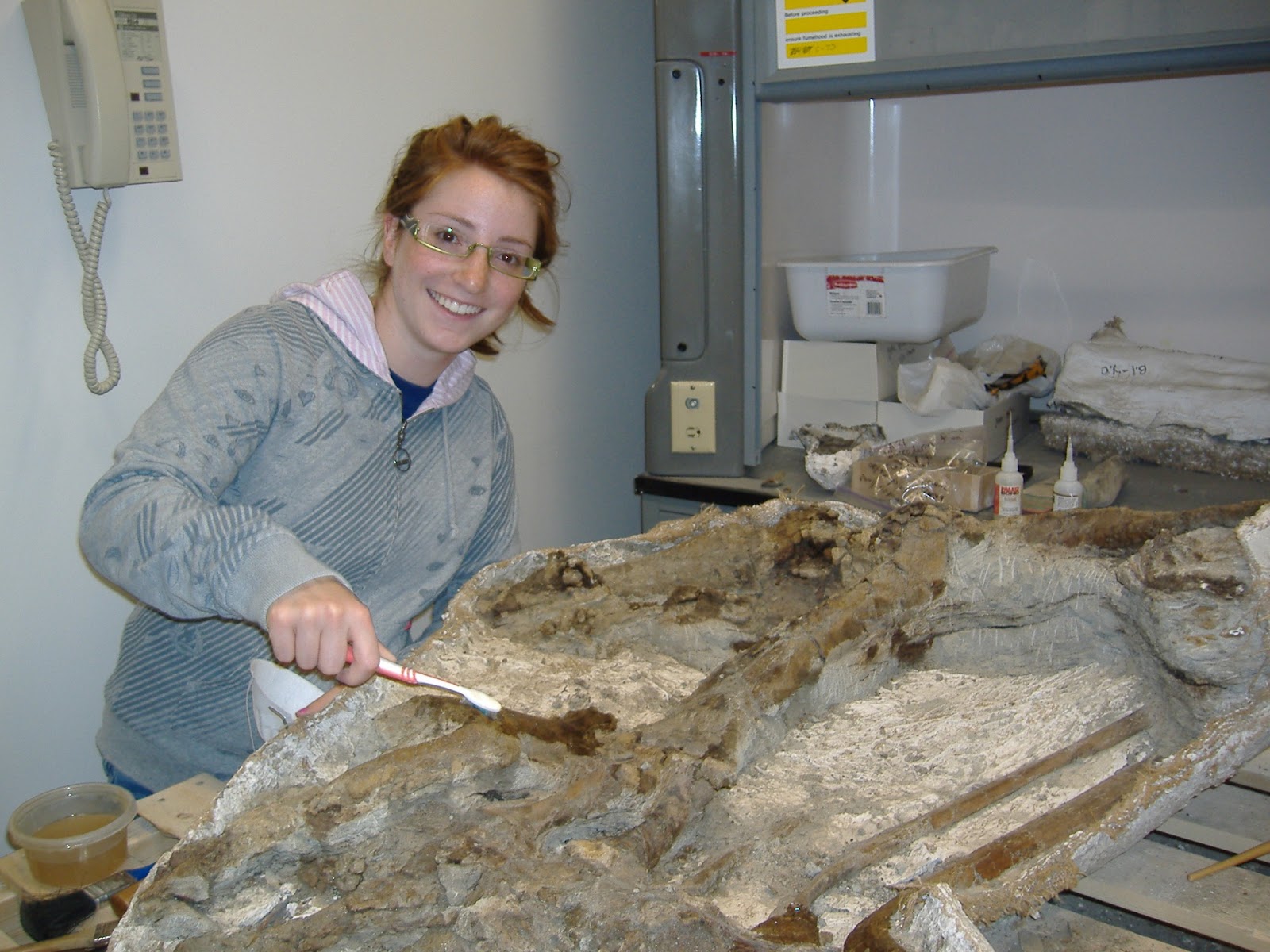
Hop in the wayback machine, here's a picture from 2007, my first year at the U of A, working on the cervical half rings of UALVP 31.


Preparing the material took a couple of years, because I did it in bits and snags around my research and other projects. I had help from several of my fellow grad students and technicians – Robin Sissons did the scapula, Mike Burns and Kristina Barclay helped with the pelvis, and Ian Macdonald and Clive Coy assisted with some of the trickier parts like the poorly-preserved second cervical half ring.

You guys, opening up old jackets is hard! Anyway, this is Mike and Robin in 2008 being awesome weirdos. 


In 2009, I decided to supervise two high school students in the University of Alberta's WISEST Summer Research Program. WISEST (Women in Scholarship, Engineering, Science and Technology) is an awesome organization that organizes conferences for junior high and high school students, and supports grad students, postdocs, and early career professionals on campus. Their Summer Research Program places high school students into university labs for about 6 weeks during the summer, and by the end the students produce and present a poster discussing what they've been up to. In 2009 I was joined by Carmen Chornell and Idel Riemer, who were enthusiastic and excellent fossil preparators! Together we completed preparing the UALVP 31 pelvis, as well as other small bits.


Carmen works away on the pelvis and leg...

...while Idel puts the finishing touches on some osteoderms.

The UALVP 31 cervical half ring turned out pretty neat, but I needed more information to figure out if the half ring of CMN 0210 was unique. I visited lots of museums to see what the half rings of other "Euoplocephalus" specimens looked like, and to see the half rings of other species of ankylosaurs. Thankfully, it seems that the half ring of CMN 0210 is diagnostic, so Euoplocephalus is a real taxon after all. The first cervical half ring has 6 tall, keeled osteoderms, and each pair has a distinct morphology. The middle (medial) pair are tall, with a centrally located apex to the keel. The lateral pair also have a keel, but it's kind of sigmoidal (or, S-shaped). The distal pair, which cover the tips of the band, are flange-shaped. Some specimens, like UALVP 31, are missing the distal osteoderms – these don't seem to fuse on as tightly, so it's possible that they are more easily broken off before fossilization. The half ring of UALVP 31 shares the same morphology as CMN 0210, and so UALVP 31 was one of the few specimens that I could confidently refer to Euoplocephalus for a long time (another being AMNH 5406). UALVP 31 was the only one of these that had a complete skull. 

On the left, CMN 0210, in the middle is UALVP 31, and on the right is AMNH 5406.

In the next post, I'll talk about figuring out variation in the cranial ornamentation in Euoplocephalus skulls.


AND HERE ARE SOME PAPERS!


Brown B. 1908. The Ankylosauridae, a new family of armored dinosaurs from the Upper Cretaceous. Bulletin of the American Museum of Natural History 24:187–201.

Gilmore CW. 1923. A new species of Corythosaurus with notes on other Belly River Dinosauria. Canadian Field Naturalist 37: 1–9.

Lambe LM. 1902. New genera and species from the Belly River Series (mid-Cretaceous). Geological Survey of Canada Contributions to Canadian Palaeontology 3: 25–81.

Lambe LM. 1910. Note on the parietal crest of Centrosaurus apertus and a proposed new generic name for Stereocephalus tutus. Ottawa Naturalist 14: 149–151.

Penkalski P. 2001. Variation in specimens referred to Euoplocephalus tutus. In: Carpenter K (ed.) The Armored Dinosaurs. Bloomington: Indiana University Press, 363-385.

Wilson JA, Upchurch P. 2003. A revision of Titanosaurus Lydekker (Dinosauria – Sauropoda), the first dinosaur genus with a “Gondwanan” distribution. Journal of Systematic Palaeontology 1:125-160.

Who-oplocephalus?


Today I published a revision of the North American ankylosaurid genus Euoplocephalus. I'd like to take some time to go through some of the major points of the paper over the next few days here, but today I will give a brief introduction to the motivation behind this study.

Euoplocephalus is one of those 'classic' dinosaurs. Named in 1902 (as Stereocephalus, which was preoccupied by...a beetle! of course), it wasn't known from very much material. All that Lambe had was a chunk of the snout/forehead region, and an unusual structure called a cervical half ring. Cervical half rings are totally bizarre structures that seem to be unique to ankylosaurids. They're made of an underlying yoke of fused bone segments, and topped by fused osteoderms like you see on the rest of an ankylosaur's body. 

Canadian Museum of Nature 0210, holotype of Euoplocephalus tutus. On the left, the skull chunk. On the right, the first cervical half ring. Images modified from Arbour and Currie (2013).


Over the next couple of decades, three more ankylosaurid species would be identified from Alberta (besides Ankylosaurus): Anodontosaurus, Dyoplosaurus, and Scolosaurus. Anodontosaurus is known from a complete but somewhat squished skull and a half ring, Dyoplosaurus is known from an articulated pelvis and tail, plus hindlimb and other assorted bits, and Scolosaurus is known from an exquisitely preserved skeleton with in situ osteoderms and skin impressions, but without a skull or tail club.

In the 1970s, Walter Coombs, Jr. undertook a large and important study of the ankylosaurian dinosaurs, which formed the foundation for many subsequent studies of ankylosaur anatomy and systematics. More specimens had been collected by that point, and subtle variations in the skull ornamentation among these specimens led Coombs to conclude that either every specimen must be its own distinct species, or they all represented the same species: Euoplocephalus (because it was named first). That's a pretty reasonable conclusion to have drawn with the available evidence at the time.

For my MSc thesis at the University of Alberta, I studied the biomechanics of tail clubbing in ankylosaurids, and specimens referred to Euoplocephalus formed an important part of that research. This is where I became interested in the variation that I saw in tail clubs referred to Euoplocephalus – some were small, some were large, some were skinny, some were round, some were pointy. What did it all mean? Were all of these the same species? Was I looking at ontogenetic changes? Were tail clubs just really variable in Euoplocephalus? What would this mean for how the tail clubs were used?

Wow, 2007 was a long time ago. Anyway, here's me at the Royal Ontario Museum holding the smallest tail club referred to Euoplocephalus, ROM 7761, and standing next to the largest, ROM 788. I CT scanned ROM 788 for my finite element analysis research, and you can now see it on display in the ROM's dinosaur gallery.


This was ultimately what led me to pursue my current line of research into ankylosaur systematics and evolution. I hoped that by understanding variation within Euoplocephalus, I would be better able to assess the validity of other ankylosaurid species, and perhaps identify new species. Over the next couple of posts, I'll talk about how I did this study, and what makes a Euoplocephalus a Euoplocephalus. Stay tuned!


The title for this post was shamelessly stolen from Collin Vanburen, because it is hilarious and perfect.


(But you don't have to take my word for it...: Arbour VM, Currie PJ. 2013. Euoplocephalus tutus and the diversity of ankylosaurid dinosaurs from the Late Cretaceous of Alberta, Canada, and Montana, USA. PLOS ONE 8: e62421.)