Showing posts with label Pipestone. Show all posts

Friday, October 12, 2012

Let's Build the Currie Museum!


A message from my colleague Dr. Phil Bell:

Hi all,
 
Some of you are already aware of the Philip J. Currie Dinosaur Museum, which is scheduled to be built in Grande Prairie, but certainly all of you are aware of Philip Currie himself. As part of the final push to raise the remaining construction funds, we have launched a crowd-fundraising campaign on www.indiegogo.com/curriemuseum. The aim is to raise $1,000,000 in 120 days. In the first hour alone, we raised $1,600!
 
Every donation, no matter how small, is important and donors are rewarded with a range of increasingly cool gifts including a museum logo pin, t-shirts, and original artwork by palaeo-art master Julius Csotonyi. It's all outlined on the website, so please check it out, spread the word, and help us build a world-class museum and research institute.

Many thanks!
 
Phil Bell
Head Palaeontologist
Pipestone Creek Dinosaur Initiative


The Philip J. Currie Dinosaur Museum has been working hard to raise funds for the construction of the museum, which will showcase fossils from northwestern Alberta and support research and education on Albertan dinosaurs. They've raised $17.4 million of the $30 million needed. Even without a museum building, the crew from the Currie Museum is doing an incredible amount of education, outreach, and research. Just last week, Phil visited the University of Alberta to CT scan a hadrosaur with skin impressions from Red Willow Creek. But it can only continue if the museum is funded and built. Please support the museum - they are good folks up there, and every little bit helps!
 

Aluk the Pachyrhinosaurus visits the Wapiti River Bonebed in 2009.
 

Hadrosaur mummies have been collected along Red Willow Creek.
 

New fossil lizards have been described from Kleskun Hills, the northernmost outcrops of badlands in Alberta.

The Wapiti River Pachyrhinosaurus bonebed has been excavated each year since 2007. We're still preparing material from that bonebed in order to figure out which species of Pachyrhinosaurus we have!


Tuesday, August 9, 2011

Hugo's Boss

I almost forgot to mention a fun bit of news coverage that happened during our Grande Prairie fieldwork. The first Pachyrhinosaurus skull to be prepared from the Wapiti River bonebed was nicknamed Hugo (for I hope obvious reasons...). It is on loan to the Grande Prairie Regional College for the next few months and is on display in a case beside their bookstore. The Grande Prairie Daily Herald-Tribune did a nice little piece on the new display and features a completely awesome photo of Phil Currie and prep technician Susan Kagan.

Susan has been pummeling her way through the hard ironstone nodules that enclose the Wapiti River skulls - here is a photo from last fall of progress on the next skull to be prepared. It's come a long way since then, but it takes a long time to get these guys ready.


Grande Prairie Regional College also has a full skeletal mount of Pachyrhinosaurus lakustai, the species known from the Pipestone Creek bonebed.

Ok, that should actually be the end of Pachyrhinosaurus updates for the next little while...

Monday, August 8, 2011

Pipestone Creek Bonebed

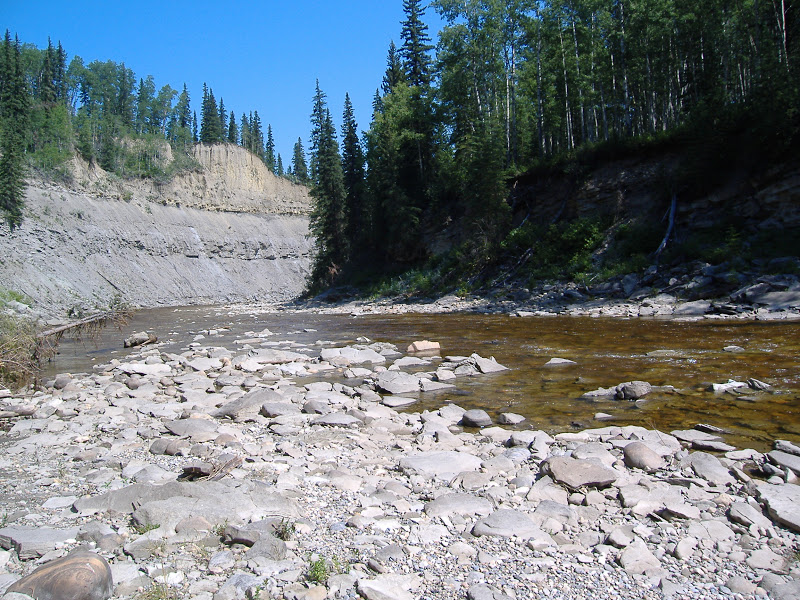
The area around Grande Prairie is rich with dinosaur fossils, although the setting is somewhat different than you might expect if you're used to working in badlands like Dinosaur Provincial Park. In Grande Prairie, the only badlands outcrops are the Kleskun Hills, and most other sites are found along creeks and river valleys. I spent the bulk of my time at the Wapiti River bonebed, but helped out a little bit at the concurrent excavation at Pipestone Creek.

The Wapiti River bonebed has yet to be described, but Pipestone Creek is a fairly famous locality because of the huge numbers of Pachyrhinosaurus that were collected there during the late 80s by the Royal Tyrrell Museum and featured in the touring exhibition Dinosaur World Tour: The Greatest Show Unearthed. This bonebed was reopened last year as plans for the new museum to be built in the area began to solidify. In 2008 the animals in this quarry were separated from Pachyrhinosaurus canadensis (found in southern Alberta), and named Pachyrhinosaurus lakustai after Al Lakusta who discovered the bonebed.

Although material from the Wapiti River and Pipestone Creek bonebeds are currently accessioned at the University of Alberta, we've had a lot of help from the Grande Prairie Regional College, who have helped with many of the logistics of working in the area and allow us to stay at their dorms (it sure is nice to have kitchens, showers, and proper beds).  Here's a few photos from the last days of this year's fieldwork at Pipestone Creek.


The Pipestone Creek bonebed is incredibly dense, and I've been told that upwards of 100 bones have been found in a single square meter here. We were particularly excited this year because a very fine P. lakustai skull was uncovered, which you can see here as the large jacket. We had to jacket a bunch of smaller bones along with it because they sit partially underneath the skull and could not be removed. They'll be extracted back at the lab.


Here the skull has been flipped and the crew jackets the underside in preparation for transport. Pipestone Creek is a much easier site to access than Wapiti River. As you can see, the bonebed is not far above the creek, and a road has been constructed to allow visitors an easy walk to the site.


Helicopters are essential for getting large-ish jackets out of the Wapiti River bonebed, since the hill is too steep and high to easily get large jackets up to the edge and into the truck, or down to the river and into jetboats. This year, the helicopter was also a much needed tool for getting the large skull jacket out of Pipestone Creek. Here it sits in a field at the campground after three successful lifts.


We were a little apprehensive about getting the large skull into the truck, but luckily a crane was in the area and happy to help us out. The driver weighed the jacket - it came out at a whopping 1200 lbs! Too bad we didn't have a crane for getting it out of the truck once we were back at the university...

 
I'll probably have more updates as some of this material is prepared at the U of A, but that concludes my Grande Prairie fieldwork for this year. You can keep up to date with the goings on up there by keeping an eye on the museum project, formerly called the River of Death and Discovery Dinosaur Museum and recently been renamed the Philip J. Currie Dinosaur Museum. They have a pretty nifty new website (and blog, which you can find on the blogroll here).

Wednesday, April 6, 2011

River of Death gets a name change.

I haven't talked a whole lot here about the Pipestone Creek Dinosaur Initiative or the proposed River of Death and Discovery Museum. The area around Grande Prairie, Alberta, about a five hour drive northwest of Edmonton, is rich in Late Cretaceous fossils. The most famous locality is Pipestone Creek, where hundreds of the horned dinosaur Pachyrhinosaurus perished millions of years ago.

For nearly ten years, a dedicated group of folks in Grande Prairie have been trying to get their own palaeontology museum off the ground. The working name for the museum was the River of Death and Discovery Dinosaur Museum. However, the word 'death' in the museum name has made it difficult for the museum to get as many sponsors as they would have liked.

And so it was announced yesterday that the museum would be renamed to the Philip J. Currie Dinosaur Museum! You can read more about the name change at the Grande Prairie Daily Herald-Tribune's article.

There are some exciting things coming up this summer for the museum foundation, including the Akroyd Family and Friends Dinosaur Ball (yes, those Akroyds!), and the University of Alberta will return to our annual excavations at the Wapiti River Pachyrhinosaurus bonebed and the newly-reopened Pipestone Creek bonebed.


A helicopter approaches at the Wapiti River bonebed during the 2009 excavation. Helicopter lifts are the only way the large blocks can be brought up to the edge of the river valley.