Showing posts with label museums. Show all posts

Monday, February 1, 2016

Cool stuff at my museum.

Today I wanted to share some of the cool stuff the North Carolina Museum of Natural Sciences does besides palaeontology!

My home is in the Nature Research Center, the new addition to the museum that opened in 2012 and which features a 3-story-tall globe on the outside! The globe is always an attention-getter, and most days when I'm walking to the bus there are people outside posing in front for pictures. It's a cool thing to have as the icon for the museum. It looks cool in the rare snow we get here, and moody at night.

But the globe isn't just a cool external feature, it's also an important part of the inside of the museum, as the Daily Planet Theatre. The inside of the globe forms a curved surface visible from all three floors, during which scenes from nature are projected for most of the day. Each day one of the scientist gives a special presentation on their research in this venue, and special guests speak here for events. This is where Lindsay and Susan debuted the Carolina Butcher last spring!

The first floor has this spectacular right whale skeleton, but it's not just any right whale - this one has an important scientific story to tell. If you look closely on the right mandible (on the left in this image), and towards the back, you will see a series of little circular divots. This whale's mandible was sampled in order to understand breaking stresses in whale jaws during ship strikes, the cause of death for this poor fellow. Research on this specific whale helped create new legislation for ship speeds in whale zones. I think it's an awesome example of real science making tangible benefits. It's a great way of linking research to a specimen and giving it a powerful narrative.

Within the Nature Research Center are five active research laboratories - Paleontology, Astronomy & Astrophysics, Genomics & Microbiology, Evolution, and Biodiversity. Our labs are part of the exhibit space and visitors to the museum can peer into the labs. Most of the labs have interesting displays in the windows and one of my favourites is the Biodiversity Lab's dermestid colony. They have bear skulls, deer skulls, coyote bits, and all kinds of things decomposing in full view, and at the moment there is a whole baby seal in there.

Not all of the animals are dead! The museum has a pretty extensive collection of live animals on exhibit, like this matamata turtle. Another really cool thing is the visible veterinary lab in the Nature Research Center, where you can see veterinarians caring for the museum's animals. And sometimes this includes surgery! There is always a bi crowd of people whenever the vet window is occupied. Most recently, the museum took in several cold-stunned sea turtles to rehabilitate.

One of my very favourite things in the whole museum besides the Paleo Lab is the Naturalist Center, basically a hands-on library of STUFF. All kinds of good stuff: bones, fur, feathers, specimens in plastic, stuff to look at under the microscope, field guides and anatomical diagrams. I've never really seen  something quite like this in any other museum. It's almost always busy, especially on the late nights on Thursdays, and kids LOVE IT and I think parents probably absorb some information too because everything's hands on.
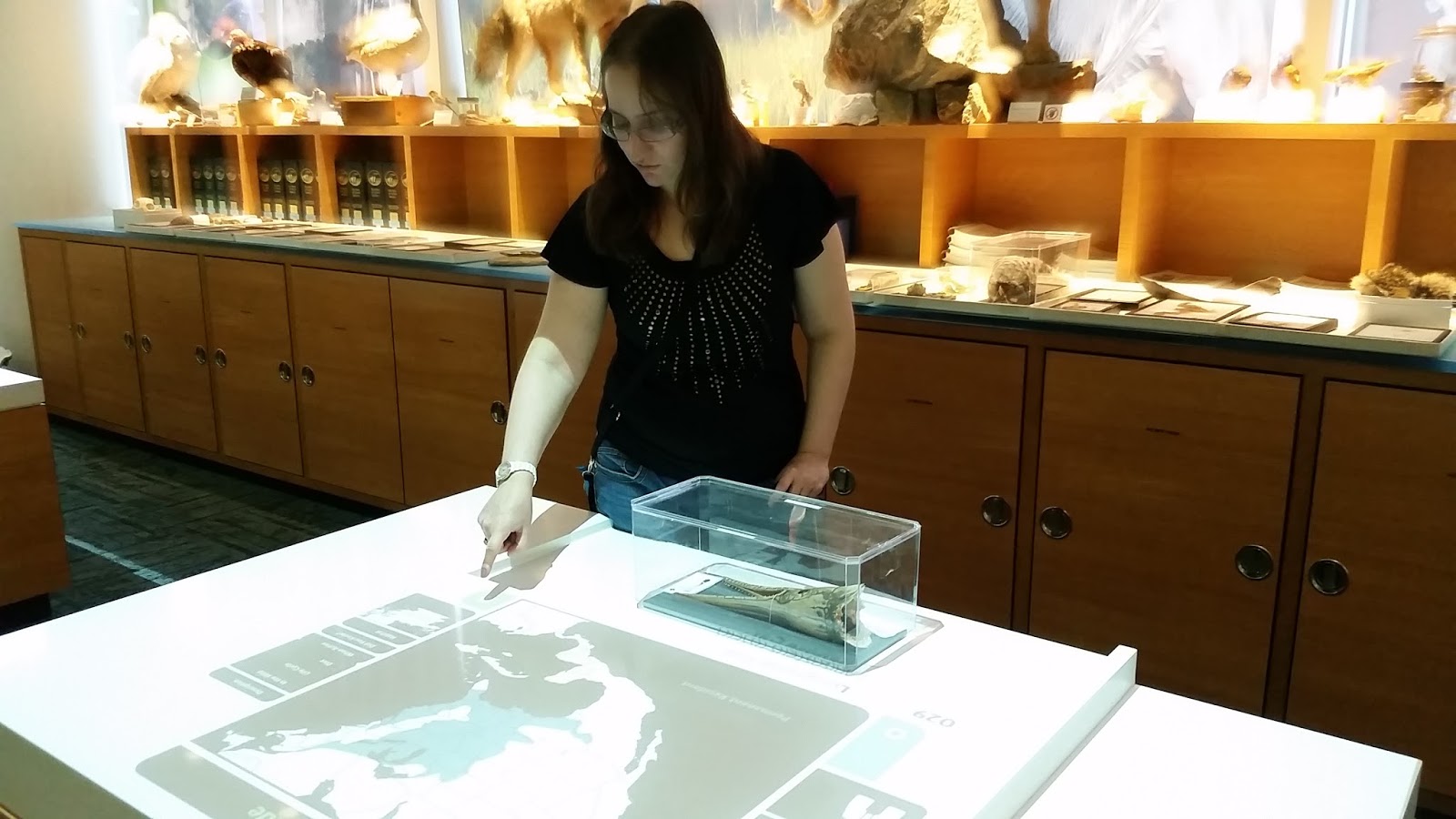
The thing that gets the most attention is this awesome interactive table where you can take specimens from a specially designated shelf, stick them on, and then a computer somewhere recognizes the specimen and projects a whole bunch of interactive information onto the table. There is much swooping and swishing and it's one of the only touch screen info things I've seen people really use for more than 2 seconds. It's slick, it's cool, and you move a real object around in order to make it work. It's perfect. Here it is in action:


There's so much more that I can't possibly put everything in one post, but I hope this gives you a sense for the unique and interesting ways the museum incorporates real-time scientific research, hands-on and experiential learning, and cool narratives into its exhibits. Things are blended really well and it's no surprise that the museum is one of the most popular destinations in the region. Here's a dinosaur, thanks for sticking around!

Sunday, December 6, 2015

Heroes in a half shell

In my continued quest to betray my dinosaurian research roots, I went to the American Museum of Natural History in New York to look at turtles! And what turtles they were - this is the skull of Ninjemys (the ninja turtle!), a giant meiolaniid turtle from Australia. Meiolaniids are the best turtles you've never heard of and it's a crying shame that they don't feature more prominently in prehistoric popular media.

Meiolaniids are basically ankylosaur-convergent turtles, all of which are very large for turtles and some, like Ninjemys, which would have been legitimately huge. They are only found in the southern hemisphere (and really mostly in Australia and nearby), and they all have elaborate cranial ornamentation. On the left in this picture is that same Ninjemys skull cast, and on the right we have Niolamia from Argentina - smaller, but arguably even weirder with those huge nuchal crests flaring off the back of the skull.

I'm interested in meiolaniids at the moment because they are one of the other groups of tetrapods that evolved a club-like tail weapon. Here's Meiolania platyceps, an island dwarf (!) meiolaniid, with some kind of boring mammal for scale.

And here's the business end of Meiolania. Stay tuned for more exciting discussion of animal business ends in the future!

Since we're looking at animal butts today, apparently, here are some Edmontosaurus rears...

...and a Triceratops derriere, for good measure.

Elsewhere in the fossil halls, I enjoyed meeting the disembodied floating head of this indricothere, which makes for a nice counterpoint to the fleshed-out model currently on exhibit at the North Carolina Museum of Natural Science's feature exhibit Extreme Mammals.

And here's a lovely trio of cingulates! The big fellow is the derived glyptodont Panochthus, the medium-sized fellow is the early glyptodont Propalaeohoplophorus, and off towards the back the little guy is the extant six-banded armadillo, Euphractus sexcinctus. The tail club on the Panochthus is mounted really weirdly, with it sticking straight out from the back of the shell rather than having any of the mobile rings from the base of the tail present, so I'm not sure what's quite up with that.

I post woefully few fish fossils on this blog, so here's a pretty great semionotid!

Science and anatomy and zoology are all around us if you keep your eyes open! I loved this chameleon logo on the side of a restaurant we came across one evening.

Wednesday, October 28, 2015

How to look at dinosaurs in a museum

I've been traipsing around North America a lot lately for a fresh burst of museum visits, which got me to thinking about the things I need to do in order to do research in museum collections. I thought I'd share some advice about visiting museum collections – consider this a mix of tips for beginners and experienced collections researchers alike. Obviously this advice is geared towards palaeontological research, but I bet it's applicable to many other fields as well, and it would be interesting to hear about differences! Also beware, this post is more text-heavy than usual for me!

Before going to the museum:
  • Before visiting a collection, you'll need to contact a curator or collections manager to request access to the collections. Write a polite (but brief!) email outlining who you are, what you want to see, and the dates you're interested in visiting.
  • Once you've settled on a visit, you should also ask the collections manager or curator what time you should arrive and if there is a special entrance you should arrive at – sometimes you aren't entering through the regular public entrance but a staff entrance, so make sure you know where to go. If you're visiting a collection located on a university campus, ask if they can point you towards a campus map, since it's often a bit more difficult to navigate around unfamiliar campuses. I rarely rent a car when I'm traveling, but if you are arriving via a car, make sure you check out parking rates and locations ahead of time – university parking lots are notoriously expensive for visitors or have restricted access for non-permit holders.
  • It's also good to ask if the collections are closed during lunch, and what time you need to leave by. I usually also ask (or check the museum's website) to see if there is a cafe or restaurant nearby for lunch – a notable example where there is no food on site is the Canadian Museum of Nature collections: bring your own lunch if you're visiting there, as there isn't any food nearby!

On the plus side, the CMN staff cafeteria looks over a very pleasant pond, and also there is an Amargasaurus to keep you company!


What to bring with you:
  • DSLR camera – although I typically use a point-and-shoot or cellphone camera for fun and casual pictures, for specimen photos I use a DSLR camera. I am by no means an accomplished photographer and I really ought to take some classes or watch some tutorials to get the most out of my camera, but having at least a basic beginner's DSLR is important for getting publication-worthy specimens photos. BUT, in the earliest days of my MSc I got away with a point-and-shoot digital camera because I had a:
  • Tripod – you can get away with a less good camera if you have a tripod. I have a nice Manfrotto tripod that extends out to about as tall as I am and has a pivoting head. It set me back about $100 CAD, but a tripod is really crucial for getting good photos. A tripod and decent lighting will get you 90% of the way to a good photo if you're working with large-ish dinosaur fossils; for small fossils, you probably need some different gear.
  • That being said, keep a backup camera on you in case something happens to your 'good' camera! I also have had pretty good success pointing a regular digital camera down the eyepiece of a microscope to take pictures when I didn't really have a proper setup for doing that kind of work. The DSLR didn't work as well in that instance so I was glad I had my little point-and-shoot camera.
  • Calipers – I have a digital caliper that I love to death because I am a lazy butt and don't want to fuss about with reading the actual numbers on the calipers. Turn it on, zero it, line it up, and bam you're done. They are the best. If you work on very small fossils and/or require a super high degree of accuracy, you might want to invest in fancier calipers, but for me these calipers from Canadian Tire get the job done. Pro tip: avoid packing calipers in your carry-on luggage – I have run into trouble with security thinking they could be used as a weapon, and have almost had them confiscated!

My basic kit! If you've got these, you're 90% of the way there.

  • Measuring tape – some of my fossils are too big for my calipers, so I still rely on measuring tape for the large fossils. Also, soft measuring tape is crucial for taking circumference measurements, say if you want to eventually calculate body mass using limb bones. Don't leave home without measuring tape!
  • Notebook and pencil kit – I am a weirdo who likes to write down my measurements before transferring them to Excel or wherever, so I always keep a lined notebook and a bunch of pens, pencils, pencil crayons, erasers, and pencil sharpeners on hand for museum trips. Secret pro tip: only write on one side of your notebook pages – it seems wasteful, but prevents bleed-through of your notes if you scan your pages later or as ink penetrates the paper, and prevents smudging on opposite pages if you're using pencil.
  • Scale bars – I keep like a billion scale bars on me at all times because I lose them everywhere. You should always keep a scale bar in your photographs! I like to buy the official Society of Vertebrate Paleontology scale bars (although the new ones are not as good, SVP exec! Bring back the old blue ones!), but I have frequently gotten good freebies at conferences, and some cool credit-card sized ones from the Journal of Vertebrate Paleontology and the Canadian Museum of Nature that can stay in my wallet! You can get away with just your measuring tape and/or calipers, but scale bars look nicer.
  • Things I don't do yet: Portable lights! Most museums have a variety of desk lamps or photography setups for visiting researchers, but not everywhere. While you can still get pretty ok photographs sometimes without extra lighting, sometimes you might want some low-angle lighting to highlight skin impressions or other subtle features, or you might want light to penetrate more deeply into an object, like the palatal region of a skull. I have sometimes included a small flashlight in my kit, for spotlighting areas on fossils and for peering into dark racks and cabinets. I have been considering purchasing a small desk lamp that could travel in my checked luggage – readers, do you travel with your own lighting?
  • While I don't often use a background cloth, some of my friends travel with either a white or black sheet to lay under fossils. Somewhat counterintuitively, black works well if you have dark fossils, because of the way it makes your camera interpret the light. I don't mind deleting out backgrounds manually from my photos, but a uniform white or black background probably cuts down the processing time for some people.

At the museum:
  • Be gentle with fossils! Make sure you're handling fossils carefully, by lifting them at the most sturdy parts and supporting as much as them as possible. Use carts wherever possible, and keep them on foam – if there isn't foam already on the cart or table, scavenge around the collections until you find some. When photographing specimens in different views, try to keep delicate parts supported on foam or sandbags; if for some reason those things are not readily available, I have occasionally used erasers (white and gum) to provide soft-ish supports for fossils during photography.
  • Be nice to collections managers and curators: put fossils back exactly where you found them, and keep specimen cards with the specimens. If something breaks, tell them!
  • Take more photos than you think you need – make sure you get orthogonal views (top, bottom, sides, etc.), but try varying the angle of your light sources, your zoom, your angle, etc. It's also helpful to have a variety of close-ups for interesting features (braincases, noses, palates), and to have unorthodox views that might jog your memory or reveal proportions or angles that are lost in orthogonal-only views. Sometimes I literally just walk around the specimen snapping photos, such that I could probably make some photogrammetry models from things I photographed 10 years ago before photogrammetry was a thing. I take hundreds of photos each day during a collections visit.
  • When you're photographing a specimen, include a least a few photos where you include the original specimen tag – this helps keep the info with the specimen for years later when you may be revisiting old photos.
  • Lunchtime is a good time to visit the exhibits and snoop on how people are interacting with the museum's interpretive materials, which is one of my favourite creepy pastimes.

Here's me and my inexplicably hidden face (I obviously haven't totally figured out this new 'do yet) working in the Ft Worth collections last week! Working in museum collections is awesome and one of my favourite parts of being a palaeontologist.


After your visit:
  • Download your photos each night and sort them by specimen number. I have a huge folder of all of my specimen photos sorted by museum, visit (when I've been to a collection more than once), date, and specimen number. I'm a weirdo and tend to remember things in time-relative terms, so sorting by date helps me remember specimens and correlate back to my notebook; you might prefer to sort by taxon and then museum, or museum and then taxon, or any way that works for you.
  • Scan/photograph/photocopy your notebook as a backup.
  • Send a thank you email to the people who helped you during your visit! It's just good manners and also it is nice to be nice to other people.

Ok, that's my slightly too long stream-of-consciousness discussion of museum visit tips and tricks! What things do you bring with you or do in order to have a successful research visit in museum collections? What would you recommend to beginners in the field? And don't forget to fill out the research survey about science blogs!

Saturday, October 24, 2015

Ankylosaurs all the way down

After the SVP meeting in Dallas, I spent a couple of days working on Texan ankylosaurs at the Ft Worth Museum of Science and History, and at the collections at Southern Methodist University. It was nice to see a bit of Texas outside of downtown Dallas, so here's a few shots from my visit to Ft Worth!

You know it's going to be a pretty good museum visit when you're greeted by Dr. Suess statues on your way in! Especially when it's from your favourite Dr. Suess story, the underappreciated Yertle the Turtle.

This is probably the most interesting office space I have ever worked in. Or at least, the most intimidating. Look closely between the dueling bears and you will see...

...Pawpawsaurus! This is the holotype and only known skull of this beautiful little nodosaur. What a treat to be able to study the original in person.


Just next to me were these very interesting Katsina dolls, including my new favourite character, Squash Man. Apparently he is present in harvest stories and now I want to know all about him because he is the greatest.


The museum has a pretty nice dinosaur exhibit, which I liked a lot because it features local Texas dinosaurs rather than the standard Tyrannosaurus and Triceratops that museums of this size typically have. There was also an outdoor dig site recreating the Jones Ranch quarry that I had visited the previous week on the SVP field trip!


The dinosaur exhibit has these really great gigantic line drawings of Texas dinosaurs, which I liked a lot. They look like somebody roughed in some chalk drawings on the walls, and I find them really appealing and dynamic!

The room is dominated by the skeleton of "Paluxysaurus", more recently considered a junior synonym of Sauroposeidon. Whatever it's called, it's an interesting sauropod, representing one of the last North American sauropods before the lengthy 'sauropod hiatus' from the mid Cretaceous until the Maastrichtian.

Here's something new for me - the foot of Tenontosaurus! A cool original fossil to have on display; behind it there's a reconstructed Tenontosaurus skeleton, and there was also a slightly worse for the wear original Tenontosaurus skull. It's like Tenontosaurus central around here!

Here's a super cool interactive station! Measure the circumference of a femur, put your measurements onto the computer, and see how massive different animals were!


Given the extreme dearth of ankylosaurs in museum exhibits, I was pretty over the moon that Pawpawsaurus featured so prominently! Usually the original skull is on display in the glass case, but today they had taken it off exhibit for me to look at and replaced it with a cast. Now somebody just needs to find the rest of the skeleton so we can have a more complete picture of this important mid Cretaceous ankylosaur!


If you haven't already done so, please take a moment to contribute to research on science blogging by filling out the survey! It only takes a few moments to complete and you can enter to win prizes! I promise I will stop pestering you all soon!

Thursday, October 22, 2015

This Way to the Dinosaurs

Welcome to the Perot Museum of Nature and Science! The Society of Vertebrate Paleontology Annual Meeting's welcome reception was held here last week. This museum is trying out some interesting and different exhibition ideas that I haven't seen too often elsewhere, so let's take a look at some highlights. One of the most interesting design elements is the visible escalators poking out the side of the building. Back in 2013 at the Korea-Mongolia International Dinosaur Project Symposium, Tony Fiorillo gave a really interesting presentation on the design of this museum, and talked about how a lot of people never make it off the first floor of a museum, which is also usually where the dinosaurs are. So at the Perot Museum, the dinosaurs are on the top floor and you are immediately shuttled upstairs (it's actually kind of hard to *not* go to the top floor first!), and then you work your way down the museum to exit. 

The dinosaur exhibits feature some interesting species that aren't found in a lot of other museums - here's a modern take on Tenontosaurus, and the still unnamed Proctor Lake 'hypsilophodontid' (somebody name that guy, already!).

My favourite exhibit in the whole museum! One of the only places where I've seen the North American-Asian faunal interchange visualized in an exhibit. Tarbosaurus is in Asia, and its close relatives are in North America (I can't remember exactly which taxon is featured here, but perhaps it is Bistahieversor based on its geographic position?). Also whoa, Beringia sure looks strange from this polar vantage point.

Another interesting thing the museum has done is to place modern animals alongside the dinosaurs for comparative purposes. Here we've got predators and prey - a mountain lion and a deer, and Tyrannosaurus and the sauropod Alamosaurus (off to the left of my photo).

A similar approach is taken in the Alaskan dinosaur corner - here's the herbivorous Edmontosaurus Ugruunaluk...

...and its extant analogue the caribou (Rangifer!). I wasn't totally sold on this approach, but I was intrigued by the mixture of extant and extinct, and of modern and ancient ecosystems, so maybe I just need to ruminate on it a little more.

I'm a sucker for Sinclair dinosaurs, what can I say.

Does the mould for the Ankylosaurus exist anywhere still??? DO WANT.

At one end of the dinosaur hall you take a set of stairs up to the bird exhibit! I liked this a lot, both because the bird exhibit had some cool interactive stuff, but also because I like the symbolism and narrative structure to traveling upwards towards birds from dinosaurs - it's like moving up the phylogenetic tree, and gaining flight.

From up in the rafters, you get a nice view of the dinosaur gallery, and a great vantage point for examining the gigantic Alamosaurus (real vertebrae are tucked down at ground level behind the skeleton from this angle). Alamosaurus is a weird and biogeographically interesting creature, representing a re-emergence of sauropods in North America after a lengthy hiatus throughout much of the mid Cretaceous. 


ELSEWHERE IN THE MUSEUM...

Rocks and minerals! With gigantic mineral shapes! (My favourite is the giant malachite clump in the back.)

Brains! There's a really fun section on medicine and human anatomy.

Phylogenies! Can you find where humans are located on this giant tree of life?

Outside the museum, we were bid farewell by these very fine green leapfrogs, which surely must be great fun to play with if you are smaller than I am.

More Texas adventures forthcoming - stay tuned!

If you haven't already done so, please take a moment to contribute to research on science blogging by filling out the survey! It only takes a few moments to complete and you can enter to win prizes!

Monday, September 28, 2015

Mad-packed with all nine essential nutrimites to fortify your X-Zone!

So extreme! X-treme! Even more extreme than Extreme Blu!

I might find the name a little 90s for my liking (although I guess that Clone High reference I just made is circa 2002), but this is a must-see exhibit that shows off a whole lot of cool animals you probably haven't heard of before. It's an awesome mix of fossils, casts, life restorations of extinct mammals, skeletons and taxidermy mounts of unusual modern mammals, nice graphics, and fun interactive stations. Here's a slice of highlights from the opening party I attended last Friday!

Giant rhino relative Indricotherium (Paraceratherium?) greets you as you enter the exhibit. Ancient rhino relatives are really cool and don't get enough love!

Uintatherium, a weirdly ornamented archaic Palaeocene mammal, and not one you see in too many museum exhibits.

And check out this sivathere skull - this is a giraffe relative!

The exhibit includes a nice diagram showing the changes that occurred between the earliest synapsids, like Dimetrodon, to modern mammals, and even talks about the concept of 'crown groups'.

This floofular Macrauchenia looks like something straight of Jim Henson's workshop. Macrauchenia is a South American hoofed mammal that's part of a larger group of hoofed mammals from that continent of confusing and uncertain ancestry - we'll see a few more later.

Lots of exhibits showcased particular features of mammal anatomy and showed convergences across clades. Here's Thylacoleo, the marsupial lion, with Thylacosmilus, the marsupial sabre-tooth in the background.

Speaking of teeth, this exhibit showcased extreme incisors - that's a narwhal skull in the back, and an extinct elephant called Platybelodon in the front.

And more weird teeth: the extinct giant marsupial Diprotodon.

Real mammoth hair!!!

Way back in the Eocene, things were a bit toastier than today, and Arctic Canada was a lush forest inhabited by Coryphodon. This guy is one of the earliest really big mammals that evolved after the K-Pg extinction, but doesn't have any close living relatives despite its hippo-like appearance.

One of the most spectacular specimens in the exhibit, this Scarrittia is a notoungulate, another of those weird South American hoofed mammals. It probably would have looked somewhat rhino-like when alive, but I'm always weirded out by the lack of a gap between the front teeth and the molars, like you see in things like cows and horses.


Bonus alive mammals! We got to meet several living animals during the opening festivities, including...

Jerry the binturong, from the Conservators Center.

Plus this shy armadillo...

...hungry sloth....


and curious bat-eared fox from the Flying Fox Conservation Fund!


Extreme Mammals is at the North Carolina Museum of Natural Sciences until March 27, 2016, and is well worth a couple of visits! Have you seen Extreme Mammals on its tour? Tell me about it in the comments!