Showing posts with label turtles. Show all posts

Monday, February 1, 2016

Cool stuff at my museum.

Today I wanted to share some of the cool stuff the North Carolina Museum of Natural Sciences does besides palaeontology!

My home is in the Nature Research Center, the new addition to the museum that opened in 2012 and which features a 3-story-tall globe on the outside! The globe is always an attention-getter, and most days when I'm walking to the bus there are people outside posing in front for pictures. It's a cool thing to have as the icon for the museum. It looks cool in the rare snow we get here, and moody at night.

But the globe isn't just a cool external feature, it's also an important part of the inside of the museum, as the Daily Planet Theatre. The inside of the globe forms a curved surface visible from all three floors, during which scenes from nature are projected for most of the day. Each day one of the scientist gives a special presentation on their research in this venue, and special guests speak here for events. This is where Lindsay and Susan debuted the Carolina Butcher last spring!

The first floor has this spectacular right whale skeleton, but it's not just any right whale - this one has an important scientific story to tell. If you look closely on the right mandible (on the left in this image), and towards the back, you will see a series of little circular divots. This whale's mandible was sampled in order to understand breaking stresses in whale jaws during ship strikes, the cause of death for this poor fellow. Research on this specific whale helped create new legislation for ship speeds in whale zones. I think it's an awesome example of real science making tangible benefits. It's a great way of linking research to a specimen and giving it a powerful narrative.

Within the Nature Research Center are five active research laboratories - Paleontology, Astronomy & Astrophysics, Genomics & Microbiology, Evolution, and Biodiversity. Our labs are part of the exhibit space and visitors to the museum can peer into the labs. Most of the labs have interesting displays in the windows and one of my favourites is the Biodiversity Lab's dermestid colony. They have bear skulls, deer skulls, coyote bits, and all kinds of things decomposing in full view, and at the moment there is a whole baby seal in there.

Not all of the animals are dead! The museum has a pretty extensive collection of live animals on exhibit, like this matamata turtle. Another really cool thing is the visible veterinary lab in the Nature Research Center, where you can see veterinarians caring for the museum's animals. And sometimes this includes surgery! There is always a bi crowd of people whenever the vet window is occupied. Most recently, the museum took in several cold-stunned sea turtles to rehabilitate.

One of my very favourite things in the whole museum besides the Paleo Lab is the Naturalist Center, basically a hands-on library of STUFF. All kinds of good stuff: bones, fur, feathers, specimens in plastic, stuff to look at under the microscope, field guides and anatomical diagrams. I've never really seen  something quite like this in any other museum. It's almost always busy, especially on the late nights on Thursdays, and kids LOVE IT and I think parents probably absorb some information too because everything's hands on.
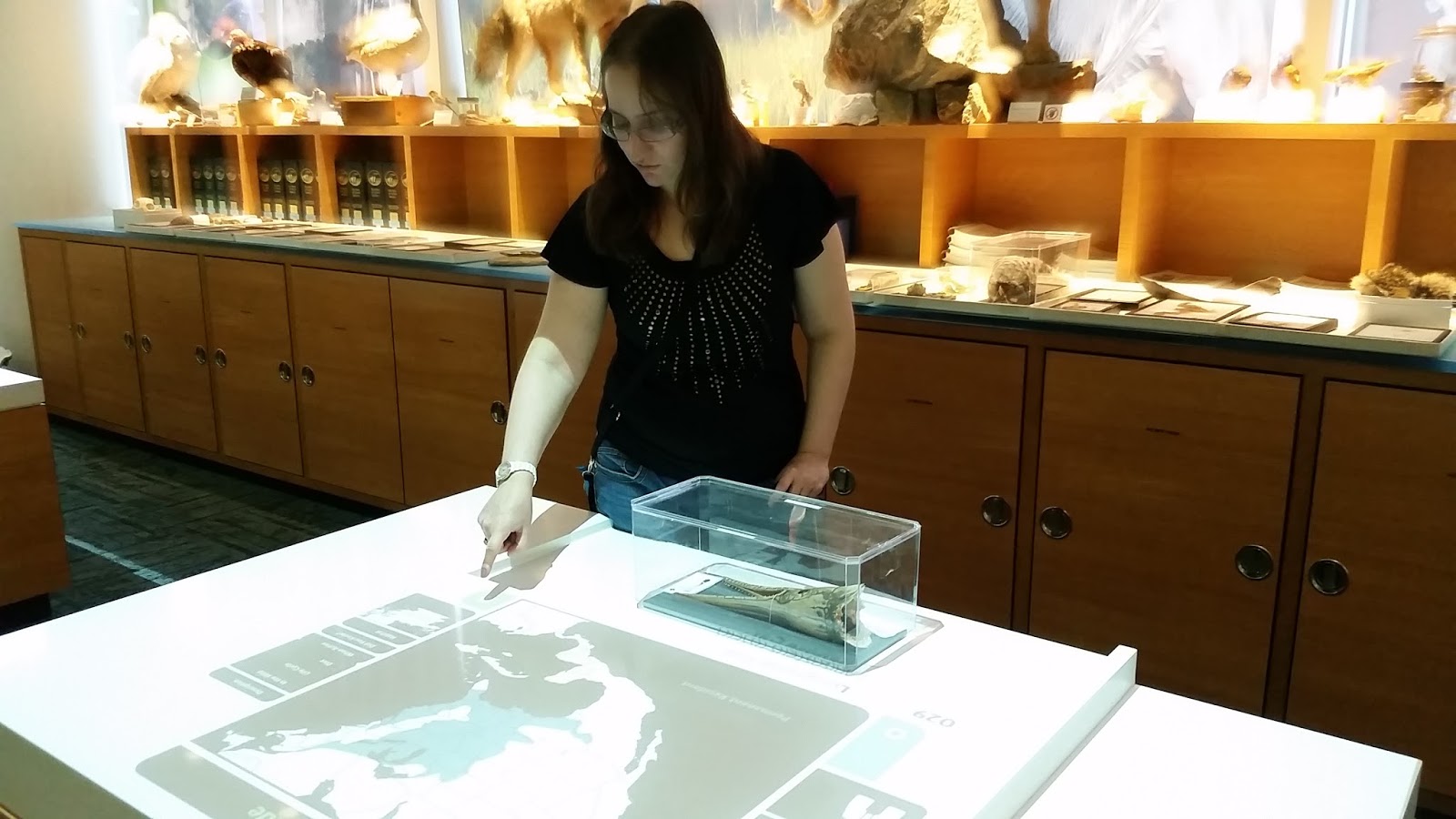
The thing that gets the most attention is this awesome interactive table where you can take specimens from a specially designated shelf, stick them on, and then a computer somewhere recognizes the specimen and projects a whole bunch of interactive information onto the table. There is much swooping and swishing and it's one of the only touch screen info things I've seen people really use for more than 2 seconds. It's slick, it's cool, and you move a real object around in order to make it work. It's perfect. Here it is in action:


There's so much more that I can't possibly put everything in one post, but I hope this gives you a sense for the unique and interesting ways the museum incorporates real-time scientific research, hands-on and experiential learning, and cool narratives into its exhibits. Things are blended really well and it's no surprise that the museum is one of the most popular destinations in the region. Here's a dinosaur, thanks for sticking around!

Sunday, December 6, 2015

Heroes in a half shell

In my continued quest to betray my dinosaurian research roots, I went to the American Museum of Natural History in New York to look at turtles! And what turtles they were - this is the skull of Ninjemys (the ninja turtle!), a giant meiolaniid turtle from Australia. Meiolaniids are the best turtles you've never heard of and it's a crying shame that they don't feature more prominently in prehistoric popular media.

Meiolaniids are basically ankylosaur-convergent turtles, all of which are very large for turtles and some, like Ninjemys, which would have been legitimately huge. They are only found in the southern hemisphere (and really mostly in Australia and nearby), and they all have elaborate cranial ornamentation. On the left in this picture is that same Ninjemys skull cast, and on the right we have Niolamia from Argentina - smaller, but arguably even weirder with those huge nuchal crests flaring off the back of the skull.

I'm interested in meiolaniids at the moment because they are one of the other groups of tetrapods that evolved a club-like tail weapon. Here's Meiolania platyceps, an island dwarf (!) meiolaniid, with some kind of boring mammal for scale.

And here's the business end of Meiolania. Stay tuned for more exciting discussion of animal business ends in the future!

Since we're looking at animal butts today, apparently, here are some Edmontosaurus rears...

...and a Triceratops derriere, for good measure.

Elsewhere in the fossil halls, I enjoyed meeting the disembodied floating head of this indricothere, which makes for a nice counterpoint to the fleshed-out model currently on exhibit at the North Carolina Museum of Natural Science's feature exhibit Extreme Mammals.

And here's a lovely trio of cingulates! The big fellow is the derived glyptodont Panochthus, the medium-sized fellow is the early glyptodont Propalaeohoplophorus, and off towards the back the little guy is the extant six-banded armadillo, Euphractus sexcinctus. The tail club on the Panochthus is mounted really weirdly, with it sticking straight out from the back of the shell rather than having any of the mobile rings from the base of the tail present, so I'm not sure what's quite up with that.

I post woefully few fish fossils on this blog, so here's a pretty great semionotid!

Science and anatomy and zoology are all around us if you keep your eyes open! I loved this chameleon logo on the side of a restaurant we came across one evening.

Saturday, October 24, 2015

Ankylosaurs all the way down

After the SVP meeting in Dallas, I spent a couple of days working on Texan ankylosaurs at the Ft Worth Museum of Science and History, and at the collections at Southern Methodist University. It was nice to see a bit of Texas outside of downtown Dallas, so here's a few shots from my visit to Ft Worth!

You know it's going to be a pretty good museum visit when you're greeted by Dr. Suess statues on your way in! Especially when it's from your favourite Dr. Suess story, the underappreciated Yertle the Turtle.

This is probably the most interesting office space I have ever worked in. Or at least, the most intimidating. Look closely between the dueling bears and you will see...

...Pawpawsaurus! This is the holotype and only known skull of this beautiful little nodosaur. What a treat to be able to study the original in person.


Just next to me were these very interesting Katsina dolls, including my new favourite character, Squash Man. Apparently he is present in harvest stories and now I want to know all about him because he is the greatest.


The museum has a pretty nice dinosaur exhibit, which I liked a lot because it features local Texas dinosaurs rather than the standard Tyrannosaurus and Triceratops that museums of this size typically have. There was also an outdoor dig site recreating the Jones Ranch quarry that I had visited the previous week on the SVP field trip!


The dinosaur exhibit has these really great gigantic line drawings of Texas dinosaurs, which I liked a lot. They look like somebody roughed in some chalk drawings on the walls, and I find them really appealing and dynamic!

The room is dominated by the skeleton of "Paluxysaurus", more recently considered a junior synonym of Sauroposeidon. Whatever it's called, it's an interesting sauropod, representing one of the last North American sauropods before the lengthy 'sauropod hiatus' from the mid Cretaceous until the Maastrichtian.

Here's something new for me - the foot of Tenontosaurus! A cool original fossil to have on display; behind it there's a reconstructed Tenontosaurus skeleton, and there was also a slightly worse for the wear original Tenontosaurus skull. It's like Tenontosaurus central around here!

Here's a super cool interactive station! Measure the circumference of a femur, put your measurements onto the computer, and see how massive different animals were!


Given the extreme dearth of ankylosaurs in museum exhibits, I was pretty over the moon that Pawpawsaurus featured so prominently! Usually the original skull is on display in the glass case, but today they had taken it off exhibit for me to look at and replaced it with a cast. Now somebody just needs to find the rest of the skeleton so we can have a more complete picture of this important mid Cretaceous ankylosaur!


If you haven't already done so, please take a moment to contribute to research on science blogging by filling out the survey! It only takes a few moments to complete and you can enter to win prizes! I promise I will stop pestering you all soon!

Thursday, December 8, 2011

Museo de La Plata


Those regal cats at the entrance to the Museo de La Plata aren't just any ol' big cats - look closely and you'll see that a pair of Smilodon greet you at this museum.


The Museo de La Plata is in a beautiful park and is a great old-school kind natural history museum, which I mean in the best of ways. Others have said it better before me, but natural history museums are at their best when they are full of natural history objects, and this museum delivers on that front. I was delighted to see a hall of marching skeletons and flying whales, which is one of my favourite ways that comparative osteology is showcased.


I liked the glass cases used to display the taxidermy mounts, since you could look at the animals from all sides.


In the fossil galleries, I was pleased to see this cast of a meiolaniid turtle! I love how much these guys look like ankylosaurs.


There was a mounted skeleton of the small ornithopod Gasparinisaura with this excellent life-size model next to it.


And there was a cast of the Carnegie Diplodocus in its own very nice gallery, along with some femora of the giant titanosaur Antarctosaurus.


Next up: the Museo Argentino de Ciencias Naturales.

Saturday, August 14, 2010

Name that specimen, IVPP edition.

The IVPP’s public galleries are quite a lot of fun, and Scott and I spent a lunchtime wandering around. We saw many famous fossils! Can you guess the identity of the following close-ups? Answers at the bottom!


1

2.


3.

4.

5.

6.


1. This scaly appendage is the lobe-fin of a preserved Latimeria.
2. A delicious meal of Psittacosaurus can be found inside Repenomanus.
3. This friendly fangly smile is that of the pterosaur Haopterus.
4. The delicate toes and feathers of Microraptor.
5. The perfectly placed plastron of Odontochelys.
6. A Pachyrhinosaurus wannabe, the nose of the rhino Coelodonta.

Monday, July 19, 2010

Taking the Seoul Train, part 1

Scott and I trekked in to Seoul on Saturday and visited Gyeonbok Palace. The palace was founded in the 14th century, during the Joseon Dyanasty. It was a monsoon day in Korea but that meant the crowds were pretty thin and we had a great day.

There are 36 stone figures around the main hall, Geungjeong-jeon. One of my favourites was this turtle monster, called a dusky warrior turtle. Perhaps an inspiration for Gamera?


There were many excellent statues around the grounds.


Scott says hello to a new friend.


This is the garden behind Gyotae-jeon, the Queen’s residence. The chimneys have various symbolic animals on them. We learned that cranes and turtles represent longevity, butterflies and flowers represent fertility, and, somewhat surprisingly, bats represent wealth.


This is Hyangwon-jeong, a garden for relaxation. We saw two ducklings slowly making their way across the tops of the lily pads here.