Showing posts with label the literature. Show all posts

Wednesday, March 9, 2016

Ankylosaurs by the sea

Ankylosaurs, like probably most other dinosaurs, were landlubbing, terrestrial animals without obvious aquatic adaptations. And yet, surprisingly, their fossils are found in marine sedimentary environments more often than most other dinosaurs (except hadrosaurs). Some, like Aletopelta, wound up in shallow or lagoonal environments - Aletopelta's carcass became a reef! - but some, like the Suncor nodosaurid, wound up far away from shore.

Aletopelta! See if you can spot the oyster marks, invertebrates, and shark teeth around the pelvis and legs.

I wanted to look into this phenomenon in a bit more detail than it had been investigated previously, and with my work on ankylosaurid phylogenetics and biogeography published last year the time was right to dive into marine ankylosaurs. I added in more taxa into my ankylosaurid character matrix to check whether there were any secret ankylosaurids hiding in the taxa I didn't previously include. 


Surprisingly, Hylaeosaurus popped out as a basal ankylosaurid in this analysis, an intriguing result that I think needs further investigation but could be really interesting. Mostly everything else that should be a nodosaurid was a nodosaurid, and I got surprisingly good resolution in the Nodosauridae, but take the interrelationships there with a tiny grain of salt given that I didn't make any new characters for this analysis and the existing character set is geared towards ankylosaurids.

Next up, I downloaded a dataset of all the ankylosaur occurrences in the Paleobiology Database and went through each entry (more than 500!) to verify whether or not the specimens were ankylosaurids, nodosaurids, or if we couldn't tell for sure, and their depositional environment. With that data in hand, we wanted to know what the geographic distribution of ankylosaur marine occurrences looked like, and here it is:


Lots of ankylosaurs in the northern hemisphere, not so many in the southern hemisphere. More than half of marine ankylosaurs occur in North America, which is perhaps unsurprising given that North America had a bad habit of being underwater for a lot of the Cretaceous. When we exclude indeterminate occurrences, we get an ankylosaurid-nodosaurid marine-terrestrial split that looks like this:


In North America and Asia, the distribution of ankylosaurs in different environments is statistically significant, but it isn't in Europe (and remember, Hylaeosaurus hasn't previously been found as an ankylosaurid so there might not even be ankylosaurids in Europe).

Although there are nodosaurids and ankylosaurids in Asia, I don't think they overlapped very much in time - nodosaurids disappear from the Asian fossil record around the time that ankylosaurids appear. North America is unique in that it is the only place where we find both clades of ankylosaurs overlapping for significant chunks of time, so I wanted to know whether or not the significant marine-terrestrial dichotomy holds up in different time intervals within North America. We decided to divide up the dataset by the ebb and flow of the Western Interior Seaway, or, transgressive-regressive cycles. There were several major cycles well known to sequence stratigraphers and other geologists, and it seemed like a logical way to look at how the seaway influenced marine occurrences in ankylosaurs. How does that data look?


Like this! Unsurprisingly, a huge number of ankylosaur occurrences are clustered at the end of the Cretaceous, largely because of the Dinosaur Park Formation and its well-documented dinosaur fauna. But focus on the marine occurrences and an interesting pattern emerges - while the number of terrestrial occurrences fluctuates widely, the number of marine occurrences stays relatively steady. We think this reflects the absence of terrestrial outcrops for a chunk of the mid Cretaceous when sea levels were at their very highest - in other words, although there's a greater proportion of marine occurrences in the middle, they don't really increase in absolute terms and the proportion is being driven by the drop in terrestrial occurrences.


And here's what it looks like when we exclude indeterminate ankylosaurs. Unfortunately, this is the point at which we lose statistical power for most of the data, which means we can't really interpret most of the results with any confidence. Plus, there is a good chunk of time in the mid Cretaceous in which there are no ankylosaurids known at all, which probably represents a regional extinction for this group of dinosaurs. BUT, one time bin shows a significant difference between depositional environment and clade - the Kiowa-Skull Creek cycle in the Albian-Cenomanian.

What does it all mean? For one thing, breaking down the global ankylosaur dataset still yields enough statistical power for some analyses to be useful and give us more insight into biogeographic patterns...up to a point. Secondly, there really does seem to be something about nodosaurids that makes them wind up in marine environments more often than ankylosaurids. And this begs the question: why don't ankylosaurids like the beach? Given that ankylosaurids disappear from North America right around the time that sea levels rose to their highest point, could rising sea levels have led to the extinction of North American ankylosaurids? Did sea levels need to drop substantially before the inland, somewhat desert-dwelling Asian ankylosaurids migrated back into North America in the latest Cretaceous? Did ankylosaurids avoid the European archipelago because they didn't like to get their feet wet? I don't have definite answers yet, but I find this pattern terribly interesting and I'm sure this isn't the last we'll be looking at this weird split in environmental preferences between ankylosaurids and nodosaurids.

The paper is free until April 22! Get your PDF while it's still hot! Arbour VM, Zanno LE, Gates T. 2016. Ankylosaurian dinosaur palaeoenvironmental associations were influenced by extirpation, sea-level fluctuation, and geodispersal. Palaeogeography, Palaeoclimatology, Palaeoecology 449:289-299.

Tuesday, April 28, 2015

May your mountains dark and dreary be.

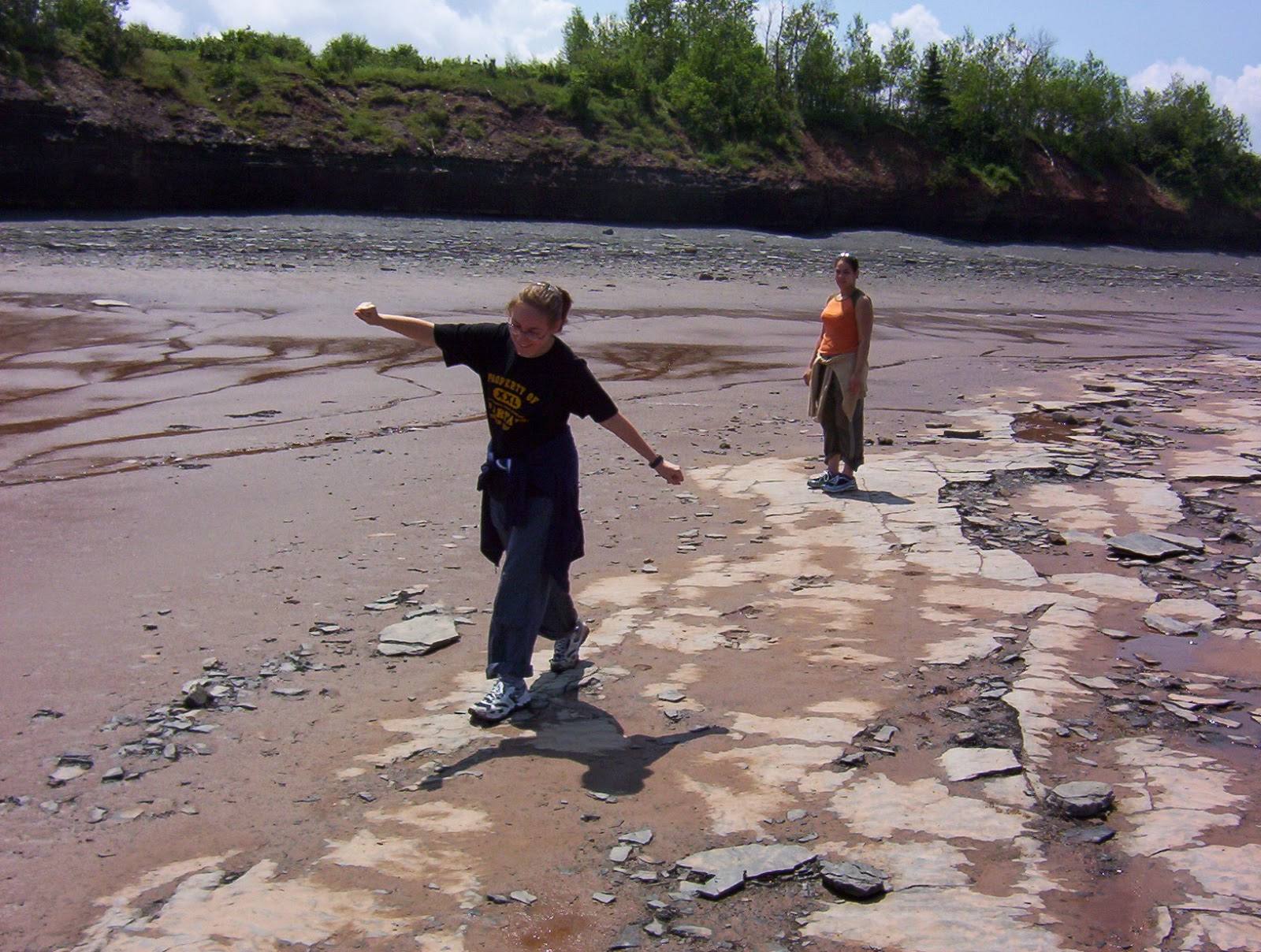
Just wanted to give a quick shout out to some old fossil friends of mine. Horton Bluff/Blue Beach is a pretty cool place and I have fond memories of field trips out there during my Dalhousie days. Between this new paper and the recent paper describing the Permian to Jurassic assemblage of tetrapods, it's been a good time for Nova Scotia palaeontology.

Your friendly neighbourhood ankylosaur palaeontologist, in the before time (i.e. 2003), at Horton Bluff, following in her tetrapod ancestor's footprints. It's goopy there.


Which of course makes me miss it all terribly.


Anderson JS, Smithson T, Mansky CF, Meyer T, Clack J. 2015. A diverse tetrapod fauna at the base of 'Romer's Gap'. PLOS ONE 10:e0125446.

Tuesday, April 7, 2015

A Brontobyte of Sauropods

Palaeontology emergency alert! This is not a drill! Brontosaurus is back!

YES I FINALLY GOT TO USE THIS ON THE BLOG. Success!


I mean, Brontosaurus never really left. That's the nice thing about taxonomy – once a name is out there, it's there forever, even if we decide later on that it might represent the same kind of animal that another name does. And so every now and then, we get to bring an old name back from the dead. Today, Tschopp and colleagues have published some very good support to indicate that Brontosaurus really is distinct from Apatosaurus after all, and we can all use that name and stop telling people that Brontosaurus isn't real. OMG, WHAT A RELIEF. 

To recap: Brontosaurus has not been an accepted name in the palaeontological community for more than 100 years, but because of its use in some museum exhibits, and things like the 1964 World's Fair and the "Rite of Spring" passage in Fantasia, for example, the name has become entrenched in the popular consciousness in a way few other dinosaur names have. It is very disappointing to learn that palaeontologists don't call that big dinosaur Brontosaurus, but the decidedly less evocative name Apatosaurus instead.

Click for sauropod-size. With many thanks to the authors and PeerJ for creating such a useful diagram, which I'm sure will be reproduced often and with much gratitude by palaeontologists, teachers, and other science communicators.


The new paper is staggering in its length (almost 300 pages!) and the amount of work it represents, and I'm not a sauropod specialist, so I'll summarize it here without delving into sauropod anatomy very much:
Two of the Big 3 diplodocids: Apatosaurus (in the back) and Diplodocus (foreground) face-off at the Carnegie Museum.

  1. Tschopp et al. did a specimen-level phylogeny of diplodocids, the sauropods like Apatosaurus and Diplodocus, but not Brachiosaurus or Camarasaurus. This means that individual specimens were coded, rather than species. Often, phylogenetic studies have just looked at the 'classic' diplodocids Apatosaurus, Barosaurus, and Diplodocus (the 'Big 3', shall we say?). And most of those studies elide the many species represented by these three genera. So a specimen-level phylogeny is a much-needed approach to resolve some questions about diplodocid diversity.
  2. They then used some techniques to quantify differences among specimens – pairwise dissimilarity, and apomorphy counts – that would help justify dividing clusters of individuals into different genera. There isn't a rule in palaeontology that individuals need to be a certain amount 'different' from each other in order to be a new genus or species, so the authors looked at how many unique characters separate some sauropods that everyone seems pretty comfortable calling different species and genera. Apatosaurus ajax and Apatosaurus louisae had 12 different features, and Diplodocus carnegii and Diplodocus hallorum had 11 different features. So 13 different characters was set as the baseline for separating out genera in the specimen phylogeny. Using the same approach, they also set 6 differences as the baseline for separating species within a given genus. These numbers only apply to this particular analysis, but it's an interesting approach that I think would be worth considering for other dinosaur phylogenies.
  3. Using this, they wind up doing some taxonomic reshuffling:

a.       Diplodocus longus lacks any diagnostic features at the species level and is a nomen dubium, which is bad because it's also the type species for Diplodocus. A petition to the ICZN to switch the type species to D. carnegii is in the works. Diplodocus includes the species D. carnegii and D. hallorum (née Seismosaurus)
b.      Dinheirosaurus (from Portugal) is a junior synonym of Supersaurus, and so Supersaurus is a cross-continental genus represented by two species.
c.       Diplodocus hayi passes the threshold for generic distinctiveness from Diplodocus and gets a new name, Galeamopus hayi. Specimens of Galeamopus are actually more complete than Diplodocus, which means that Diplodocidae is best represented by Galeamopus at present if you need a diplodocid for whatever you're working on.
d.      And finally, and arguably most significantly, Brontosaurus passes the threshold for generic distinctiveness from Apatosaurus. There are three species within Brontosaurus: B. exelsus ('classic' Brontosaurus), B. parvus (née Elosaurus), and B. yahnahpin (née 'Eobrontosaurus').


The third of the Big 3 diplodocids, the iconic rearing Barosaurus at the American Museum of Natural History.


I really hope this taxonomic shuffling gains wide acceptance, because 1) I think their approach and reasoning are pretty sound, and 2) it's going to be SO MUCH EASIER not to have to constantly 'debunk' Brontosaurus with non-palaeontologists.The oft-repeated story that "Brontosaurus" wasn't real because it had the head of one animal and the body of another is wrong, but the real story, about the rules of taxonomy and how we define species, is much more difficult to explain. (It's interesting, but it's not as easily parsed to a lay audience.) And let's face it, Brontosaurus was a really good name and it was sad that it had to be synonymized. The story of Brontosaurus now has a new and interesting chapter – our ideas about the biology of Brontosaurus have changed, but now we can talk about changes to how we think Brontosaurus looked and lived, rather than just focusing on a quirk of taxonomy. So let your Brontosaurus flag fly high, dinosaur fans, because Brontosaurus is back and that's awesome.

Old-timey sauropod in the little diorama at the Smithsonian, back in 2011.

Big taxonomic revisions are hard and important but often don't feel as 'sexy' as some of the other research that gets publicized. I like thinking about alpha taxonomy (uh, perhaps obviously) and I like doing this kind of research, and I think it's really important that we recognize how important this kind of work is – alpha taxonomy is really foundational to a lot of other studies. If you don't know how many species you have, or where they lived, or what anatomy belongs with each species, how can you do projects that look at the evolution of certain features through time, or understand changing ecosystems? 

For example, given that there's at least 14 species of diplodocid in only 11 million years of Morrison Formation, it's unlikely that there's a slice of time in there in which there's only one diplodocid species. (And remember, diplodocids weren't the only sauropods in the Morrison – this is also the home of Brachiosaurus and Camarasaurus and Suuwassea and who knows what else.) This is a pretty good reason to reject what I like to call the "Highlander hypothesis", i.e. There Can Only Be One ___(ankylosaur, tyrannosaur, whatever)___ in a given formation, something that I've encountered in conversations on occasion. It's understandable that we would feel unease at the idea of high species/generic diversity in such massive dinosaurs, because how are they dividing up ecosystem space? But over and over again it seems like lots of similarly-shaped dinosaurs were occupying similar times and spaces in terms of what we see in the rock record, which I find very interesting indeed. (Now what we need is a really good stratigraphic framework for putting all of these diplodocids into chronological and geographical context.) We can only do a good job of addressing these kinds of questions by having good data to put into those studies, and that data comes from taxonomic revisions like this one.

And revising taxonomy is probably a never-ending job, because we need to keep reassessing our definitions of genera and species as we get more information through new specimens. Let's make sure we all support this kind of research as palaeontology continues to evolve with new techniques, questions, and approaches. Bully for Brontosaurus, and bully for alpha taxonomy.


Stray observations:
  • The concept of a 'relatively small' animal that is 12-15 metres long amuses me. (re: Kaatedocus, page 2)
  • The 'brontobyte' image at the top of this post is an old joke from my Currie lab days; a brontobyte is actually 10^27 bytes. But I think it would be a good collective noun for sauropods, and it also feels appropriate given the large number of sauropod species recovered by Tschopp et al. In fact, we need more collective nouns for dinosaurs, and so I'd like to propose brontobyte for sauropods and armada for ankylosaurs, to join terror of tyrannosaurs.


Go read the paper! It's open access!: Tschopp E, Mateus O, Benson RBJ. 2015. A specimen-level phylogenetic analysis and taxonomic revision of Diplodocidae (Dinosauria, Sauropoda). PeerJ 3:857.

Sunday, October 5, 2014

Happy birthday, Dynamosaurus!

Today marks the auspicious anniversary of one of the most significant dinosaurs ever described: Dynamosaurus imperiosus! Surely one of the greatest and most fearful of all of the predatory dinosaurs, it stomped through the Maastrichtian of Wyoming and other parts of western North America. Dynamosaurus is noteworthy for its diagnostic dermal plates, which ran in transverse rows down its body and which formed a large knob of bone at the end of the tail. The function of these plates are still hotly debated, but they certainly gave Dynamosaurus a unique look among theropods.


I kid, of course, but I think Dynamosaurus deserves a mention on its more famous relative's naming day as well. Tyrannosaurus, Dynamosaurus, and Albertosaurus were all named by Osborn in 1905 and although Tyrannosaurus and Albertosaurus have proven to be distinct from each other, Dynamosaurus turned out to be a junior synonym of Tyrannosaurus. If Tyrannosaurus hadn't appeared first in the publication, good ol' T. rex might not be the household name it is today and we might all stand and gape at Sue or Scotty or Stan the Dynamosaurus. The distinctive osteoderms are probably Ankylosaurus osteoderms, although I haven't attempted to track down the specimens myself or any papers that discuss their identity, so I suppose they could also be Maastrichtian nodosaurid osteoderms. Updated 2 October 2015: Last year when I fired this off quickly I completely forgot that the Dynamosaurus osteoderms are figured in Ken Carpenter's 2004 Ankylosaurus paper!

Anyway, happy birthday, Dynamosaurus. I still like you, even if you never existed.


Osborn HF. 1905. Tyrannosaurus and other Cretaceous carnivorous dinosaurs. Bulletin of the AMNH 21: 259-265.

Osborn HF. 1906. Tyrannosaurus, Upper Cretaceous carnivorous dinosaur (second communication). Bulletin of the AMNH 22:281-296.

Friday, July 25, 2014

Big screaming hairy dinosaurs.

Kulindadromeus, a little ornithischian from the Jurassic of Siberia, has the palaeosphere abuzz with talk of fluff, feathers, scales, and all kinds of interesting integumentary goodness. Kulindadromeus has scales on its feet, hands, and tail, but the head, body, and upper limbs are covered in three different kinds of filamentous integument. 

Beautiful restoration of Kulindadromeus by Andrey Atuchin, via National Geographic.

Feathers and fluff are extensively known in coelurosaurian theropods (and possibly other theropods as well), but are more controversial in ornithischians. Bristle- or quill-like structures are known in the little ceratopsian Psittacosaurus, and in the 'heterodontosaur' Tianyulong, but since these structures are so different than the filaments and feathers of theropods, there's been some debate about whether or not they evolved independently of true feathers.


A not-so-great photo of a cast of the quilled Psittacosaurus specimen at the Carnegie Museum (look towards the top of the photo for the long, thin filaments), and a life restoration in the museum as well.


In Kulindadromeus, the torso and head are adorned with simple filaments that are thinner than the quill-like bristles in Psittacosaurus and Tianyulong. There are tufted plumes, where multiple filaments converge to a scale-like base, on the upper arm and upper leg. Finally, there are some ribbon-like clusters of filaments on the shins. The tufted plumes still aren't really like anything in the theropods, but the fact that they are branching filaments certainly suggests these are more feather-like than the quills of other ornithischians.

Besides its amazing fluff, Kulindadromeus is pretty neat for a couple of other reasons: 1) we don't really have a lot of dinosaurs from Siberia, so anything new from this region is cool!, and 2) basal things are always interesting, and 3) its non-feathery integument is super interesting! Kulindadromeus is a little more derived than Agilisaurus or Stormbergia, but is still in a relatively basal position in Neornithischia, the clade of ornithischian dinosaurs that includes everything except thyreophorans (ankylosaurs and stegosaurs), 'heterodontosaurs' like Heterodontosaurus, Fruitadens, and Tianyulong, and the most basal ornithischians like Pisanosaurus. The scales on its tail remind me of aetosaur osteoderms, but lack any bone and so aren't osteoderms, but true epidermal structures.

Anyway, I've been thinking about dinosaur skin a lot lately, having written papers on ankylosaur scale pattern diversity and soft-tissue crests in Edmontosaurus. In particular, I'm intrigued by the idea of scaly and fluffy ornithischians. We know that hadrosaurs and ankylosaurs had scaly skin, but does that preclude having fluff too? Well, Kulindadromeus shows you can totally have skin and fluff in different regions of the body. On the other hand, lots of large mammals today lack hair over most of their body, so large dinosaurs may have done the same.

Most of the ankylosaur skin impressions I know of come from Alberta, where the conditions are not ideal for preserving feathers and fluff. However, it's not impossible – feathers have been reported from ornithomimids from Alberta, so maybe we just need to look more carefully in the future. I think the idea of a fluffy ankylosaur probably seems preposterous – how could such an armoured, osteodermy animal have filaments in addition to its tough scales? And it's true – most animals today with osteoderms, like crocodiles, turtles, and lizards, don't have fluff. But there's one group of animals around today that very definitely have osteoderms and fluff:

Via Arkive.

Here's the big hairy armadillo, Chaetophractus villosus. It's one of the fuzziest of the armadillos, with lots of coarse hair on its belly, but also hairs growing off of the individual scutes (if I understand correctly). I'm not going to argue that ankylosaurs definitely had this kind of morphology – armadillos, being mammals, have totally different osteoderms than ankylosaurs that evolved on their own independent evolutionary pathway, and mammal hair/skin and ankylosaur skin are very different. Additionally, we now have evidence for branching filamentous structures as far back as Neornithischia, but ankylosaurs lie outside of that clade (Tianyulong, with its quills, is more basal than ankylosaurs). But being an armoured, osteodermy animal does not always rule out also being a gross hairy thing. Because seriously, look at that guy.

So here, have a big hairy Pseudoplocephalus. He's not so bad, is he?


Or better yet, make it a screaming hairy Pseudoplocephalus, like Chaetophractus vellerosus.


Papers! (And if anyone has any literature on big hairy armadillos, please send it my way!)

Arbour VM, Burns ME, Bell PR, Currie PJ. 2014. Epidermal and dermal integumentary structures of ankylosaurian dinosaurs. Journal of Morphology 275:39-50. [Paywalled! Accessible post here.]

Bell PR, Fanti F, Currie PJ, Arbour VM. 2014. A mummified duck-billed dinosaur with a soft-tissue cock's comb. Current Biology 24:70-75. [Paywalled! Accessible post here.]

Godefroit P, Sinitsa SM, Shouailly D, Bolotsky YL, Sizov AV, McNamara ME, Benton MJ, Spagna P. 2014. A Jurassic ornithischian dinosaur from Siberia with both feathers and scales. Science 345:451-455. [Paywalled! Accessible post here.]

Mayr G, Peters SD, Plodowski G, Vogel O. 2002. Bristle-like integumentary structures at the tail of the horned dinosaur Psittacosaurus. Naturwissenschaften 89:361-365. [Paywalled! Accessible post here.]

Zelenitsky DK, Therrien F, Erickson GM, DeBuhr CL, Kobayashi Y, Eberth DA, Hadfield F. 2012. Feathered non-avian dinosaurs from North America provide insight into wing origins. Science 338:510-514. [Paywalled! Accessible post here.]

Zheng X-T, You H-L, Xu X, Dong Z-M. 2009. An Early Cretaceous heterodontosaurid dinosaur with filamentous integumentary structures. Nature 458:333-336. [Paywalled! Accessible post here.]

Thursday, May 22, 2014

Did the sauropod Leinkupal survive the End Cretaceous mass extinction?

No.

Discovery News has a short video up discussing a new paper in PLOS ONE, Gallina et al.'s "A diplodocid sauropod survivor from the Early Cretaceous of South America". I think it is really great that they want to showcase this interesting new find! But the DNews report leaves an awful lot to be desired.


The news report is titled "There's a dinosaur that survived mass extinction!", which would lead most people to think that some kind of post-Cretaceous dinosaur has been discovered. At about 25 seconds in, the reporter says this is the first time scientists have found a dinosaur that survived the great extinction, presumably referring to the End Cretaceous mass extinction that happened 66 million years ago. Right away, it seems that there's a huge misunderstanding here – there have been multiple mass extinctions in the history of life, not just the one that killed the non-avian dinosaurs. Additionally, the 'great extinction' should really refer to the End Permian extinction, by all accounts the most devastating mass extinction ever.

Anyway, Gallina et al. have described a new diplodocid sauropod, called Leinkupal, from the Early Cretaceous (probably about 140-130 million years ago) in Patagonia. This is significant because diplodocid sauropods were pretty abundant in Jurassic rocks from North America, Europe and Africa, but seem to have disappeared from the fossil record after the Jurassic. Since diplodocids were present in the Jurassic of Africa, it was also thought that they were probably present in the Jurassic of South America, but no fossils had ever been found. So, Leinkupal confirms one hypothesis (that diplodocids were present in South America), and also rejects another (diplodocid sauropods went extinct at the end of the Jurassic). Good stuff all around! But Leinkupal does not tell us that dinosaurs survived the 'great extinction' (whatever that is), and it certainly did not survive the End Cretaceous extinction, on account of it having been dead for about 70 million years before that happened.


This little video is an amazing microcosm of misconceptions about evolution and palaeontology, and it's really frustrating to see this coming from Discovery News. Here's some other little snippets:

* "The diplodocid sauropod is a family" – I hate to nitpick over grammar (wait, who am I kidding – I love nitpicking over grammar!), but the grammatical failure here I think represents a pretty basic misunderstanding of how taxonomy works. Later on, the reporter says of diplodocids that "the species was thought to be an exclusively North American dinosaur". Diplodocids are a subset of sauropods, in the same way that sauropods are a subset of dinosaurs. Diplodocidae is the formal 'family' name for this group, and Diplodocidae contains many genera and species. Some of these are familiar, like Diplodocus and Apatosaurus, some are less familiar, like Tornieria and some are new, like Leinkupal. We use classification systems to understand how animals are related to each other, and to understand the scale of certain biogeographic patterns. Getting this stuff right is both relatively easy and also important!

The imposing figure of "Seismosaurus" hallorum, a diplodocid from New Mexico on display at the New Mexico Museum of Natural History & Science. "Seismosaurus" is thought by some authors to be the same genus as Diplodocus.

*At one point, the reporter says that diplodocids were "assumed to have gone extinct", which is kind of true but also takes a lot of the science out of the story! Palaeontologists didn't just assume diplodocids were extinct, they observed the pattern in the fossil record in which diplodocids were present in some layers and then not in others, and concluded that either 1) diplodocid sauropods went extinct at the end of the Jurassic or 2) we have incomplete data, and sauropods may just not be preserved in the post-Jurassic rocks we've looked at. It turns out that the latter idea was correct!

* The reporter comments that the Patagonian discovery is the earliest record of diplodocids. It's easy to get mixed up with this sometimes, but Leinkupal represents the youngest, and therefore latest record of the group. The earliest record of a group would be the first record, and therefore the oldest record. Since this is the main point of this story, they should really get this right!

* The reporter also states that Leinkupal was found in a place that palaeontologists never expected (South America), when in fact the biogeographic pattern of known diplodocids hinted strongly at the possibility of South American diplodocids. This is so great! We were able to use our knowledge of the fossil record to predict where we might find a kind of dinosaur that we had not found there before.

* Finally, the segment opens with the reporter making a show of how hard it is to pronounce the new dinosaur's name. It's true that Leinkupal doesn't have the familiar Something-saurus structure that lots of dinosaurs have, but it's not overly difficult to pronounce. There are two things that bother me here: 1) Why, Discovery News, are you making your female presenter pretend to be dumber than she surely is? and 2) An unfamiliar foreign word is made out to be this super weird and difficult thing, when they could have taken a moment to point out that this unusual name means "Vanishing family" in Mapudungun. It's a beautiful and evocative word that reflects the significance of the specimen, and highlights a local language that most of us are not familiar with. A moment that could have been used to learn something new was instead used to indicate that new things are weird and learning is hard.

This is really shallow and lazy writing. All of the important points to cover in a video segment of this length can be found in the three-paragraph introduction of the open-access paper. There's no excuse to not get it right. Instead of highlighting how this discovery shows the power of scientific predictions, we got a video that can't get basic facts correct, and pretends that this stuff is really hard rather than working to make it accessible to everyone.

Friday, April 27, 2012

Waking up from hibernation.

And by hibernation, I mean grad school. The last few weeks have been pretty busy here in Edmonton and I've found myself without a lot of time to blog about interesting things that have been going on. Thankfully, that busy-ness is a result of research productivity and teaching, which are both good things! So, over the next few days, as we head into the (still somewhat cold) field season here in Alberta, I'll try to cover a bit of what's been happening for the last couple months...

First up: Alberta Paleontological Society Symposium

I can't believe it's been more than a month already since the APS symposium! The Alberta Paleontological Society is a group of amateur and professional paleontologists from around Alberta, which organizes summer field trips and an annual symposium and workshop series. The symposium is always a good time, and there's usually palaeontology professors and grad students from the University of Calgary, University of Alberta, and Royal Tyrrell Museum (plus often other institutions like the T. rex Discovery Center, Canadian Fossil Discovery Centre, Tumbler Ridge Museum, and Grande Prairie Regional College). This year I gave a talk about my travels in Korea, China, and Mongolia last summer, and was also invited to host a 3-hour workshop the following day.


Because I was expecting a largely adult audience (rather than families or mostly small children), I had to come up with something a little different than previous dino-workshops I've given. What do you do that's hands-on, not super boring, and not a craft? Well, two years ago I, and my fellow grad student Mike Burns, had given a talk about the frequent (and usually hilarious) misrepresentation of ankylosaurs in the popular media, and it had been a big success. So I decided to run with that. I brought with me a bunch of ankylosaur casts (skulls, a tail club, a foot), and some real fossils (osteoderms, thin sections, teeth), and lots and lots of popular reconstructions of ankylosaurs, mostly in the form of toys (or, uh...scientific models?) and books. These were scattered around the lab, which holds about 20 people.


Over the course of the workshop, I talked for about 10-15 minutes at a time about the anatomy of ankylosaurs, starting with a general overview, then moving on to the skull, skin/armour, tail, and legs and feet. We finished up watching a couple of clips from various documentaries and talking about posture, movement, and behaviour. Each workshop attendee picked 2 or 3 reconstructions to evaluate during the workshop, and had a worksheet to make notes about the anatomy of their reconstructions. After I would talk about some aspect of ankylosaurs, there was 10-20 minutes for looking at specimens, discussing the pros and cons of different reconstructions, and asking questions. Then I'd call everyone back together and ask who had the worst/best reconstructions and why.

If you're ever called to do a dinosaur or paleontology workshop for adults - do this! It was lots and lots of fun. It required fairly minimal preparation, which is a plus if you're often asked to do this sort of thing. I spent a couple of hours at most putting together a powerpoint of mostly specimen images, picking out books and toys and fossils to bring with me, and making up some handouts). It's a great way to engage adult learners, and could probably easily be restructed to work for kids or families as well.

More importantly, I think this might be a really effective way of communicating a lot of information about paleontology in a way that will encourage the general public to look at popular science more critically. Since most people will generally not be going to the primary literature to answer their paleontology-related questions, their information is going to come from illustrated books, magazine
articles, computer animated documentaries, and museum exhibits. If I had just discussed the anatomy of ankylosaurs via presentation and specimens, I'm not sure a lot of the points I discussed would have sunk in as much as they did by critiquing the illustrations and toys most people are likely to encounter. This was an easy way to make a talk more hands-on, and the casual atmosphere and conversation between the workshop attendees was really great.

The next APS Symposium will be held on Saturday, March 16, 2013. The symposium is always held in the Jenkins Theatre at Mount Royal University in Calgary, Alberta.


(Thanks to Angelica for taking some photos of the workshop!)

Sunday, March 25, 2012

5 Questions for Aaron Leblanc

It's been a bit quiet around here lately as I plug away at my thesis, but here's an interview with UALVP alumnus Aaron Leblanc, now a PhD student at the University of Toronto. Aaron's description of the new mosasaur Eremiasaurus was published in the January issue of the Journal of Vertebrate Paleontology.


1. What inspired you to conduct this study?

My inspiration for this study comes from my work on an undergrad honors thesis with Dr. Michael Caldwell back in 2007–2008. I remember being shown potential subjects for my project and being drawn to the skull of what is now Eremiasaurus right away. Back then only the left side of the skull was prepared and really didn’t look like much, because most of the elements of the skull had been badly crushed and displaced from their original positions (Al Lindoe did a great job preparing the other side of the University of Alberta specimen, but that didn’t happen until I had started my Master’s thesis on the same subject over a year later). Even at that point you could tell that the teeth of this mosasaur were really unusual. I think the teeth alone were what drew my attention and got this whole project rolling.

2. How does a mosasaur wind up in Morocco?

By the end of the Cretaceous, mosasaurs were everywhere, but this wasn’t the case around 90 million years ago when the first mosasaurs took to the seas. At that point in time, mosasaurs were rather small, occasionally reaching lengths of two meters or so. More importantly, these early mosasaurs were probably still capable of walking on land and may have been restricted to shallow marine habitats. Coincidentally, the early fossil record of mosasaurs is quite restricted geographically. Most of the early mosasaur fossils (a group traditionally called the aigialosaurs) have been recovered from Croatia, Slovenia, and possibly from Texas. If you fast-forward to the Maastrichtian, the time interval from which Eremiasaurus is found, mosasaurs had become incredibly large (some reaching body lengths of 15 meters) and their remains have been recovered from every continent, including Antarctica. The occurrence of mosasaurs in Morocco isn’t a new discovery, but it is certainly becoming an increasingly more valuable data point the more we learn about their diversity and paleoecology during that time and in that particular region of the globe. The Late Cretaceous seas of Morocco were home to some very unique mosasaur taxa that occupied nearly every aquatic predatory niche, from hard shell-crushers like Globidens phosphaticus to (what I believe, anyway) fish-eaters like Eremiasaurus heterodontus.

3. What is special about the tail of Eremiasaurus?

Nobody paid particular attention to the tails of mosasaurs until a recent study of Plotosaurus bennisoni from the Maastrichtian of California by Johan Lindgren and colleagues back in 2007. Their work was incredibly important, because it challenged a traditional view of mosasaurs as resembling giant sea serpents, slithering through the water using side-to-side motions of their whole bodies to move through the water. What Lindgren et al. (2007) were able to show is that there is anatomical evidence that the tails of more advanced mosasaurs were much more specialized for aquatic locomotion than this historical view. The vertebrae at the base of the tail (called pygals) did not allow much side-to-side movement and the bony supports for a tail fin were pushed further back along the body. What this means is that at some point in their evolutionary history, mosasaurs abandoned that slithering style of swimming for a more thunniform (tuna-like) body shape and swimming mode. This represents a more efficient swimming style for cruising the open waters and engaging in pursuits of food, instead of lurking and ambushing. Mosasaur researchers aren’t as lucky as those that study ichthyosaurs (an unrelated group of marine reptiles), because there are no recorded cases of soft tissue outlines of the tails of mosasaurs. While it is only speculative, the current view is that mosasaurs had a crescent-shaped tail fluke like an ichthyosaur or a Great White shark. The vertebral column in well-preserved mosasaur specimens, including Eremiasaurus, has a gentle downward bend that starts just behind the pelvic girdle, and the tall neural and haemal spines (upwards and downwads projections of the tail vertebrae respectively) form a broad sweeping fan at the back of the tail that would have supported an expanded dorsal tail fin made entirely of soft tissue.

Where Eremiasaurus differs from other mosasaurs is in how far back the bony supports of the tail fluke have been “pushed” compared to other species. While it isn’t the most ichthyosaur-like tail ever reported for a mosasaur (though it is a close second), it still suggests that it adopted a more thunniform style of swimming than most other related forms.

4. What is unusual about the teeth in Eremiasaurus?

The teeth are certainly the most conspicuous features of the skull of Eremiasaurus. I always imagined it having a fiendish grin, especially when looking at the right side of the skull of the University of Alberta specimen. The teeth are unusual in that they change shape so dramatically along the length of the jaws and along the roof of the mouth (mosasaurs had a second row of upper teeth that lined the pterygoid bones, just for good measure). The front teeth are straight and cone-shaped,


the middle ones are slender triangular blades,


and the back teeth are more bulbous and hooked.


Whatever Eremiasaurus was eating, it was very good at tearing it apart into smaller more palpable pieces. The front teeth interlock when the jaws are closed, making for an efficient trapping mechanism, while the middle and back teeth are serrated and shear past each other like a pair of scissors to cut and dismember prey. The pterygoid teeth are curved backwards and would have kept struggling prey in the mouth. From an evolutionary perspective, attributing these kinds of teeth, tail anatomy and other unusual features of the skull to anything but a new genus and species was all too difficult.


5. What does Eremiasaurus tell us about the relationships among mosasaurs?


Adding Eremiasaurus to an existing phylogeny of mosasaurs added a great deal more complexity to the story, particularly within the subfamily Mosasaurinae (the group to which Eremiasaurus belongs). In many ways Eremiasaurus is an intermediate between two well-established groups of mosasaurines, something that was clear from the first phylogenetic analysis we performed. Where these relationships became more complex was in a second analysis in which we added and updated information to the existing data set. We performed this second analysis, because many of the characters and species of mosasaurines that were originally used back in 1997 by Gordon Bell were in need of revision. New species had been described since then and had not incorporated into such an analysis, while others had since been re-examined and re-described. Using this updated data set, we were able to conclude that many of the features previously thought to be diagnostic for one of the major groups of mosasaurines were actually present in most of the members of the other group as well, or were secondarily lost. Because of this, many of the previously well-established relationships within the subfamily Mosasaurinae broke down in this analysis, suggesting that there is a need to reconsider some of our classifications, or re-evaluate the characters that we use to define them.


Thanks Aaron! You can read more about Eremiasaurus in:

Leblanc ARH, Caldwell MW, Bardet N. 2012. A new mosasaurine from the Maastrichtian (Upper Cretaceous) phosphates of Morocco and its implications for mosasaurine systematics. Journal of Vertebrate Paleontology 32:82-104.

Thursday, February 23, 2012

Gobi Desert Diaries: Nemegtomaia Edition

Today I've got five questions for Federico Fanti, the lead author on a paper published a few weeks ago in PLoS ONE on a nesting oviraptorosaur. I first met Federico during the 2007 Nomadic Expeditions Dinosaurs of the Gobi expedition, in which we all had a grand time prospecting for dinosaurs and during which we celebrated a fine discovery indeed.


1. What inspired you to conduct this study?

Well, the fossil itself! I grew up with incredible pictures taken somewhere in the Gobi Desert of Mongolia, with spectacular fossil remains literally emerging from the vermillion sand. When Phil Currie and I realized that we were looking at a nesting dinosaur we were simply happy and enthusiastic: there are only 5 specimens of brooding dinosaurs known to date in the world, it is a unique find. I couldn't wait to find out more about this specimen and finally, after more than four years, I'm glad to see the paper out.

 
(MPC-D 107/15 diagram from Fanti et al. 2012, by Marco Auditore.)

2. Nemegtomaia is not exactly a household dinosaur name. Who is Nemegtomaia?
Nemegtomaia means "good mother of the Nemegt" and curiously the name was chosen long before our discovery. In the '90s, the type specimen - including a nicely preserved skull - was collected from the Nemegt Formation not far from where we found the nest: however, no trace of eggs or nest were found at the time. The discovery of MPC-D 107/15 (or Mary, as I still like to call it) definitely supports the choice of Nemegtomaia as the name for this species. Nemegtomaia is a genus of oviraptorid dinosaur that inhabited what is today southern Mongolia during the late Cretaceous period, approximately 70 million years ago. It is characterized by a well-developed crest on the skull and relatively short forelimbs with robust claws.

(Nemegtomaia skeleton reconstructions from Fanti et al. 2012, by Marco Auditore.)

3. What's so special about MPC-D 107/15?
Unlike all other nesting dinosaur that have been discovered so far, this specimen has a nicely preserved skull and therefore it was possible to reliably refer MPC-D 107/15 to the genus Nemegtomaia. Furthermore, within the context of the Nemegt area where dinosaur eggshells are frequently recovered, it was possible to refer a specific egg type to this genus. In addition, the preservation of the forelimbs allowed us to reconsider the classification of this genus within the oviraptorosaurs: unlike many other oviraptorid species, in fact, Nemegtomaia has relatively short and robust forelimbs, indicative of different adaptations and behavior.

4. In the acknowledgements section of the paper you note that MPC-D 107/15 was excavated 'under what were at times difficult circumstances'. How did you find this specimen, and what were the challenges in excavating it?
I found the specimen while prospecting in a sayr, a canyon located not far from the Camp. It was barely cropping out from a vertical cliff, about 3 feet from the valley ground. A section of the nest and of the pelvis was visible at the time, meaning that, with the exception of the tail, the skeleton was still preserved in the cliff.

(Federico did well to spot the nest, which was hardly exposed at all in the surface - just eggs and legs in cross section.)


It took a full week and the work of several people to take it out, and I must thank all the people that participated in the 2007 fieldwork (including the author of this blog! [aw, shucks - VMA]) for the help in the field.


Difficult circumstances? A mix of heavy rain, collapsing blocks of sandstone alternated with 45 degrees in the shadow are .. interesting circumstances!

(Although I didn't spend much time working on the nest excavation, I do know what Federico, Phil, and Badam are referencing when they say 'difficult circumstances'. On the second-to-last day in Nemegt, the skies opened and it poured rain ALL DAY. The nest had to come out the next day, so a team went out to the site and worked under a tarp all day in the soggy, soggy desert.)


5. What does this specimen tell us about the nesting habits of oviraptorosaurs?

Nemegtomaia has been collected in both the Baruungoyot and Nemegt formations, which are representative of aeolian/desertic and fluvial environments respectively. This indicates that Nemegtomaia was a long-living genus and adapted to different environmental and climatic conditions. The nest preserves approximately 20 eggs: we know from other spectacular specimens of oviraptorid dinosaur that they were able to laid 2 eggs at time, thus we assume that different individual laid their eggs in a single nest. As a consequence, the animals that we discover in brooding position are not necessarily the parents nor the mothers. It is possible that a male was "selected" for parental care during early development of embryos.


If you haven't yet read Fanti et al. (2012), go get it right now for free from PLoS ONE! Thanks Federico!