Showing posts with label Royal Tyrrell Museum. Show all posts

Wednesday, September 10, 2014

What's new with Dino 101?

The third offering of Dino 101 kicked off again last week, and we're already into our 2nd lesson, on taphonomy and fossilization. Here's a quick update for what's new this time around!
  • A new section about the palaeobiogeography of dinosaurs was filmed, including lots of new scenes at the Royal Tyrrell Museum
  • We get to show off the Edmontosaurus with the "cock's comb"!
  • We added in some more information on non-dinosaurian critters from the Mesozoic throughout the course, including pterosaurs, marine reptiles, and early mammals
  • I made a bunch of new 3D models for our fossil viewer interactive – now you can enjoy the baby chasmosaur's skull in three dimensions of terror and amazement!


These are all in addition to some of the snappy upgrades to version 2, like the section on the baby chasmosaur and the fancier study guides.

So far there's more than 11 000 students registered in Dino 101 v3, which means we've now reached nearly 50 000 students from around the world! The on-campus versions of Dino 101, including the flipped/blended PALEO 201, are also underway, and the PALEO 201 team is making some new activities about dinosaur footprints and trackways. I'm sure they're going to have a great time!

You can join the fun at Dino 101 for free - register now at Coursera! And you can follow the course in its various social media forms, including Facebook and Twitter.

Sunday, December 1, 2013

Paleo201 comes to an end

The first offering of Paleo201, Dinosaurs in the Fossil Record, essentially comes to an end today with the final field trip of the semester. The students will have their exam later in December.

Even though it is a lot of work to be involved in the creation of a new course, I think Paleo201 is a great addition to the University of Alberta's paleontology offerings. Using the Dino101 content on Coursera, and pitched at an essentially first-year level (despite its 200 designation) for students from all faculties, Paleo201 is what's called a blended learning course. We rely on the Dino101 course videos to deliver the base lecture content for the course, which means we typically only meet once per week for an in-class lesson. These lessons have included research talks by grad students in our labs on topics relevant to each week's lesson. However, we also tried to break away from the lecture format for at least some of the in class lessons, to take advantage of some of the resources available on campus. One week we learned the basics of the rock cycle and general Canadian geology using the Department of Earth and Atmospheric Sciences Geoscience Garden, an installation of rocks from around Canada arranged in a particular fashion for students to learn basic mapping skills. And last week we did tours of the Paleontology Museum and our prep labs, including sneak peeks of some cool up and coming research projects. FUN FACT: Our Dunkleosteus skull cast was ranked higher than the dinosaur specimens in my highly scientific 'what did you find most interesting' poll. Blindingly obvious take-home message for instructors: Students like new things and surprises, and dinosaurs are not necessarily the be-all and end-all!

But the highlights, in my opinion, are the three field trips to Jurassic Forest, Dry Island Buffalo Jump Provincial Park, and the Royal Tyrrell Museum.

Jurassic Forest is a tourist attraction outside of Edmonton that features animatronic dinosaurs set outside in a forest. Although I had some comments that this was an odd place to take students on a university field trip, I actually think it worked really well as a way to ease students into some of the topics covered in the first couple of lessons – basic dinosaur anatomy, diversity, diet, etc. And because a lot of the signage and interpretive material at the forest has been put together by graduates of the UofA's BSc program in Paleontology, the educational content is accurate, up to date, and nicely presented.


Many of the students told me that our trip to Dry Island was the first time they had really gone hiking, so I think that speaks to the value of having a course like this one. We hiked the students around the badlands and out to the Albertosaurus bonebed, stopping to discuss  geology, look for fossils (but not collect any, as we didn't have permits this time), and talk about how we interpret bonebeds and make inferences about dinosaur behaviour. Everyone was SO EXCITED to find little bits and fragments of bones. A couple of the students told me they returned the next weekend with their families because they had enjoyed the field trip so much! Blindingly obvious take-home message for instructors: Students like to go outside! And while videos and online stuff and lectures are perfectly fine, doing 'real' things with real fossils and real locations etc. etc. can never fully replace the online experience. Also I got artists and history students and linguistics majors and such to like rocks, so there.


And today we headed down to the Tyrrell Museum, which is a bit of a long day trip from Edmonton, since Drumheller is a little more than 3 hours away – but we were helped along by some dino documentaries. As always, the museum is an amazing resource, and it was super fun to see the students putting together many of the different concepts learned this semester. There were many good questions and enthusiastic discussions about the things we were seeing. And of course, having Phil there to talk to the students about the history of the museum and some of his personal experiences in collecting many of the fossils on display is pretty cool!


Because this is partly an online course, one of the things I've tried to incorporate into the field trips is discussion of the field trip in the course discussion forums. Each time the students have had to take a picture of themselves with a backdrop of choice (favourite dinosaur at Jurassic Forest, favourite scenic view at Dry Island, favourite display at the Tyrrell) and tell us something about it. This worked really well and it is also a fun way to get some feedback about what people are twigging onto as interesting in the course. Fun fact: Not everyone's favourite dinosaur/etc. was T. rex! There is hope for the world!


This is the last course for which I will ever be a teaching assistant, as my grad school days are wrapping up in a few weeks. This course was lots of fun to teach, hopefully has been fun to take, and I hope future students and instructors have as much fun as I did!

Tuesday, May 14, 2013

Who-oplocephalus: The Fellowship of the Half Ring

Behold, NHMUK R5161: the extraordinary holotype of Scolosaurus cutleri. This is truly one of the most amazing dinosaur fossils that has been collected from Alberta, and is one of the best preserved ankylosaurs in the world. And the best part is that it is on display for everyone to enjoy in the galleries of the Natural History Museum in London.

(Many thanks to Angelica Torices for snapping this photo for me! NHMUK R5161 is beautiful to look at, but difficult to photograph well, and I'm afraid most of my photos from my visit in 2009, while useful to me, are not necessarily that nice to look at.)

Most of the time, when you're looking at a drawing or model of Euoplocephalus, what you're really mostly looking at is NHMUK R5161. This specimen preserves a large amount of intact skin, which means that the free-floating osteoderms are, for the most part, in their correct life positions. Osteoderms form in the dermis of the skin, and so osteoderms are usually found as isolated elements, or scattered around disarticulated or associated skeletons. Because NHMUK R5161 is so complete, it has formed the basis for most restorations of Euoplocephalus.

Yup, all of these are kind of Scolosaurus. Especially the pink one. Perhaps somewhat embarassingly, this does not represent my complete collection of ankylosaur 'scientific models'.

However, you may have noticed something important: Scolosaurus lacks a skull and tail club. So, how could I figure out if Scolosaurus was the same as Euoplocephalus, if I couldn't look at the patterns of cranial ornamentation? If you remember back to part 2 of this series, I said that the morphology of the first cervical half ring was useful for diagnosing Euoplocephalus. 

The first cervical half ring of NHMUK R5161 has some important differences when compared to CMN 0210, UALVP 31, or AMNH 5406. In NHMUK R5161, the two medial osteoderms (closest to the midline) are round and lack keels, instead having a centrally located bump. Even in specimens of Euoplocephalus that have relatively flat medial osteoderms on the cervical half rings, like AMNH 5404, the medial osteoderms always have a keel and are more oval than circular. This suggested that Scolosaurus was distinct from Euoplocephalus and Anodontosaurus, even though it didn't have a head or tail club. (I largely agree with Penkalski and Blows' (2013) assessment that Scolosaurus is a valid taxon, but for somewhat different reasons than what they present in their paper.)

This reconstruction of Scolosaurus was drawn by Alice Woodward based on NHMUK R5161, and I suspect that many subsequent images of Scolosaurus were inspired by Woodward's art.

(A quick note about tail clubs and Scolosaurus – many artists have reconstructed this animal with a short tail and spiked tail club. The tail of NHMUK R5161 is broken at about the midpoint of the tail, probably just in front of where the tail club would have started. The skin is kind of sloughed out in this area, which has led many to erroneously interpret Nopcsa's figures and drawings as showing the knob of bone at the end of the tail. The 'spikes' on the tail club are really just osteoderms present at about the midpoint of the tail – no ankylosaurs had spikes on their tail clubs.)

The collection of NHMUK R5161 is one of the more interesting stories of palaeontological collecting in Alberta. The specimen was discovered and primarily excavated by William Edward Cutler in 1914, working for the Calgary Syndicate for Prehistoric Research (an excellent name for an organization that is, sadly, defunct). During excavation, the ankylosaur block collapsed on Cutler, no doubt causing grievous injuries. One of the Sternbergs finished the excavation, and the specimen was shipped to London.

NHMUK R5161 is significant, beyond being so complete, because it may derive from the Oldman Formation of Dinosaur Provincial Park, rather than the Dinosaur Park Formation. The quarry is somewhere across the river from Happy Jack's, the University of Alberta's field camp since 2008. However, the precise locality of the quarry is somewhat up for debate, and Oldman Formation sediments crop out in this area. Next week I'll be heading to Dinosaur Provincial Park, and one of the goals is to check out some of the potential quarry locations with our crew from the UofA, as well as Darren Tanke from the Tyrrell Museum, who has been investigating the NHMUK R5161 quarry for some time. It's important to know whether or not Scolosaurus comes from the Oldman or Dinosaur Park formation, so we can know whether or not Scolosaurus lived at the same time as Euoplocephalus. We will also be on the lookout for any leftover material…like the skull and tail club.

Two Medicine Formation skulls, from Arbour and Currie (2013). Notice the long, curved squamosal horns.

For a long time I was bitterly disappointed that there was no skull known for Scolosaurus. Could some of the isolated skulls I was referring to Euoplocephalus instead belong to Scolosaurus? Or was the skull of Scolosaurus noticeably different from Euoplocephalus? I despaired that I wouldn't have an answer to that question unless we miraculously collected another Scolosaurus from Dinosaur Park during my thesis. In the meantime, I was trying to figure out the identities of "Euoplocephalus" specimens from the Two Medicine Formation of Montana, which seemed very different from the Albertan specimens. These skulls had much longer and pointier squamosal horns with a 'backswept' appearance compared to Euoplocephalus and Anodontosaurus. I thought perhaps that the Two Medicine ankylosaurids might represent a new species of ankylosaurid (as did others – Penkalski named Oohkotokia earlier this year based on MOR 433, which has this unusual squamosal horn morphology).


From left to right, the first cervical half rings of AMNH 5337, TMP 2001.42.9, USNM 7943, and NHMUK R5161. The top row shows the half rings in anterior or posterior view, and the bottom row shows the rings in dorsal view. NHMUK R5161 is in dorsal view. Modified from Arbour and Currie (2013).


One day I was flipping through my photos of the Two Medicine Formation specimens when I realized that the morphology of the first cervical half ring of TMP 2001.42.9, the only specimen that had a half ring and skull, matched that of NHMUK R5161. Both had flat medial osteoderms with a central bump, rather than a keel. And indeed, another isolated half ring from the Two Medicine formation had this morphology as well. Scolosaurus was present in Montana!

I'll just take a moment here to address Oohkotokia: while I agree with Penkalski (2013) that the Two Medicine Formation ankylosaurid differs from Euoplocephalus, I do not think it differs sufficiently from Scolosaurus for these to be considered separate species. Perhaps one day in the future we'll find another Scolosaurus from Dinosaur Park that has flat medial osteoderms on the cervical half ring, but a skull with different squamosal horns compared to the Two Medicine skulls. If that happens, then I think you could make the case that Oohkotokia is valid. Until then, Oohkotokia is a junior synonym of Scolosaurus.


With the referral of the Two Medicine ankylosaur material to Scolosaurus, Scolosaurus now had a head! TMP 2001.42.9 even has a tail club, so we know that Scolosaurus had a round tail club knob. With the in situ osteoderms and skin impressions of NHMUK R5161, Scolosaurus is now one of the best understood ankylosaurids in the world. Now, if we could just figure out for certain exactly where it was collected from…

Next time: wrapping up loose ends, and figuring out what it all means.


PAPERS!


Arbour VM, Currie PJ. 2013. Euoplocephalus tutus and the diversity of ankylosaurid dinosaurs from the Late Cretaceous of Alberta, Canada, and Montana, USA. PLOS ONE 8:e62421.

Nopcsa BF. 1928. Palaeontological notes on reptiles. V. On the skull of the Upper Cretaceous dinosaur Euoplocephalus. Geologica Hungarica, Series Palaeontologica 1:1-84.

Penkalski P, Blows WT. 2013. Scolosaurus cutleri (Ornithischia: Ankylosauria) from the Upper Cretaceous Dinosaur Park Formation of Alberta, Canada. Canadian Journal of Earth Sciences 50:171-182.

Penkalski P. 2013. A new ankylosaurid from the Late Cretaceous Two Medicine Formation of Montana, USA. Acta Palaeontologica Polonica, in press.

Monday, September 10, 2012

What I Did on My Summer Vacation: Danek Bonebed

The summer is over and school is back in session. Here in Edmonton the leaves already started to turn yellow last week. And somehow the summer got so busy that I hardly posted anything at all here. So, it's nice to fix that up and talk about what I did on my summer 'vacation', by which I mean the time that undergrads are not at university but grad students are.
 
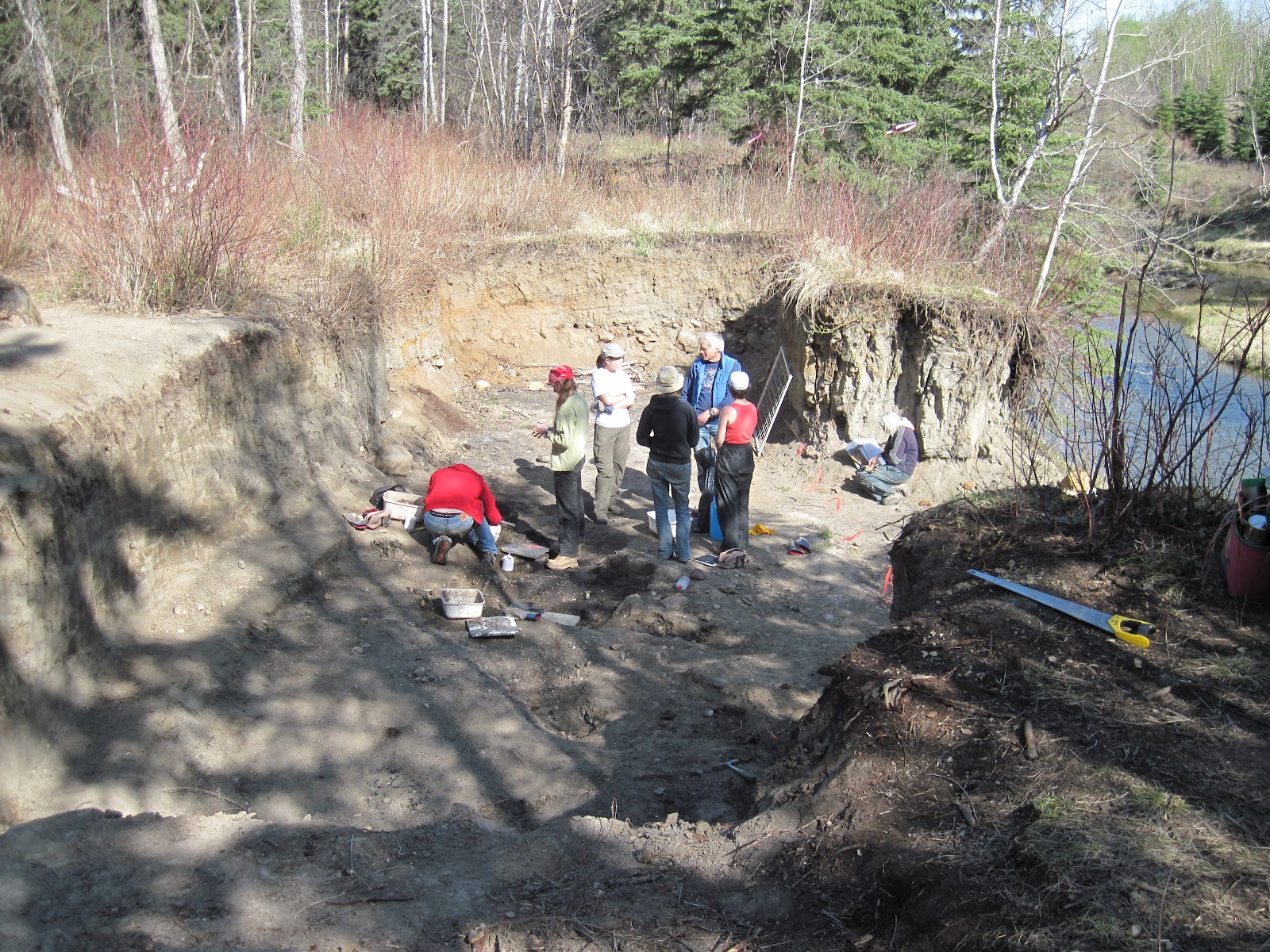
The 'summer' (which doesn't really start until mid-June in Edmonton, but whatevs) started up with the PALEO 400 field school in early May. For three weeks, students help excavate the Danek Bonebed, a hadrosaur bonebed located right in the city (but in a secret location, to prevent vandalism). Over the course of those three weeks, they get to do everything: shoveling lots of dirt, uncovering bones with fine tools, plaster jacketing, carrying heavy things back to the truck, quarry mapping, field identification, you name it. Each student comes up with a research project related to the bonebed and writes a paper and/or presents a talk in October. This year we had five enthusiastic students and I am looking forward to hearing all about their projects later this fall.


The Danek Bonebed is in a protected nature area, and as such we have to follow special rules to protect the surrounding environment. To prevent sediment runoff into the adjacent creek, we have to be careful about how we dispose of our unwanted dirt and rocks. This involves clearing an area in the forest nearby and removing and saving the topsoil. All of our dirt is evenly distributed in the cleared area, and at the end of the fieldwork the topsoil is places on top of the spoil pile. This helps the vegetation regrow more easily.

 
Once the spoil area is prepared, we can beginning digging in the actual quarries. We have been excavating this bonebed since 2006, and our three quarries are starting to get pretty large. This part is really hard work and quite time consuming, but luckily there are always lots of hands to take turns shoveling, carrying buckets, and hauling the wheelbarrow.


Here's the main quarry as of this year. The notch cut out in the foreground is the newly excavated area for 2012. Most of the sediment overlying the bonebed is glacial till and/or fluvial sediments, much of which is fairly easy to shovel except for the large boulders sitting immediately above the bonebed. The trickiest part this year was getting through some of the frozen soil, which required pickaxing. Yup, in May the ground was still frozen.


The original quarry, shown here, was first excavated by the Royal Tyrrell Museum in the late 1980s. We have expanded it a little over the last few years, and it proved to be the most productive area this year.
 
 
Almost all of the bones in the bonebed are from a large hadrosaurid (duck-billed dinosaur). We don't really find articulated skeletons, but lots of isolated, jumbled elements. The sediment around the bones is really easy to remove - no hammers and chisels required, just garden trowels and dental picks. The bonebed is within the Horseshoe Canyon Formation, although I'm not sure exactly which unit.
 
Once the bones come back to the university we have a pretty dedicated team of volunteers who help clean them up during our evening volunteer prep program.

Friday, June 8, 2012

Thoughts on Tarbosaurus, Part 2

In my last post I talked about the role of museums in conserving fossil resources, with regards to the recent news about the Tarbosaurus auction. I wanted to address some of the other frequent comments I have seen on blogs and news articles. So, we’re now on to:

Comment 2: How do we know the tyrannosaur came from Mongolia? (and the related question, which I’ve decided to lump with this one: Why does the auction company, and subsequent news stories, refer to the specimen as Tyrannosaurus bataar while palaeontologists call it Tarbosaurus?


The first thing we need to address with these questions is the concept of ‘species’. In high school, most of us will have learned that a species is defined as a group of interbreeding individuals that can produce fertile offspring. This is called the Biological Species Concept. What many people may not know is that this is just one of many species concepts. Palaeontologists can’t go back in time to check on which dinosaurs were interbreeding, so the biological species concept can’t really be used in palaeontology. Instead, we generally use the Morphological Species Concept, which essentially boils down to ‘a species is a group of individuals that look like each other and not like others’.

Much of the arguing and debate in palaeontology results from the problems associated with the morphological species concept, and that is because individuals from the same species can look different from each other, and individuals from different species can look similar to each other. Biologists working on still living (‘extant’) animals need to worry about three main sources of morphological variation:
1.      Changes that occur during growth: An older individual of the same species can look different from a younger one.
2.      Sexual dimorphism: Males and females of the same species may look different.
3.      Normal individual variation: Individuals within a species can look different from each other because of normal variation resulting from small genetic differences and environmental differences. As an example, think about all the different dog breeds there are today. All dogs can interbreed (theoretically, although surely a Great Dane crossed with a Chihuahua must be pushing the limits of what is practical...) and produce fertile offspring, and belong to the same species, Canis familiaris. On top of that, all dogs are descended from domesticated grey wolves, and so many scientists regard them as a subset of the species Canis lupus. In taxonomic terms, this is called a subspecies, and we would write it as Canis lupus familiaris.


Palaeontologists need to add one more source of variation because we work with fossils, and that is:
4.     Changes that occur during fossilization (‘taphonomy’): Most fossils preserve only the skeleton, and so information from soft tissues like colour, integument, and muscles is lost. Skeletons become disarticulated, and individual bones get broken. All of this reduces the amount of information we have to work with. Finally, the remaining bones can become squished and distorted because of the extreme forces that occur as rocks form.

 Disarticulated Argali sheep skeleton in Mongolia, 2010.


Finally, it is important to remember that the natural world doesn’t always fit into discrete categories, and that the concept of species, genus, etc. is something that humans have created to help sort living things into workable categories. How many differences do two populations need to have in order to call them different species? How many differences until we split things into different genera? There isn’t really an answer to those questions, and so deciding on what are ‘species-level’ differences vs. ‘genus-level’ differences is the source of much debate.

But that’s ok, because that is a big part of what is fun about taxonomy and palaeontology!

So, moving on to Tyrannosaurus rex vs. Tyrannosaurus bataar vs. Tarbosaurus bataar. Tarbosaurus bataar and Tyrannosaurus rex have several morphological differences in the skull, but these are not necessarily obvious if you’re not accustomed to anatomical terminology or used to looking at skulls. Nevertheless, they are present, and there is an excellent, free to access paper in Acta Palaeontologica Polonica that you can go download right now to see for yourself. In a nutshell, the skull of Tarbosaurus is narrower than Tyrannosaurus when you look at it front on, and the nasal bones (the bones along the top of the snout) are domed near the front of the eyes. Additionally, the arms of Tarbosaurus are proportionately even shorter relative to the rest of the body than those of Tyrannosaurus, which are already pretty short.

Tarbosaurus bataar partial skull at the Palaeontological Institute in Moscow.


Tyrannosaurus rex skull at the Royal Tyrrell Museum in Drumheller, Alberta.


It’s pretty clear that Tarbosaurus bataar and Tyrannosaurus rex represent different species, because these differences are geographically separated. Small-armed, narrow-skull tyrannosaurs are only found in Mongolia, and longer-armed, wider-skull tyrannosaurs are found only in North America. You could make an argument that perhaps the differences are insufficient to warrant having two genera, in which case the genus Tyrannosaurus has priority over Tarbosaurus because it was named first. However, most palaeontologists accept both the genus Tarbosaurus and the genus Tyrannosaurus as being valid. So why did the auction house consistently call their skeleton Tyrannosaurus bataar? I can’t say for sure, but I suspect it is because Tyrannosaurus is much more a household name than Tarbosaurus, and this makes the skeleton more recognizable and interesting. It’s easier to tell someone your skeleton is a Tyrannosaurus than to do what I’ve just done here and explain how there is a similar, but different, tyrannosaur in Mongolia called Tarbosaurus.

So, we can look for anatomical features in the skull and skeleton that indicate whether or not the tyrannosaur was a Tarbosaurus or a Tyrannosaurus. But how do we know that the skeleton came from Mongolia? Well, much like certain animals today are found only in certain places, some dinosaurs were found only in some places and not others. Tarbosaurus has so far only been recovered from the Nemegt Formation, a set of rocks that are only known in the Gobi Desert of Mongolia. If the skeleton is shown to be a Tarbosaurus, and not some other species of tyrannosaur, then the conclusion we must come to without any additional information is that the specimen comes from Mongolia. We can also use the colour and preservation of the bones to identify where the skeleton came from, because different rock units will produce differently coloured fossils (in Alberta, dinosaur bones are often brown or black, and in Mongolia, they are often white or reddish).

If for some reason there was good evidence that the skeleton did not, in fact, come from Mongolia, that would only make the specimen more scientifically important, as it would extend the geographic or stratigraphic range of the genus Tarbosaurus and would give us important new information about that genus.


I had originally hoped to post this second part much sooner, and so much has transpired since my original Tarbosaurus post. I’m particularly pleased to see that a delegation of Mongolians and palaeontologists examined the auctioned Tarbosaurus this week as part of the investigation into the specimen. You can read their report at the Painter Law Firm's website. I also highly recommend this article at the Guardian by palaeontologist Dave Hone, and many thanks to Brian Switek at Dinosaur Tracking for his kind words about my first post in this series.

Literature!

Friday, October 7, 2011

Hearing more about them.


After the talks had ended on the first day of the Hadrosaur Symposium, I had a bit of free time to visit the galleries, which I hadn't seen in about a year and a half. I was expecting the Alberta Unearthed: 25 Years of Discovery exhibit, but was delighted by this unexpected surprise: a short, but excellent, exhibit on women in palaeontology!


Located on the ramp up to the Darwin exhibit after you exit Lords of the Land, the exhibit consists of 19 or 20 profiles of female palaeontologists. Each framed image included a photo, a brief biography, and an image of a representative specimen or field locality (example above featuring Dr. Betsy Nicholls). I was particularly pleased to see that the Tyrrell had attempted to include women of many different races, nationalities, ages, and career stages, studying a variety of taxa and using many different techniques.

I was particularly intrigued the quote from Naomi Oreskes below the exhibit title, "The question is not why there haven't been more women in science, the question is rather why we have not heard more about them." Dr. Oreskes is a historian of science at University of California at San Diego, and her paper "Objectivity or Heroism? The Invisibility of Women in Science" is well worth a read (and really, go read it - palaeontology is all about heroism). It's a sentiment that I share and that I've discussed before: although there may not be an equal ratio of women:men in palaeontology yet, we're definitely getting closer, so why don't we seem to be as visible as the men? It is certainly up to us to speak up for ourselves, but it's really, really nice to see a major institution like the Tyrrell stepping up and hosting an exhibit like this.

I hope that at least some people will take the time to stop and read some of the biographies on their way to the fossils - if I had one complaint, it is that because the exhibit consists only of pictures in a hallway leading to the main exhibits, that it may be easily passed over. If specimens had been incorporated somehow, as they were with the Great Minds, Fresh Finds exhibit (showcasing the work of the museum's scientists), that might have been able to grab more attention. Sadly, most people walking through this hallway while I was present would pause for a moment at the entrance, but then skip on through the rest of the exhibit. I realize that space constraints probably would not permit anything more than what they have done, however, and the exhibit is pleasant to look at and rewarding for those who take some time to read the biographies. In particular, I hope school groups take advantage of it and that teachers incorporate questions about female scientists into their activities.

I'll finish here with a very nice video produced by the Tyrrell, featuring Dr. Don Brinkman discussing the work of Dr. Betsy Nicholls, who was a curator at the museum until her death in 2004 and whose work is featured in the Triassic Giant gallery.

Sunday, September 25, 2011

Hadrosaurs get their moment in the sun.

Living in Edmonton means I'm in close proximity to the dinosaur capital of Canada, Drumheller, and the wonderful Royal Tyrrell Museum. Last week the U of A crew headed down to the Hadrosaur Symposium, a wonderful event by all accounts with lots of interesting talks and good conversation. I won't report on the science presented as much of the research is as yet unpublished (although look out for the eventual symposium volume), but thought I would share a few photos and links to symposium goodies.

First off, the Tyrrell is making some of the keynote lectures available on their Youtube channel. David Weishampel's is already online; other keynote speakers were Kishigjav Tsogtbaatar, Pascale Godefroit, Rodolfo Coria, and Jack Horner.


You can also check out the official Hadrosaur Symposium Flickr page for some very nice photos of the goings on.

And here's a few photos of my own!


Symposium attendees get a backstage tour of the collections.


Hadrosaur heads in the main gallery.


And some hadrosaur bodies!


There were some original skulls on display in the poster room as well.

Friday, July 1, 2011

Stegoceras is everywhere!

And by everywhere, I mean in two PLoS ONE papers this week. (But that's pretty good!) Stegoceras is the focus of a study on cranial ontogeny in pachycephalosaur skulls, and in head-butting in pachycephalosaurs and artiodactyls.


I've always thought of Stegoceras as an unofficial mascot for dinosaur palaeontology at the University of Alberta. The best Stegoceras skeleton ever collected is UALVP 2 (that's right, 2! 1 UALVP 1 is a turtle), shown here on display in our museum in the Earth Sciences Building. The actual recovered bones are displayed below the mounted skeleton. It's a beautiful skull, and pachycephalosaur postcranial material is extremely rare. 


Stegoceras makes an appearance at lots of museums all over North America. Before this corner of the Royal Tyrrell Museum was converted into the new ceratopsian exhibit, it featured a diorama including a fleshed out Albertosaurus, Edmontonia, and Stegoceras.


You can still see these two Stegoceras skeletons at the Tyrrell.


I even saw the UALVP 2 Stegoceras skull at the Smithsonian last May - can you spot him in this who's who of pachycephalosaurs?


Read all about Stegoceras in these new papers:

Schott RK, Evans DC, Goodwin MB, Horner JR, Brown CM, Longrich NR. 2011. Cranial ontogeny in Stegoceras validum (Dinosauria: Pachycephalosauria): a quantitative model of pachycephalosaur dome growth and variation. PLoS ONE 6(6): e21092.

Sunday, May 22, 2011

Ankylosaur tail pathologies.

My most recent paper with my coauthor and supervisor Phil Currie appeared online at Historical Biology this week. It is the last of the chapters from my MSc on ankylosaur tail club biomechanics (although I am still working on ankylosaurs, the focus is now on the phylogenetic relationships within the ankylosaurids and their biogeography). However, it contains very little about the biomechanics of tail clubs...

Most of my MSc thesis used a lot of math and fancy-dancy computer modeling to look at whether it is biologically feasible for ankylosaurids to have used their tail clubs for forceful impacts (and therefore as offensive or defensive weapons). But another way to look for evidence of behaviour is to look for injuries, which can sometimes, if you’re lucky, give you clues about some of the more dramatic moments in an animal’s life. So as I was looking at specimens for my MSc (and into my PhD), I always kept an eye open for anything unusual or abnormal that could be a pathology.

What I would love to tell you is that I found healing fractures in the handle vertebrae or knob of the tail club, because that would be pretty good evidence that ankylosaurids were smashing things with their tails. Sadly, I have not seen anything like that in any of the tail club specimens I’ve seen. There are several explanations for the absence of handle pathologies:
  1. Ankylosaurids did not use their tails for forceful impacts.
  2. Ankylosaurids did use their tails for forceful impacts, but the impact forces were never enough to cause the tail to break.
  3. Ankylosaurids did use their tails for forceful impacts, and the impact forces were so great that a fracture was probably catastrophic and unlikely to heal.
  4. Ankylosaurids did use their tails for forceful impacts, and injuries occurred sometimes, but we haven’t found any injured specimens yet.
Out of all of the above scenarios, I think #4 is the most likely. Ankylosaurids could pack a wallop with their tails, especially those with the largest knobs. I am quite sure injuries occurred sometimes, but I bet they were reasonably rare and the chances of finding a healed tail club are probably low.

What else did we find? Well, there’s a tail club knob that may have become infected – it’s on display at the Royal Tyrrell Museum Field Station if you happen to be visiting Dinosaur Provincial Park this summer, and you can check it out for yourself. There's a big hole on the right major osteoderm, and this osteoderm is also much taller in posterior view.


In two pelvis specimens, I saw large holes where some of the sacral vertebrae attach to the ilium. One of these is AMNH 5337, on display in the Hall of Ornithischian Dinosaurs at the American Museum of Natural History. I am unsure what exactly may be causing these holes, but in the paper we speculate that they may be similar to the extra fenestrae that sometimes occur in ceratopsian frills (see Tanke and Farke 2007). Perhaps these are areas of low mechanical stress and the bone is simply resorbed. They are certainly unusual, and it would be interesting to see if any other dinosaurs show evidence of lesions like these.


And finally, several specimens of anterior free caudal vertebrae had rough, rugose bone textures on the neural spines and sometimes on the transverse processes. In two specimens (a Euoplocephalus at the AMNH and the Talarurus mount at the Palaeontological Institute in Moscow) some of these anterior vertebrae are fused together. At first I thought these might be infections, but as it turns out, the anterior caudal vertebrae of whales and crocodiles can fuse as a mechanical response to stress from swimming motions (see Galatius et al. 2009 and Mulder 2001). It is conceivable that this was occurring in ankylosaurids either as a response to keeping the heavy tail club elevated off that ground, or as a result of tail club swinging.

I wasn’t able to draw any definitive conclusions about tail-clubbing in ankylosaurs based on my pathology survey, and trying to diagnose bone pathologies in fossils is EXTREMELY challenging. Perhaps it is something that gets easier with time. But I had a lot of fun with this project and I think it is worthwhile to look at palaeopathologies as potential sources of information, as long as you’re careful how you interpret them.

References!

Arbour VM, Currie PJ. 2011. Tail and pelvis pathologies of ankylosaurian dinosaurs. Historical Biology, online 19 May 2011.

Galatius A, Sonne C, Kinze CC, Dietz R, Beck Jensen J-E. 2009. Occurrence of vertebral osteophytosis in a museum sample of whitebeaked dolphins (Lagenorhynchus albirostris) from Danish waters. Journal of Wildlife Disease 45:19–28.

Mulder EWA. 2001. Co-ossified vertebrae of mosasaurs and cetaceans: implications for the mode of locomotion of extinct marine reptiles. Paleobiology 27:724–734.

Tanke DH, Farke AA. 2007. Bone resorption, bone lesions, and extracranial fenestrae in ceratopsid dinosaurs: a preliminary assessment. In: Carpenter K (ed). Horns and beaks. Bloomington (IN): Indiana University Press. p. 319–348.

Thursday, March 24, 2011

Fossils in the Tar Sands.

A short but exciting post today!


Shawn Funk, a shovel operator at Suncor Energy Mine near Fort McMurray, Alberta, found the remains of a possible ankylosaur earlier this week. The Royal Tyrrell Museum has been up to investigate and has posted some tantalizing photos on their Facebook page.


Fort McMurray, for non-Canadians, is where all of the oil comes from.

This would not be the first vertebrate fossil discovered in the oil sands. The ichthyosaur Athabascasaurus bitumineus was named in 2010 by Patrick Druckenmiller and Erin Maxwell, and was found in a Syncrude Mine near Fort McMurray. The specimen was featured in the Royal Tyrrell Museum's 25th Anniversary exhibition Alberta Unearthed - it is still oozing tar. It's a beautiful specimen.

The well-known dinosaur-bearing formations of Alberta, like the Horseshoe Canyon Formation, Wapiti Formation, and of course the Dinosaur Park Formation, are all Late Cretaceous deposits. This new dinosaur, however, is from the Early Cretaceous, and is therefore likely to be quite different from the ankylosaurs known from southern Alberta. Ankylosaurs from this time period include lots of nodosaurs, like Sauropelta from Wyoming and Utah, Pawpawsaurus and Texasetes from Texas, and Cedarpelta (which may actually be a shamosaurine ankylosaurid - see Carpenter et al. 2008) from Utah. I will certainly be very interested to hear more about this new find! And great job to the folks at Suncor who spotted the fossil and called in the Tyrrell so quickly.


Papers!

Druckenmiller PS, Maxwell EE. 2010. A new Lower Cretaceous (lower Albian) ichthyosaur genus from the Clearwater Formation, Alberta, Canada. Canadian Journal of Earth Sciences 47: 1037–1053.

Carpenter K, Bartlett J, Bird J, Barrick R. 2008. Ankylosaurs from the Price River Quarries, Cedar Mountain Formation (Lower Cretaceous), east-central Utah. Journal of Vertebrate Paleontology 28: 1089–1101.

Thursday, November 4, 2010

Edmonton's Sewersaurus


I was in Mongolia when this story originally appeared in the news, but I like it too much to not mention it here on the blog.

Last August, Edmonton city construction workers were digging a new sewer tunnel when they discovered dinosaur bones! My fellow ankylosaur worker Mike Burns, and Don Brinkman from the Royal Tyrrell Museum helped out at the site for about two weeks, excavating bits and pieces of Edmontosaurus and Albertosaurus. In particular, some awfully nice Albertosaurus teeth were found.


Image from the Edmonton Sun.


Mike has mentioned that it was a lot of fun to get lowered down into the tunnel each day. I suspect this was quite an unusual excavation experience - we don't usually work deep underground when digging up dinosaurs!


Overall, the material looks quite similar to a bonebed we've been excavating in the south of Edmonton for the last several years - dark black shales, and dark black bones. There's a good chance there's dinosaurs underneath us everywhere in Edmonton, but they're covered up by trees and roads and buildings and such.


Recent update in the Edmonton Sun.


Original articles at the National Post and CBC News.


A nice slideshow can be seen at the Edmonton Sun.


And there's a short video about the find at the Toronto Star.

Thursday, April 15, 2010

What I've been up to.

To get this blog warmed up, I thought I would post a few pictures about my ankylosaur-related travels from the past few years. I've had the opportunity to visit museums in several different countries now. Today I will start close to home with some pictures from the Royal Tyrrell Museum in Drumheller, Alberta, which I've visited several times now both for fun and work.


These first photos are from way back in fall 2006, just after I had moved to Alberta. The museum has changed in many ways since that first visit, including the placement of the statues out front.


Run away!


This is a photo of one of several extinct exhibits (did you see what I did there? eh?) that have been replaced recently. Extreme Dinosaurs showed some of the cool finds, mostly theropods if I recall correctly, from the Sino-Canadian Dinosaur Project. This fella is Sinraptor. I liked the blue and purple lighting.


Although this post is somewhat theropod-heavy, pachycephalosaurs are one of my favourite groups. I think this is one of the only models of a Stegoceras that I know of, and it's a shame it's not on display anymore.


Finally, we'll end with a shot of the Triassic Hall, now inhabited by the stupendous Shonisaurus sikanniensis. This hall had a great diversity of skulls and mounts; in this photo we've got Dilophosaurus and Heterodontosaurus.